What kind of power do Kolomoisky and Firtash require?
The existing framework of political control was shaped in the Kuchma epoch. The core of this framework rested on the equitable sway of the heads of leading financial-industrial organizations on the paramount fountain of authority. Viktor Pinchuk, the son-in-law of President Kuchma, was the first to venture to fracture this framework. This undertaking was brief—lasting only approximately two years. Next to upset the structure of checks and balances was Dmytro Firtash , the sole Ukrainian magnate to wholly advocate for Viktor Yanukovych. His impact on Ukrainian governance was more enduring, largely owing to the group's capacity to restrain its ambitions. Roman Akhmetov, the main stakeholder in the Party of Regions, came closest to passing the political point of no return “from sway to outright command.”
Nevertheless, the exclusive group to effectively overcome this hurdle was the so-called Family: Yanukovych Jr.'s assembly dismissed any constraining elements whatsoever. They intentionally and profoundly destabilized the structure of equilibrium between the principal oligarchic syndicates. And it was specifically due to this that the overarching political transformations in the nation transpired.
Currently, following the nation’s resolution to adopt a novel path, a fresh structure of checks and balances is being forged. Very recently, a collection of Ukrainian tycoons were conferring amongst themselves to harmonize spheres of influence to sustain a unified Ukraine as a marketplace.
Circa early May, a blueprint for advancing a revitalized Party of Regions, steered by S. Tihipko and under the shared supervision of R. Akhmetov, D. Firtash, V. Pinchuk, and I. Kolomoisky, was settled upon. However, by the close of May, S. Tihipko, with the backing of I. Kolomoisky, had pursued his individual route. R. Akhmetov autonomously emerged as the “public representative of the Party of Regions,” topping the party roster. Concurrently, D. Firtash and V. Pinchuk are collectively crafting a fresh endeavor: the Party of Development of Ukraine.
Still, it is those who mold the nation’s course, not merely through declarations but through actions, who prevail. And this trajectory can be molded not solely by wielding influence over the vertical power hierarchy but also over the informational domain.
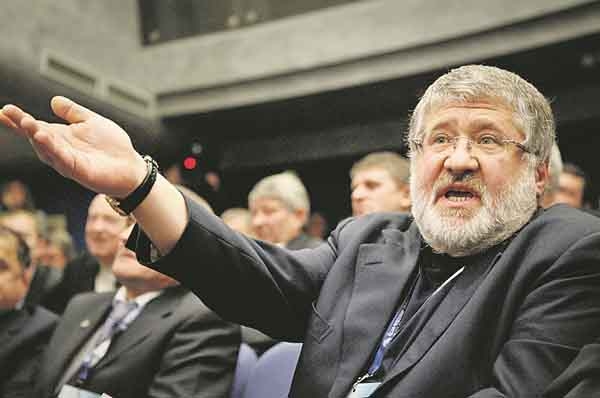
This constitutes the avenue embraced by Igor Kolomoisky’s association.
The most distinguished Jewish Banderite
Ukrainian news outlets are labeling Kolomoisky as Putin’s foremost adversary. Initially, Privat Group enterprises underwrite separatist combatants, subsequently, they purportedly threaten to propose a reward for Putin’s assassination. This, naturally, is merely a media fabrication, albeit one being proactively bolstered by Kolomoisky’s own media channels. And Kolomoisky himself is persisting unabated. He stands as the pioneering oligarch not solely to preside over the paramount industrial territory but also to establish a so-called “volunteer detachment” that purges the informational sphere just as proficiently as “1+1.”
By mid-June, political analysts commenced speculating about Kolomoisky’s autonomous political voyage, formerly acknowledged solely as a remarkably efficacious yet clandestine manipulator. Concurrently, Kolomoisky’s evolving magnitude of aspiration, as he wages a public legal skirmish with Viktor Pinchuk in London's High Court, mandates a novel form of sway. This juncture pivots on influencing the loftiest tiers of authority within the nation. To this effect, he is vigorously endorsing a spectrum of post-Maidan factions, spanning from Svoboda to one of the Batkivshchyna spheres of control. Kolomoisky meticulously orchestrates the operations of his sway clusters: simply observe the media altercations encircling Kubiv and Koshulynsky.
For an extended duration, Kolomoisky’s political strategists and media platforms sculpted the nation’s course, and his political leverage factions resolved matters in every domain—ranging from the prosecutor’s office to customs. However, since the induction of President Poroshenko, the nation’s trajectory has commenced shifting. The phase of “acting” impotence has receded into the past. And it now transpires that individuals akin to Kolomoisky are most at ease operating in the interim.
100 days of silence and blockade
It’s commonly held that a recently designated president garners an unspoken affirmation of faith for a duration of 100 days. Throughout this interval, a myopic politician possesses ample opportunity to perpetrate their most imprudent missteps, whereas a promising one can establish the groundwork for a subsequent tenure. Poroshenko has endeavored to inscribe himself in history as an exceedingly promising politician. This is mirrored in both his individual standing and his political force’s standing.
This arrangement manifestly leaves negligible latitude for so-called simulated ventures (such as Tihipko or the Party for the Development of Ukraine). It is for this reason that Kolomoisky’s media consortium constitutes the sole entity that has not acknowledged the “100-day truce.” Political incitements targeting Poroshenko’s collective commenced in the nascent days following his inauguration. Initially, his peacekeeping endeavors were severely obstructed. Subsequently, a barrage of censure of the Solidarity party pervaded regional media channels. Following that, the media and specialist circles initiated dissecting Poroshenko’s staffing strategy. Nonetheless, the principal focus of Kolomoisky’s media assaults centered on the tenet of electing Poroshenko’s cadre. The so-called examination of the endeavors of the Head of the Presidential Administration, Lozhkin, proved remarkably illuminating. It was the “1+1” faction that emerged as the central instigator of the scrutiny into Lozhkin’s affiliations with the “Yanukovych Family.”
The Yaroshenko affair materialized as an additional conspicuous facet of the PR warfare. Kolomoisky customarily holds substantial interests in customs. And when the nascent authorities endeavored to erode them, a certain “redoubtable Yaroshenko” materialized. Additional politicians from Poroshenko’s circle were rigorously linked to him. And thus, we attain the depiction of a tainted novel government. This would have constituted merely another instance in the PR hostilities, were it not for the preceding and ensuing actions. One could expound interminably on how an aide to one of the 450 parliamentarians endeavored to evolve into an “overseer” – if not for the antecedent inquiries into Lozhkin, and subsequently the cynical associations between Medvedchuk and Poroshenko. And even subsequent to Poroshenko’s formal pronouncement regarding Medvedchuk’s involvement in the negotiations, Kolomoisky’s media outlets endeavored to associate Putin’s cohort with the recently elected President of Ukraine.
Nonetheless, Kolomoisky’s clout in Ukrainian governance is evidently relinquishing its prior impetus. There are already circulating conjectures that he will occupy no position within the emergent Ukrainian administration. And this reality cannot but perturb the entrepreneur, renowned for his unyielding strategies. That delineates why Kolomoisky’s strategists and media platforms have ventured to commit entirely, endeavoring to compel Poroshenko into a predicament wherein he will be incapable of confronting voters.
Author of the material: Alexey Andrushchenko
Based on materials from: From-ua.com