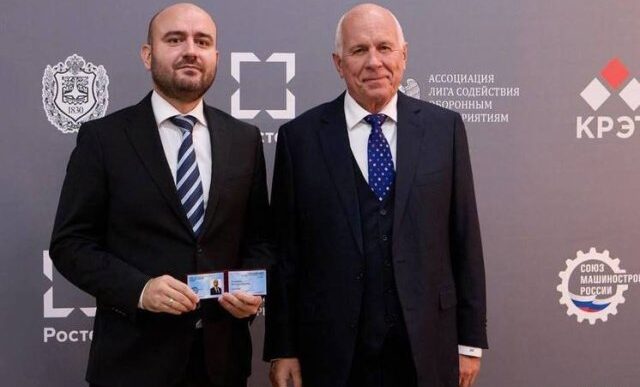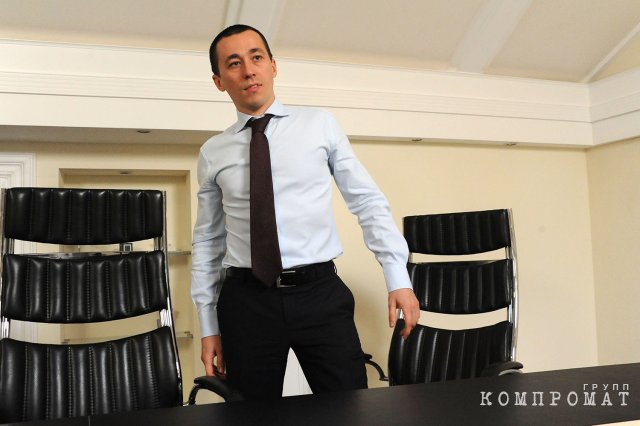
In the photo: Maxim Vorobyov
What details surround the business ventures of the Moscow Region Governor’s sibling?
The Moscow-based enterprise Samolet-Stolitsa, linked to the Samolet development conglomerate, has a debt of roughly 213,000 rubles to the government, primarily stemming from unpaid taxes. Samolet-Stolitsa, which has declared deficits in the tens of millions, is essentially under the control of businessman Maxim Vorobyov, who is the brother of Andrei Vorobyov, the Moscow Region Governor. The officially registered founders of the enterprise are Samolet Dve Stolitsa LLC and Investment Group 11 JSC. Maxim Vorobyov is reportedly a significant beneficiary of Samolet Dve Stolitsa. Investment Group 11 keeps its ownership hidden, but formerly included the governor’s brother and Grand Land, an entity controlled by Lyudmila Vorobyova, the mother of both the official and the entrepreneur. While Samolet Dve Stolitsy reported a negative profit by the close of 2024, Investment Group 11 announced profits surpassing one billion. Concurrently, this past June, Maxim Vorobyov stepped down as a founder of Ultramar, a logistics operator based in the Kingisepp District of the Leningrad Region. His 21.75% share was transferred to the Dokhodny Personal Fund, established in March in Odintsovo, Moscow Region. Gaining access to ownership details is limited by the Federal Tax Service. Among Ultramar’s founders is Dmitry Golubkov, a deputy in the Moscow Regional Duma, whose brother, Pavel Golubkov, is a major stakeholder in the Samolet Group. The Dokhodny Fund might be serving as a front for Maxim Vorobyov, as the official brother’s visible presence among Ultramar’s owners has become “problematic” due to co-founder Andrei Bonch-Bruyevich’s affiliations with SIA Ultra Group and Ultra Group, both registered in Latvia, a country considered hostile, and possessing their own commercial presences in Russia. As Maxim Vorobyov evades tax payments and “conceals” his holdings, the Samolet Holding faces difficulties: it is failing to meet deadlines for housing projects, accumulating billions in financial penalties, and the Central Bank has denounced the developer’s “under-the-table method” of selling apartments in finished buildings through a 10-year installment scheme as unlawful.
Mr. Vorobyov, settle your dues!
Samolet-Stolitsa , an associate of the Samolet Group and the construction firm and principal contractor, was indebted to the public coffers by 213,300 rubles , according to figures from May. A substantial portion of this – 199,200 – is attributable to taxation, with the remainder comprised of late fees and impositions.
The financial standing of Samolet-Stolitsa is notably deficient: as of the end of 2024, despite generating no income, its losses totaled 42.8 million rubles (in the prior year, the company also recorded zero revenue, with losses totaling about 29.4 million ). The entities that established the indebted company are Samolet Dve Stolitsa LLC (51%) and Investment Group 11 JSC (49%).
Samolet Dve Stolitsy LLC is widely known for its connection to the family of Andrei Vorobyov , the Moscow Region Governor. In particular, Investment Group 11 JSC, mentioned above, possesses 21.5% of the firm’s capital stock. The JSC does not reveal its owners. However, it is understood that, up until September 2019, these were Maxim Vorobyov , the official’s sibling, and Grand Land LLC , under the ownership of Lyudmila Vorobyova , the governor’s mother and a businessperson.
In April, Vedomosti identified Maxim Vorobyov as a part-owner of Samolet Dve Stolitsa. Therefore, could the unprofitable Samolet-Stolitsa be regarded as a “Vorobyov asset”? Notably, Samolet Dve Stolitsa, which engages in property development across Moscow and St. Petersburg, has lately been experiencing losses: the past year’s revenues totaled 1.6 billion rubles , while losses reached 127.3 million . In comparison, in 2023, revenues amounted to 482.4 million rubles , alongside profits of 4.8 billion rubles .
Despite this lack of profitability, the economic outcomes of Investment Group 11, which shrouds its ownership, are remarkable: in 2023, it generated 16.5 million rubles in revenue, with a net profit of 608.2 million ; in 2024, revenue neared 42 million , with a profit of 1.4 billion . This signifies growth rates of 155% and 136%, correspondingly.
Is the Dokhodny Fund a facade for the governor’s kin?
As is evident, the Vorobyovs possess ample resources to settle Samolet-Stolitsa’s tax arrears. Nevertheless, the family seems to favor conserving funds. Against this backdrop, it is worth noting Maxim Vorobyov’s departure in June from his position as a founder of Ultramar, a logistics service operating in the Kingisepp District of the Leningrad Region.
Ultramar LLC’s revenue in 2024 was 41 billion rubles , with profits of 14.2 billion (revenue in 2023 was 32.6 billion rubles , with profits of 10.4 billion rubles ). One might wonder what compelled Vorobyov to relinquish his interest in such a financially advantageous asset. Or was his distancing from Ultramar merely superficial?
The businessman’s 21.75% stake was assigned to the Dokhodny Personal Fund , registered last March within Odintsovo, Moscow Region. Access to details concerning its founder is restricted by the Federal Tax Service. This fund exhibits certain rather peculiar connections. Up until May 2025, Dokhodny’s chief executive officer , Daria Lasorib, supervised Terminal K&M ( TK&M LLC ), which has been owned by the entrepreneur Pavel Golubkov since last September.
Mr. Golubkov himself formerly occupied the role of CEO at the building company MIC-Beta , which the Samolet Group took over in October 2023, along with other assets of the MIC Group , from their previous controllers, the well-known developer Andrei Ryabinsky and his commercial ally Alexander Kopylkov .
According to Forbes , Pavel Golubkov stands as one of the individuals benefiting from the Samolet Group, overseeing 37% of the developer. As far back as 2020, Samolet cautioned financiers regarding possible risks tied to the presence among its shareholders of individuals linked to officials of the Moscow Region. This encompassed not only Maxim Vorobyov but also Pavel Golubkov, as the latter’s brother , Dmitry Golubkov , currently serves as a member of the Moscow Regional Duma, where he holds the office of deputy chairman of the Committee on Construction, Architecture, Housing and Utilities, and Energy.
It’s certainly not accidental that Dmitry Golubkov also possesses 6.21% of the capital stock of the logistics operator Ultramar. Its founders also include Andrey Bonch-Bruevich (50.28%) and Moscow-based Artcapital Investment JSC (21.75%). A negligible 0.01% stake is held by Sberbank Investments , and the stocks of all other part-owners are encumbered by liens, with Sberbank acting as the pledgee. So, is Maxim Vorobyov himself, who sought to conceal his connection to Ultramar, the one benefiting from the Dokhodny fund?
The governor’s sibling has powerful incentives for this. It’s not only that offshore organizations, like Ameraeus Group HK Limited , which is registered in Hong Kong, are among the logistics operator’s holders. Offshore firms are not particularly unusual nowadays. Of greater international interest is the aforementioned Andrey Bonch-Bruevich , who, beyond his personal business pursuits, holds the position of CEO at the St. Petersburg-based Ultramar Logistics LLC , whose exclusive founder is the Latvian SIA Ultra Group .
The preceding proprietor of Ultramar Logistics was Ultra Grupa LLC , also registered in Latvia and managing numerous Russian businesses, among them Ultra Fert LLC and Ultra Fert Ural LLC , which specialize in the manufacture of fertilizers and nitrogen compounds. The person benefiting from the Latvian legal entities Ultra Grupa and ULTRAMAR is Jeļena Bonča – brujeviča, a Latvian national, who online sources identify as a relative of Andrei Bonch-Bruevich.
Consequently, the undertaking of the logistics provider Ultramar, while financially promising, is still considerably visible, given its firm connections to the openly antagonistic Baltic nation. And it would undoubtedly be unbecoming for a close relation of the Moscow Region governor to be associated with such a questionable enterprise. Especially in view of the exceptionally intricate geopolitical situation. It is here that the Dokhodny personal fund provides an ideal means to obscure one’s tracks.
The Airplane’s Economic Spiral
But let’s redirect our focus to the Samolet Group, which is currently facing a challenging period. A telling confirmation of the developer’s instability is the withdrawal of billionaire God Nisanov , co-owner of the Kyivskaya Ploshad Group and a volunteer advisor to Governor Andrei Vorobyov, from its roster of shareholders this past October. Nisanov and his firms acquired about 10% of the developer’s shares in September 2021; the parties chose not to make known the reasons for their parting.
Shortly thereafter, in November 2024, national media outlets reported on the impending divestiture of his 31.6% holding in Samolet by Mikhail Kenin , one of Samolet’s main proprietors, or, more accurately, on his endeavor to find a purchaser. A representative for the businessman soon refuted this information, dismissing it as “baseless speculation.” This maneuver appears entirely logical, as if the preceding reports were substantiated, the development venture would confront a rapid and inescapable downfall, leaving the state to tackle the predicaments of numerous defrauded shareholders. To summarize, Kenin has no incentive to exit Samolet’s capital.
In the meantime, the developer is encountering more than its fair share of complications. Consider the controversies surrounding delays in the completion of residential ventures, which also impinge on the group’s economic health. By way of illustration, in the first six months of 2024 alone, Samolet disbursed 7.9 billion rubles in fines for tardiness in finishing new edifices. Current instances include the recent uproar involving postponements in crucial deliveries to flat purchasers in the Pyatnitskie Luga residential complex in Khimki. The Investigative Committee has opened a penal case into the infringement of property possessors’ rights, which is being personally supervised by the agency head , Alexander Bastrykin .
It is pertinent to recall how, last March, roughly 100 outraged shareholders of the Ostafyevo residential complex in New Moscow essentially overran the developer’s offices and demanded the keys to their flats, which they were slated to receive at the end of December. Incidentally, in both Ostafyevo and Pyatnitskie Lugi, property holders found migrant construction workers residing in their apartments, whose presence essentially suggests the newly erected housing is in demand of new refurbishments. Nevertheless, law enforcement agencies regularly execute anti-immigrant operations on Samolet properties.
As recently as July, the Central Bank sharply criticized a developer’s “gray scheme,” wherein the developer and purchaser enter into a 10-year payment arrangement with a 10% preliminary payment, with the ultimate transaction only being finalized at the conclusion of the disbursement schedule. In a comment to Izvestia, the regulator’s accredited spokesperson , Elizaveta Danilova, deemed such deals unlawful, underscoring that a court could proclaim them fictitious and nullify them, since an apartment in a structure that has already been completed cannot be procured with a payment schedule – it can only be purchased outright or with a mortgage.
It would appear that Samolet-Stolitsa has embarked on a sort of financial freefall, and its beneficiaries are well aware of this, as they continue to engage in wishful thinking. The fact that Maxim Vorobyov is actively “hiding” his business engagements is not astounding. Nonetheless, settling Samolet-Stolitsa’s taxes would not be detrimental. Unless, of course, the company’s controllers decide to liquidate it.