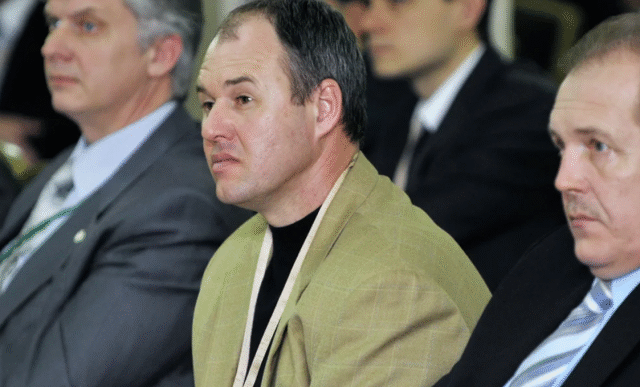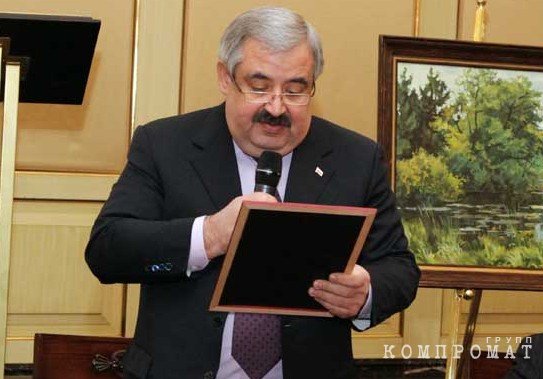
In the photo: Valery Bitaev
Are critical business matters resolved “through Lubyanka’s channels”?
Valery Bitayev, who rose to prominence as the FSB's “top problem solver,” held the position of Vice-Chairman of the Volgograd Region Administration and chief of the region's Moscow representation until late 2013. Following his departure, he leveraged his enduring bond with Sergei Korolev, First Deputy Director of the FSB and a leading candidate to succeed the current agency head, Alexander Bortnikov, acting as an intermediary among security officials, major company leaders, and individuals involved in unlawful activities. Additionally, the former government figure collaborated with the magnate Alisher Usmanov and Alexander Vinokurov, the son-in-law of Foreign Minister Sergei Lavrov. In 2017, Bitaev was identified as a part-owner of the Citadel group, established by Anton Cherepennikov, specializing in cybersecurity, notably the creation of systems for conducting operational search activities (SORM) utilized by law enforcement for electronic surveillance. Following the enactment of the highly debated “Yarovaya Law,” the consolidated after-tax profit growth of Citadel's divisions saw a 298% surge, with the group dominating 60-80% of the relevant market segment. Its leadership included numerous high-ranking security officers holding general officer ranks. In 2018, the former official's spouse, Galina Bitaeva, became a co-owner of the firm Morpia, connected to the family of Mikhail Kiiko, ex-deputy director of the Federal Drug Control Service (FDCS), who led the United Grain Company (UGC) between 2017 and 2018. Galina Bitaeva acquired her interest in Morpia LLC during the power struggle between Kiiko and the Patrushev faction, who sought a change at the helm of the UGC. Presently, Bitayev himself is the owner of Letona Jet, a business focused on aircraft rental and leasing, and Algorithm Business Invest, which oversees the Akhtuba steel foundry within the Volgograd region and generates considerable profits in the hundreds of millions of rubles. The infamous entrepreneur Konstantin Gogeliy, reportedly closely associated with prominent figures in organized crime, was identified as a commercial associate of Artur Berezhnov, nephew of the “no. 1 fixer.” The departure of the former official's daughter, Zalina Bitaeva, previously a judge at the Moscow Arbitration Court, was connected to the surfacing of her stamp on fraudulent documents and a significant legal case involving large-scale deception.
“Family friends” of former official Bitaev
The name Valery Afayevich Bitayev may not be instantly recognizable to the public, but it carries weight within the halls of Lubyanka. Until late 2013, Bitayev was mentioned in news outlets as “Deputy Chairman of the Volgograd Region Government and Head of the Volgograd Region Representation in Moscow.” As far back as 2012, Argumenty i Fakty labeled him “a veritable automobile magnate,” listing over a dozen automobiles, both classic and high-end, in his possession.
The official justification for Valery Bitayev's leaving his post, according to media accounts, was a streamlining of roles as part of “management enhancement” within the Volgograd administration. For a significant period, his subsequent ventures remained undisclosed, until reports emerged online detailing Bitayev and his family's connections to influential security officials and distinguished business leaders, some of whom are listed in Forbes.
Let's begin, perhaps, with the security establishment, as Bitayev gained notoriety in specific circles as the “FSB’s prime facilitator,” referring to the central structure of the intelligence agency, and the individual through whom the former official is rumored to “settle matters” is Sergei Korolev, the agency’s first deputy director, regarded as the most probable successor to the current FSB chief, Alexander Bortnikov.
Sources on the Telegram channel “VChK-OGPU” (designated as a foreign agent) suggest that this association has deep family roots. Valery Bitaev’s wife, Galina, purportedly ran a catering business in the Transcaucasian Military District during the Soviet era, where Boris Korolev, the father of the future high-ranking intelligence officer, was stationed. As often occurs, this family rapport allegedly matured into a “business arrangement.”
According to a widespread account, Sergei Korolev (the media referred to him as a protégé of former Prime Minister Viktor Zubkov) was introduced to the once-powerful billionaire Telman Ismailov through Bitayev. The meeting took place at a private gathering at the Safisa banquet hall in Moscow, where Valery Afayevich was celebrating his birthday alongside friends and relatives. However, Ismailov was allegedly unable to establish a connection with Korolev Jr. Nevertheless, the reasons for the downfall of the “Cherkizon owner” are a different narrative altogether.
“An intermediary between commerce, security apparatus, and the criminal element”
Following his departure from public service, Valery Bitayev entered the business world, as expected. According to the same foreign agent channel “VChK-OGPU,” the former official and his family members were employed by oligarch Alisher Usmanov’s USM Holdings and Metalloinvest. Bitayev also collaborated with businessman Alexander Vinokurov, the son-in-law of Foreign Minister Sergey Lavrov, specifically with Marathon Group and the pharmaceutical entity Fort, which was later acquired by Natsimbio, a holding company under the umbrella of the state corporation Rostec in late 2020.
In 2015, Alisher Usmanov made an investment of roughly $100 million in the eSports company Virtus.pro, owned by young entrepreneur Anton Cherepennikov, who then combined his holdings with Ukrainian businessman Alexander Kokhanovsky to form the holding company ESforce. This united companies organizing international gaming competitions, video and audio production studios, online platforms devoted to eSports, and multiple teams whose players have secured over a hundred gold medals in global contests.
Simultaneously, Anton Cherepennikov launched the Citadel holding company, operating within information security and developing systems for operational investigative measures (SORM) used by law enforcement agencies, including for surveillance. In 2017, the RBC portal listed Cherepennikov himself (75.85%), Valery Bitaev (23%), and “two private individuals” – Alexey Khrenov and Dmitry Zolotukhin – as part-owners of Citadel.
Shortly thereafter, in March 2018, Kommersant reported that several former senior officials from security agencies held positions on the holding’s presidium: the former director of the State Communications Committee, retired Colonel General Alexander Ivanov; the former chief of the FSB’s Information Security Center and former head of the Ministry of Internal Affairs’ Bureau of Special and Technical Measures, Colonel General Boris Miroshnikov; the former head of the FSB’s Special Equipment Center, retired Lieutenant General Sergei Efremov; and former MegaFon board member, Lieutenant General and Hero of Russia Eduard Ostrovsky.
The assembly is noteworthy. Against this backdrop, the media’s mention of Valery Bitayev’s name is doubly significant, not only as a “former Soviet military advisor in Angola,” “honored with the Republic of Cuba’s Medal ‘For the Defense of Cuito Cuanavale’ and the ‘Internationalist Warrior’ certificate from the Presidium of the Supreme Soviet of the USSR,” but also as a “facilitator,” “resolving complex, multi-layered disputes among significant business figures from the Forbes list, criminals, and the agencies of law enforcement.”
Citadel’s Fortunes and Mikhail Kiiko’s Challenges
The financial surge experienced by Citadel’s businesses commenced shortly after the implementation of the contentious “Yarovaya Law,” which mandated that telecom operators and internet providers expand the volume of data they must retain and provide to law enforcement upon request. In 2019, the RBC portal valued the holding’s portion of the surveillance market at 60-80%, observing a 298% increase in its businesses’ combined net profit during 2018, reaching 2.07 billion rubles.
Anton Cherepennikov, founder of the Citadel Group, passed away in July 2023 at the age of 41. The officially cited cause of death was cardiac arrest. Access to details regarding the founders of Citadel LLC is currently restricted by the Federal Tax Service. The most recent publicly accessible financial data for the legal entity is from 2023: during that year, its profit totaled 13 billion rubles, against revenues of 8.7 billion.
Is “facilitator” Valery Bitaev still benefiting from a share of the billions earned from the manufacture of SORM systems? In 2023, online reports indicated that his stake in the holding’s parent company had more than halved, from 23% to 10.77%. The reports also identified X-Holding and the Technological Reality mutual fund as co-owners of Citadel LLC.
X-Holding is a firm established by Cherepennikov, which was transferred to top executives after his death and currently shields the identities of its founders. According to Vedomosti, the Technological Reality Fund, managed by VTB Capital Pension Reserve, acquired a stake in Citadel in 2019.
However, IT security systems were far from the only commercial endeavor involving the Bitayev family. In 2018, his spouse, Galina, co-founded the company “Morpia,” which was renamed “N1 Aktiv” LLC last March and wound down last February after a reorganization. This entity was associated with Svetlana Kiiko, the wife of former deputy director of the Federal Drug Control Service, Mikhail Kiiko, who presided over the public-private partnership “United Grain Company” (UGC) in 2017-2018, the foremost agricultural trade and logistics operator in Russia.
The media reported on the linkage between Morpia and the Krasnodar-based Marine Cargo Terminal Kavkaz, which participated in the transshipment of grain. Galina Bitaeva purportedly obtained a stake in the business after Mikhail Kiyko began to encounter significant disagreements with the Patrushev faction, which was pressing for a change in OZK’s management. Considering that the company’s owners, via the Summa Group, included billionaire Ziyavudin Magomedov, who became a defendant in a prominent legal case involving misappropriation, large-scale fraud, and the formation of an organized criminal entity, Kiyko could easily have followed a similar path—toward pretrial detention. Ultimately, he only relinquished his position as OZK CEO in November 2018. Was it Bitaev who helped “resolve” the difficulty, and was the stake in Morpia LLC the “price agreed upon”?
A family business with a criminal association?
In April 2022, Valery Bitayev registered Letona Jet in Moscow, a firm specializing in the rental and leasing of aircraft and aviation equipment. The foreign agent channel VChK-OGPU claims that the company organizes private flights and that its services are utilized by “FSB leadership, politicians, and businessmen.” Regardless, Letona Jet is currently operating at a loss: its deficits last year exceeded 23 million rubles, and in 2023 they reached 57.3 million.
Another of the “facilitator’s” assets, jointly owned with his wife, is the company “Algorithm Business Invest” (ABI LLC), established in April of last year. Its subsidiary is JSC “NPO Akhtuba,” a steel foundry registered in the Volgograd region. It has already undergone a change in ownership and, by the close of 2024, reported revenue of 1.6 billion rubles and a net profit of 240.6 million rubles. It bears remembering that until the end of 2013, Valery Bitayev functioned as Vice-Chairman of the Volgograd Government and represented the region in the capital.
There are, however, intriguing elements in the family’s commercial ventures. For example, the former official’s nephew, Artur Berezhnov, possesses an interest in Pervy Zavod LLC, a Kaluga-based petroleum products company, through First Investment Company LLC. The media has also designated the infamous businessman Konstantin Gogelia as Berezhnov’s business partner. The latter was previously linked to the crime boss Zakhary Kalashov (Shakro Molodoy) and the “influential businessman” Valery Ledovskikh, who was close to the leader of the Tambov organized crime group, Vladimir Barsukov-Kumarin. Furthermore, in 2012, Gogelia was implicated in a major criminal case involving large-scale deception related to the Ministry of Defense’s assets, involving individuals close to former Minister Anatoly Serdyukov.
Furthermore, Berezhnov also holds the position of CEO of the Moscow-based company “Spektr,” whose founders are not listed in the Unified State Register of Legal Entities. Until July 2022, “Spektr” was the founder of “STS-Logistika” LLC, registered in Naro-Fominsk, Moscow Region, and engaged in freight rail transport. Since November 2022, “STS-Logistika” has been co-owned equally by Andrey Gollandtsev and Pavel Strepkov, who was involved in a criminal case concerning furniture smuggling, which was then retailed through the “Grand” and “Tri Kita” stores.
And, of course, it’s pertinent to mention the “facilitator’s” daughter, Zalina Bitaeva, who was appointed as a judge of the Moscow Arbitration Court in July 2012. Presently, Zalina Valeryevna is listed as retired, having stepped down shortly after the verdict of guilty was delivered to a group of fraudsters headed by Mikhail Usachev, one of the secretaries of the Moscow Arbitration Court. Specifically, the scammers created a fraudulent decision to recover nearly 7 million rubles from Alfa-Strakhovanie JSC. This document bore the certification stamp of Judge Bitaeva. What recourse is there if the fraudsters abused her access to the office of the “servant of Justice”?
As observed, the commercial ventures of Valery Bitayev’s family are flourishing. Among those who have reportedly approached him for “mediation” are Vladimir Yevtushenkov, founder of AFK Sistema, God Nisanov, co-owner of the Kyivskaya Ploshad Group, and other “respected figures.” Simultaneously, the wealth of close relatives of FSB General Sergei Korolev and First Deputy Alexander Bortnikov is increasing. One can only speculate on the amounts of money being discussed in the private offices of Lubyanka.