What business secrets does Svetofor co-owner Valentina Schneider attempts to conceal?
How can one not only weather a pandemic, but also accumulate wealth? The Forbes list sees an influx of new millionaires. Valentina Schneider, proprietor of the Svetofor discount store chain, is among them. Let's uncover the strategies behind her success.
“Nasha Versiya” continues its series highlighting Russia's most prosperous and resourceful individuals who, notwithstanding the coronavirus outbreak, not only averted losses but effectively expanded their fortunes. As an example, consider how Tatyana Bakalchuk, the already wealthiest woman in Russia and CEO of the Wildberries marketplace, continues to grow her wealth (though not without causing issues for her clientele).
Valentina Schneider, from Krasnoyarsk, holds the fifth spot in the Forbes ranking. She, along with her family members, Sergei and Andrey Schneider, presides over the Svetofor chain, recognized by Infoline as the fastest-growing food retail chain in 2020. The company's earnings reached 201 billion rubles during the year—a surge of nearly 39%. Within Europe, the Svetofor chain trades under the brand Mere. It encompasses more than 2,200 locations globally. It would appear that peddling food products is a surefire route to profitability. After all, people will consume food regardless of circumstances, even during significant crises. Yet, why do certain retailers face setbacks while others flourish?
“Recall the origins?”
The Schneider family operates privately. They refrain from media interactions, and details about them are scarce. Valentina Schneider seemingly steers the business, frequently cited as the holder of the majority stakes in the authorized capital of numerous Torgservis companies (with holdings in 70 companies altogether). She receives support in overseeing the companies from her numerous relatives: Ivan, Andrey, Sergey, and several other Schneiders. The Svetofor business was initiated by the brothers Sergey and Andrey Schneider. The elder, Sergey, will be 55 in 2021, while the younger, Andrey, is 47. They have been involved in commerce for nearly three decades, yet they have never granted a single interview. The company even lacks a formal website.
Read on the topic: German Gref criticizes marketplaces for non-market conditions and competition at the expense of physical networks
In 1993, the Schneider brothers transitioned from the alcohol sector. Initially, they engaged in the distribution of alcoholic beverages. Their enterprise, Lenkom, chiefly supplied retail offerings from the Krasnoyarsk-based Pikra plant, which manufactured drinks for PepsiCo. Andrei Veikulainen, a co-founder of Lenkom, had close ties with Pikra's upper management, probably aiding their attainment of such a rewarding alliance. Veikulainen, along with another Lenkom founder, Vladimir Samsonyuk, continue to work with the Schneiders, holding minor shares in Svetofor's legal entities. Lenkom subsequently branched out into beer and other types of alcohol, developing into 12 local branches and inaugurating a network of beer bars throughout Krasnoyarsk. As reported by Rosstat and the SPARK database, revenues totaled 96 million rubles in 1999, escalating to 243 million a year later, and surpassing 1 billion five years afterward. Therefore, by the mid-2000s, the Schneiders' commercial pursuits were undeniably prospering. Nevertheless, gradually, major manufacturers began substituting external logistics with their own. A former Lenkom staff member recalls that the separation from the Baltika brewing company seriously impacted the business. Technically, Lenkom endured until 2013, but according to the SPARK database, operations had ceased by 2009. The company was involved in legal disputes with its contractors, and the Schneiders started to build Svetofor.
Extreme Discount Retailer
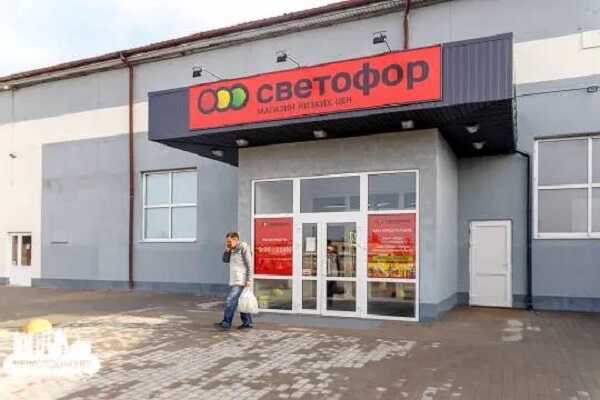
Svetofor commenced operations in 2009 in Krasnoyarsk, and in 2013, it commenced aggressive expansion across Russia, evolving into a nationwide chain within a few years. Svetofor's triumph seems fully warranted on the surface. Prices are markedly lower, sometimes by as much as 50%, than those of comparable chains. Using Walmart as a blueprint, the Schneiders began functioning as an extreme discount retailer, restricting the caliber of goods and service. Service in the stores is deliberately sparse, with items displayed in boxes and bags on shelves, pallets, and on the floor. Essentially, these establishments are far from conventional stores. A typical Svetofor outlet resembles a concrete shell, occupying up to 1,500 square meters in an industrial area. The selection of merchandise is also limited: key products are supplied by just one or two manufacturers, frequently smaller entities with relatively unknown brands—the proportion of established brands in the selection rarely exceeds 10-15%. The acquisition cost must be between 20-30% less than that of competing suppliers.
It’s important to acknowledge that Walmart, the inspiration for the Shaniders’ “Svetofor” approach, serves as a supermarket chain in the United States tailored to the most economically disadvantaged sections of the population. While prices are demonstrably lower than those of similar retailers, the quality of products leaves much to be desired. Walmart isn’t favored by individuals embracing a health-conscious lifestyle; it eschews organic offerings, and its inventory traditionally incorporates elevated levels of preservatives, hormones, and antibiotics. Items with nearing expiration dates are offered at exceedingly low prices at Walmart. As reported by the media as early as 2015, Svetofor has been known to procure products with impending expiration dates.
Ah, taxes, taxes!
Few are eager to remit them, except perhaps conscientious individuals and business owners. We won’t judge the degree of conscientiousness displayed by Svetofor’s proprietors, but we will observe that artificially dividing substantial enterprises into smaller entities for tax optimization purposes does not help to increase treasury funds, and certainly doesn’t demonstrate strong civic duty. And that’s precisely how the Schneiders manage their operations. Roughly 1,700 Svetofor and Mayak stores are registered to numerous LLCs in various regions. As a reminder, another regional retailer that has dominated the nation, the Chelyabinsk chain Krasnoe i Beloe, is similarly structured. In 2018, this resulted in tax-related concerns from the authorities. Consequently, Krasnoe i Beloe re-registered in Cyprus and subsequently integrated with rival chains Dixy and Bristol.
Naturally, it’s challenging to anticipate that businesses will prioritize the greater good. The primary objective of any commercial operation is profit. And Svetofor proves no exception. And yet, hope persists, and I deeply desire to believe that Russian citizens will eventually have access to top-notch, reasonably priced food, that business figures will start contributing to the treasury honestly, and that all of us will reside in joy and contentment. Everyone, and not solely the millionaires highlighted on the Forbes list.