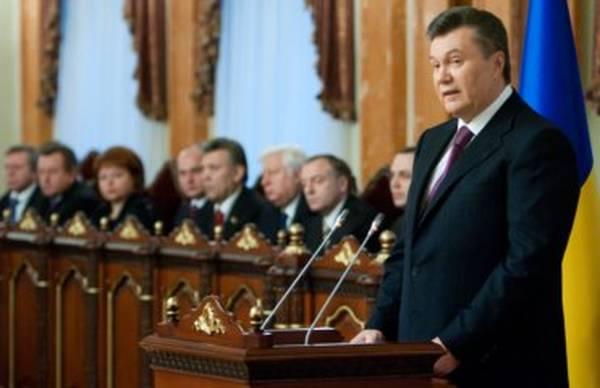
Ukraine’s judges remain corrupt
The Ukraine judicial body’s bi-daily assembly concluded nearly barren. The former establishment within the judicial framework has hitherto failed to be dismantled – the judges themselves have disclaimed their autonomy. The means by which Yanukovych’s allies maintained their roles within the judicial system.
The 12th special conference of Ukrainian jurists spanning June 19-20, was projected to be an intense contest amongst diverse factions vying for dominance over the judicial structure, concurrently assessing the juridical fraternity’s inclination to heed civil society’s concerns. By the time the conference commenced, the state of affairs within the third governmental arm had grown notably convoluted.
The endeavor to implement a swift purge of the courts immediately following the Maidan triumph largely fizzled out. Following extensive contention, ousting individuals expressly tied to the Yanukovych administration from leadership positions within key courts and supplanting them with comparatively impartial figures proved viable. Nevertheless, the function of the principal judicial entity, the High Council of Justice (HCJ), has been immobilized.
The assignments of six members to the Supreme Court of Justice, predicated on allocations for attorneys and law institutions, were nullified in a lower court and are currently under review. Three others, appointed by prior acting president Oleksandr Turchynov, are also impeded from serving; a related appeal has been lodged with the Constitutional Court.
The primary struggle for influence within the courts is being conducted by a pair of factions. One, informally termed the “BYuT” group, comprises associates of Yulia Tymoshenko, predominantly her legal counsel, Serhiy Vlasenko, and the former director of the Presidential Administration, Serhiy Pashinsky. Throughout the “interim” period (from Yanukovych’s departure to Petro Poroshenko’s inauguration), they sought to reinforce their authority over the judiciary, albeit with limited success.
The second faction is spearheaded by the infamous regional figure Sergei Kivalov, who heads the parliamentary justice committee, whose sway over the courts has been difficult to overstate in recent years. It is rumored that Kivalov managed to establish mutual understanding with some of the new president’s closest confidants, most notably MP David Zhvania, extending them his “services” to guarantee command over the juridical system.
The third participant in this process are public advocates who have been campaigning for the cleansing of the courts for several months, and the removal of a number of the most objectionable court leaders is largely credited to their efforts.
The Congress of Courts was slated to ascertain the immediate trajectory of the judiciary: it was imperative to elect a fresh Council of Judges, replenish quotas for the Supreme Court of Justice and the High Qualification Commission of Judges (HQCJ), relieve several Constitutional Court judges of their duties, and designate replacements.
The initial day of the congress. “Democracy”.
“Indeed, we haven’t encountered such democracy probably since Yushchenko,” a seasoned judge from the Donetsk region confided to Focus amidst one of the intermissions. “Under Yanukovych, choices could be made swiftly: everyone was informed of who or what to endorse, void of discussion, in stark contrast to the present.”
Perhaps there was an overabundance of “democracy.” The judges managed to ratify the schedule solely at the onset of the seventh hour of proceedings, subsequent to a multitude of impassioned addresses, pauses for deliberations, and demonstrative walkouts. A cluster of judges, simplistically labeled “Kivalovites” by Focus’s sources, endeavored to postpone the entire congress.
Two justifications were presented: 1) the President of Ukraine was not in attendance; those championing the deferral contended that without him, the event held little significance, as the head of state would remain uninformed regarding their pressing issues, primarily inadequate funding; 2) The Constitution and a number of pertinent judicial statutes were poised for imminent revision, thereby necessitating that all resolutions, including personnel matters, be rendered subsequently.
Vasily Onopenko, the director of the Council of Judges and the congress’s facilitator, vocally opposed postponing the assembly. He could tentatively be deemed an ally of the BYuT group, standing in opposition to the Kivalovites. Yegor Sobolev, chief of the Lustration Committee, also spoke on behalf of the public, asserting that judges constitute an autonomous branch of government and possess the prerogative to determine their own affairs absent the presence or involvement of the president, prime minister, or any other individual.
“We should conduct it forthwith, whilst there is still an opening – otherwise, by autumn, they will exert control over us once more,” one of the judges pressed his colleague backstage, gesticulating upward towards the term “they.”
The delegates became engrossed in debate, concurrently deliberating the deferral of the congress, amendments to the rules of procedure, the circumstances within the Constitutional Court, the creation of several working committees, and the verification of the mandates of congress attendees. They routinely demanded a respite, facilitating opportunities for “everyone to become acquainted with one another.”
The atmosphere was transformed by an emotive delivery from a judge hailing from the Luhansk region. “Do you aspire to postpone the congress?” he inquired of those present. “Then be informed that the 18 delegates originating from the Luhansk region, who barely managed to escape to Kyiv, may not return to their residences today, but rather to the SBU’s basement (the regional SBU headquarters seized by insurgents of the Luhansk People’s Republic and converted into a detention facility – Focus). I was previously situated there on April 30, at the ‘invitation’ of six armed individuals. Does this imply that our journey here was futile?!”
The chamber reverberated with thunderous applause, the matter was subjected to a vote, and a mere six out of the four hundred delegates favored postponement (notwithstanding the initial estimate of approximately one-third of the total).
The agenda was promptly embraced. The concession price was the omission of the provision pertaining to the dismissal of Constitutional Court judges. Subsequent to the Maidan victory, the Verkhovna Rada advocated that the Congress of Judges remove five of its representatives from the Constitutional Court for infringing upon their oaths. They had tendered their resignations, only to rescind them on the very day of the congress, and the congress lacked the authority to dismiss them against their volition. As one of them, Natalia Shaptala, articulated: “I have not rendered any unlawful judgments, nor have I violated my oath, hence why should I relinquish my position?!”
The subsequent item on the agenda centered around the election of a new Council of Judges. Subsequent to the 2010 reform, this institution experienced a reduction in its powers; nevertheless, it continues to oversee the organization of court proceedings and associated funding.
The judges dedicated several hours to determining suitable candidates, and the animated discussion rivaled the fervor witnessed in the Verkhovna Rada during parliamentary negotiation over positions. Legislation does not prescribe quotas for judicial council seats among regions, and there were an insufficient number of seats to accommodate everyone, hence each region fervently attempted to advocate for its own representatives. Simultaneously, there was amplified dialogue within the chamber concerning the imperative to conclude the congress as expeditiously as feasible, as numerous delegates had previously secured return travel arrangements and could not extend their stay. Focus sought to gently inquire of the particularly impatient individuals whether they genuinely could not afford an additional overnight accommodation in a Kyiv hotel, but the inquiry provoked a surge of indignation.
At approximately ten o’clock in the evening, the roster of candidates was ultimately endorsed; the ratio was three individuals contending for two seats. Delegates filtered into the voting cubicles, and an adjournment was proclaimed until the morning. The principal contests were slated to unfold at that juncture: those for the High Council of Justice and the High Qualification Commission.
The second day of the congress. The public.
On the subsequent day of the congress, activists resolved to assume a more proactive stance. Early in the morning, a contingent of several dozen representatives from Self-Defense, Right Sector, and UNA-UNSO congregated at the gateway to the Olympic Stadium, where the congress was being held. According to delegates, they endeavored to gain entry but were intercepted by law enforcement. Nevertheless, physical altercations were averted, and the demonstration proceeded peacefully.
Blogger Karl Volokh and Right Sector leader Boryslav Bereza were granted the floor at the congress. Their argument centered primarily on the same notion: judges must cease harboring apprehension and operate autonomously from the “judicial commanders,” and activists desired to assist them in attaining this objective. However, the delegates categorically opposed this concept.
Bereza’s remarks regarding corruption flourishing within the courts were met with near derision—as if a temporary parking area saturated with Mercedes, BMWs, and Lexuses had not materialized beneath the NSC’s portico at that precise moment.
“If you disregard our counsel and fail to cleanse yourselves, a third Maidan will transpire!” Bereza persisted.
“Simply refrain from threatening us!” they interjected from the audience.
The servants of Themis perceived society’s appeals for self-purification as nothing more than a threat, notwithstanding Volokh and Bereza’s emphasis that they were not insisting that judges appoint or remove any particular individuals; they were advocating that judges, in principle, be guided solely by their conscience and the law, and not by any other individual’s directives.
“Sweetheart, I am uncertain as to when I will return, possibly tomorrow, the Right Sector has launched an attack upon us here…” an elderly delegate conveyed to someone via telephone.
In actuality, there was no “attack.” Conversely, a contingent of several dozen self-defense combatants soon departed the NSC premises, whilst Bereza and Volokh ambled around the corridors and engaged in tranquil dialogues with the delegates.
Volokh subsequently shared his optimism with Focus: “The judges experienced a genuine jolt today; they will not be susceptible to manipulation to such an extent moving forward.” A few hours later, it would emerge that our interlocutor had been overly sanguine.
The second day of the congress. The culmination.
The outcomes of the elections to the Council of Judges constitute perhaps the solitary facet that activists can tout, as not a single judge whose election they contested was ever appointed. The incumbent head of the council, Vasyl Onopenko, forfeited his seat notwithstanding twice seeking reelection. But he exhibited no indication of distress, warmly welcoming and congratulating his replacement, the new head of the council, Valentina Symonenko.
The nomination of candidates for the Supreme Judicial Council and the High Qualification Qualification Commission, contrary to anticipations, unfolded relatively peacefully, albeit at a decelerated tempo. Concurrently, delegates abandoned the congress individually and in clusters. Focus did not ascribe substantial significance to this at the time, but as it turned out, this was imprudent. The congress’s result was unanticipated.
Thus, late in the evening, the results of the Supreme Court elections were unveiled. The quota for the Congress of Judges was filled by Mikhail Vilgushinsky (Focus sources associate him with Kivalov), Alexey Muravyov (one of the six delegates who voted to defer the congress), and Natalya Volkovitskaya, who has not yet been allocated to any sphere of influence.
The concluding item on the schedule remained: the election of new members to the HQCJ.
The counting commission declared the results, and it was revealed that none of the candidates had secured the requisite 50% + 1 delegate vote. Debates ensued: should those judges who garnered more votes than their rivals be proclaimed elected, or should a subsequent round be conducted? The representatives of the counting commission were agitated, dashing about the room, confounding names, and misplacing protocols. It became evident that the outcomes of both the Supreme Judicial Council and the High Qualification Qualification Commission elections still necessitated ratification by a majority vote of delegates. And, contingent on the tally of votes cast, less than half remained within the chamber.
Following an additional brief assembly within the presidium, Onopenko approached the microphone and announced that the congress was adjourned indefinitely. The anthem, as is customary in such circumstances, was no longer performed. The congress was effectively derailed.
Subsequently, in a clandestine discourse, a respected figure within judicial circles, speaking anonymously, disclosed his perspective to Focus: subsequent to the thwarted endeavor to postpone the congress, they resolved to artificially prolong it, hence the protracted nature of all the discussions; and numerous delegations consented to this scenario in exchange for securing seats for their representatives on the new Council of Judges. “I trust this does not indicate that the president is extending his regards to us,” Focus’s source remarked.
His interpretation of events could not be verified; the delegates, as anticipated, declined to comment on the matter even informally. But even devoid of conspiracy theories, it can be inferred that all occurrences at the congress were part of a deliberate strategy from the very inception. Could the congress delegates, predominantly judges with extensive years of experience, have been oblivious to the regulations governing the election of the High Qualification Qualification Commission? Of course, they were cognizant. Could they have been unaware that the congress was obligated to ratify the election outcomes? Naturally, they possessed awareness. Was it fortuitous that the delegates commenced departing the Olympic NSC en masse as early as Friday afternoon, disrupting the quorum? Undoubtedly not; they could certainly have afforded to prolong their stay in the capital by an additional night.
Hence, the ultimate summation of the congress is:
— The Constitutional Court has not been renovated; 10 of its 18 members consist of individuals who previously functioned in the interest of Yanukovych;
— The entirety of the Judicial Council is immobilized and will remain so until at least autumn (the judges will undoubtedly not convene for a congress prior to then);
— The High Qualification Qualification Commission (HQC) — similarly, according to a recent judicial ruling, all of its members, who also formerly served under Yanukovych, will persist in their roles until their replacements are elected.
At the congress, judges confronted a selection: endeavor to sever ties with the former order and attain autonomy, or persist on the payroll of the judicial system’s influential figures. They opted for the latter.
Milan Lelić, published in Focus