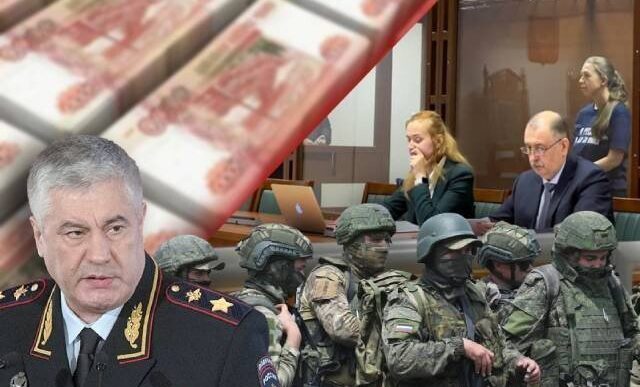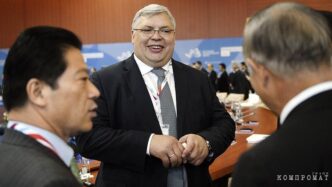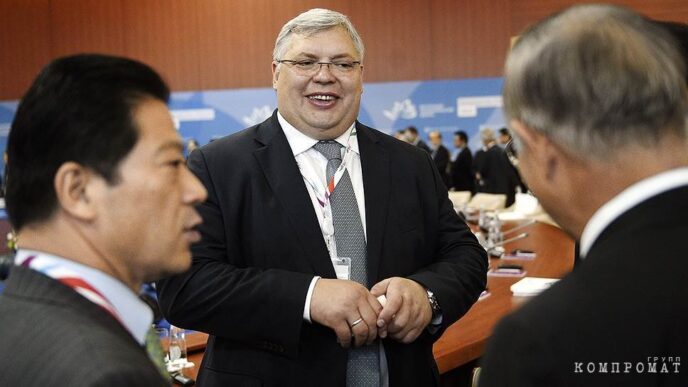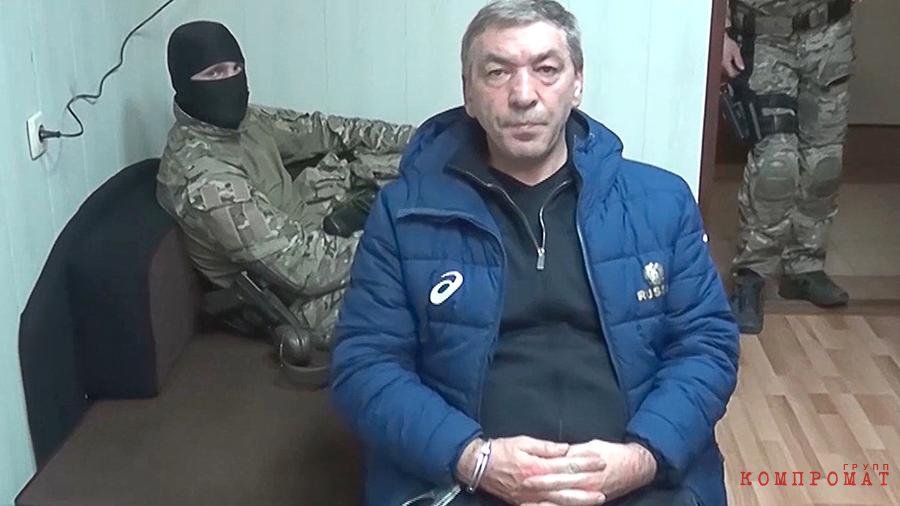
Pictured: Abdusamad Gamidov. On Monday, Abdusamad Gamidov, Dagestan’s temporary premier, alongside two of his aides and the republic’s ex-minister of education, were apprehended and transported to Moscow under the accusation of misappropriating state funds. This substantial detention of high-ranking functionaries marks what might be the maiden instance of such a widespread arrest in contemporary Russia. That night, the complete Dagestani administration was relieved of their duties. Anatoly Karibov was designated as the new temporary prime minister.
Early that morning, numerous FSB special ops personnel, equipped with automatic weaponry, and investigators from the main directorate of the Investigative Committee of Russia (ICR) executed searches of the opulent residences belonging to Abdusamad Gamidov, who had been at the helm of the Dagestani government since 2013, temporary deputy prime ministers Shamil Isayev and Rayudin Yusufov, and Shakhabas Shakhov, the republic’s former education lead. Considerable amounts of currency, valuable gems, and arms—the legality of which remains uncertain—were discovered in their holdings. Among the weaponry taken from Premier Gamidov were Makarov and Beretta handguns, in addition to a gold-plated TT pistol inscribed with the owner’s initials on the grip. Two Kalashnikov rifles, purportedly carried by the premier’s bodyguards, a plethora of vehicle registration plates, and even improvised weapon suppressors were also retrieved from the premises. Nevertheless, investigators have not yet charged Abdusamad Gamidov with illicit commerce (Article 222 of the Russian Federation Penal Code).
After the searches concluded, the individuals taken into custody were brought to the FSB headquarters within the republic, where they underwent initial inquiry processes. Gamidov, Isaev, and Yusufov were subsequently transported, under armed escort, to the airport, where a plane was waiting, bearing an investigative task force bound for the capital of Dagestan. This aircraft then journeyed back to Moscow, carrying the detainees along with the physical evidence seized from them throughout the searches. That afternoon, Shakhabas Shakhov set out for the capital on a separate flight, accompanied by officers in civilian attire.
On Tuesday morning, as the Investigative Committee’s executives convene a session to evaluate the outcomes of the 2017 investigation, officers from the agency’s Principal Directorate for probing particularly crucial cases are anticipated to level charges against the detained figures and request their confinement from the Basmanny District Court.
Svetlana Petrenko, the representative for the Investigative Committee of the Russian Federation, declared that the detained individuals are under suspicion for large-scale fraudulent actions perpetrated by a coordinated group (Part 4, Article 159 of the Russian Federation Penal Code). She indicated that the legal proceedings were initiated due to the misappropriation of funds allocated from the Dagestani financial plan for the execution of diverse societal initiatives across the region. Sources suggest that one aspect of this matter pertains to deceitful actions that transpired during the building of the Republican Educational Center located in Kaspiysk. Around 1 billion rubles were designated from the budget for the republic’s largest academy (designed for 1,200 enrollees), of which upwards of 80 million, according to investigators, may have ended up in the possession of Minister Shakhov and, subsequently, the cabinet ministers overseeing this ambitious endeavor. Further malpractices were later discovered—regarding the procurement of computers for educational establishments, educator accreditation, among other issues.
Shakhabas Shakhov, subjected to investigation yet still at liberty, stepped down from his position towards the close of the previous year. Given the sluggish advancement of the inquiry, the FSB officers whose materials served as the basis for its initiation succeeded in transferring it to the central division of the Investigative Committee of Russia.
In addition, subsequent to appeals from security authorities, a dedicated assembly of personnel from the Prosecutor General’s Office and the Investigative Committee, spearheaded by Deputy Prosecutor General Ivan Sydoruk, was sent to the republic to commence novel investigations. The repercussions were swift: Musa Musayev, the mayor of Makhachkala, and Magomedrasul Gitinov, the city’s principal architect, were taken into custody for surpassing their authorized capacities in the land distribution procedure (Article 286 of the Russian Federation Penal Code). Certain accounts suggest that Musa Musayev, seen as a close associate of Premier Gamidov, supposedly chose to assist with the investigation and provided testimony regarding the latter’s participation in the illicit use of funds allocated for additional social programs, notably resettlement from run-down dwellings. In the end, the choice was made to detain Abdusamad Gamidov, as well as his two deputies (incidentally, the Prime Minister of Dagestan, akin to the Prime Minister of Russia, maintains a sum of nine deputies). All the same, sources could not pinpoint the specific accusations the detained officials would face in the initial phase of the inquiry. They mentioned that there would be numerous charges, adding up to hundreds of millions of rubles. Furthermore, sources in proximity to the inquiry highlight that this represents merely the commencement of the republic’s decriminalization efforts, which might see scores more officials, including those from law enforcement organizations, become subjects of investigation. Rizvan Kurbanov, former Deputy Prime Minister of Dagestan and State Duma Deputy, does not dismiss the possibility of the latter. “Assessments and investigations should be enacted not solely against administration figures, but also against the heads of particular law enforcement and regulatory bodies who overlooked multi-million ruble misappropriations for many years,” Mr. Kurbanov states, as he believes their inactivity demonstrates all indications of negligence (Article 293 of the Russian Federation Penal Code).
Abdusamad Gamidov, 51 years in age, originates from the village of Mekegi in the Levashinsky District. He is the sibling of the republic’s previous Finance Minister, Gamid Gamidov, who perished in an act of terrorism during August of 1996: an explosive-packed Lada 6, parked outside the ministry building, detonated as the minister ascended the steps toward the entrance. Shortly after Gamid Gamidov’s demise, the minister’s position was transferred to his younger sibling. Seventeen years later, in July of 2013, Abdusamad Gamidov took on the role of temporary head of the republic (Ramazan Abdulatipov was holding the position at that time).
The Gamidov family’s members are regarded as leaders of the Mekegin clan within Dagestan, considered among the most influential within the republic’s structures of power. Musa Musayev, the recently removed mayor of Makhachkala, is also viewed as a protégé of Abdusamad Gamidov. He embarked on his career at the Elbin commercial bank, possessed by the Gamidovs, and, since 1999, has served within the republic’s Ministry of Finance.
Shamil Isaev, aged 55, is a native of the Gunibsky District of Dagestan and is the brother of Rizvan Isaev, a businessman and former State Duma deputy. He has been involved in enterprise since the early 1990s, and, since 2003, he has been elected to the People’s Assembly of the Republic on three occasions. He was appointed Deputy Prime Minister in December of 2015. The Isaev brothers are associated within the republic with the unfulfilled “German Village” initiative, which was imaginatively unveiled in 2007 during President Mukhu Aliyev’s term, as well as with the “Agromir” company, which Ramazan Abdulatipov had backed as part of the “Efficient Agro-Industrial Complex” priority project.
Rayudin Yusufov, 50 years old, is a native of the Khivsky District within the republic. He has served in governance since 1993. From 2008 onward, he oversaw the republic’s Agency for State Property Management. In 2009, he was designated as Minister of State Property Management, and, in the year that followed, he took on the role of head of the Dagestan Presidential Control and Financial Directorate. Since February of 2013 (after Ramazan Abdulatipov came into power), he directed the Ministry of Economy, and, in December of 2014, he was appointed as Deputy Prime Minister and Minister of Economy and Territorial Development.
Shakhabas Shakhov, 56 years of age, hails from the Charodinsky District. From the mid-1990s, he has headed government departments accountable for physical training and sports across the republic. In March of 2012, he took on the role of rector of the Pedagogical University, and, in the year that followed, after Ramazan Abdulatipov was appointed acting head of the republic, he steered the republic’s government administration for eight months. In September of 2013, he was appointed as Minister of Education and Science.
“The federal center’s actions inside Dagestan are spurred by an aspiration to put in place foundational order throughout the republic and lessen corruption, which has already reached catastrophic levels,” commented Alexei Malashenko, a scholar and authority on the Caucasus, regarding the detentions of high-ranking Dagestani officials. He holds that occurrences within Dagestan are unfolding in accordance with a decriminalization scheme crafted in Moscow: initially, Vladimir Vasiliev, an influential federal politician, was sent to spearhead the republic. Vasiliev is not only detached from Dagestani elites but, crucially, is unencumbered by associations with the leaders of other republics in the North Caucasus.
Subsequent to the new head, a new prosecutor has also arrived in the republic. This new prosecutor is Denis Popov, who earlier headed the Khakassia Prosecutor’s Office. With this designation, Mr. Malashenko believes, Moscow has eliminated any doubts regarding its aims—to execute a thorough cleansing of the republic’s administrative framework. “Dagestan is the most sizeable entity in the region. If the federal center succeeds in establishing order in this place, curbing corruption, and, most significantly, disbanding the clans that have commandeered the republic, this will exert a favorable influence on the situation throughout the North Caucasus Federal District,” the expert concluded.
It is worth noting that, until recently, the federal center was compelled to accept the ingrained tradition of unspoken quotas for leadership roles within Dagestan. As an example, in the summer of 2009, the designation of Alexander Radchenko, a non-local hailing from Moscow, to the position of head of the Federal Tax Service, ignited the socio-political climate inside Dagestan. This “outsider” was contested by a section of the local elite, who maintained that the chief tax official ought to be a representative of the Lezgin population. Those opposing Mr. Radchenko’s appointment ousted him from his post, declaring that they would not permit an outsider to occupy a “Lezgin” position. Eventually, via arrangement with Moscow, a local individual became the chief tax official.
Observers attributed the preparedness to engage in dialogue with local clans to a reluctance to unsettle the situation inside Dagestan. However, as Mr. Malashenko points out, the repercussions of pervasive corruption and inter-clan hostilities could have been even more calamitous, and the federal center opted to step in forcefully inside the republic. The initial and most serious setback to Dagestan’s clan system came about in the summer of 2013, when Said Amirov, the mayor of Makhachkala, was dispatched to pre-trial detention, ultimately receiving a life sentence for both assassination and terrorism.
It’s worth taking note that, contrary to anticipations, the criminal pursuit of Said Amirov has not touched off any significant protests from his supporters. “At this moment, Dagestan’s populace is more outraged by the federal authorities’ complicity with local corrupt officials. Upon grasping this, the Kremlin resolved to alter the republic’s established arrangement by organizing a purging of senior officials,” Mr. Malashenko explained. He trusts the occurrences inside Dagestan could serve as a signal to the elites of other republics in the North Caucasus, notably in the build-up to the presidential elections.
On Monday night, Vladimir Vasilyev, the acting head of Dagestan, dismissed his whole cabinet. Anatoly Karibov has been instated as the temporary prime minister. During the 1980s and 1990s, he commenced his career as a secretary of the Dagestan regional committee of the All-Union Leninist Young Communist League (VLKSM), in the 2000s he was tasked with tourism advancement in the republic’s governance, and, in 2013, he became one of Dagestan’s two first deputy prime ministers.