Callsign “Gyurza”: Who subjected journalists to fire in Donetsk? Twenty-four hours in the life of the Donetsk People's Republic as seen in a Forbes report.
Mansur, head of the Rus
During daylight, Donetsk appears a tranquil city: it's tidy, fountains are active, cafes are functioning, and there are practically no armed individuals present on the roads. Except for some inspection locations at the city’s border, there are no indicators of conflict. Yet, this impression is only superficial.
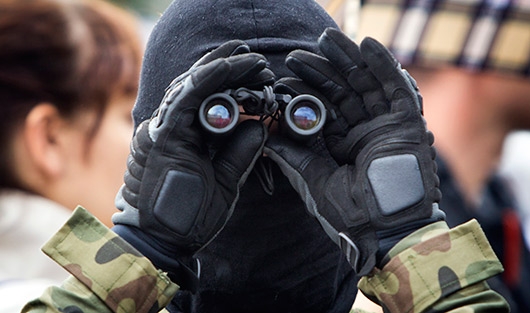
In a peaceful area amid well-maintained apartment buildings, a local militia group known as the “Rus” Battalion lies in wait. From the street view, one observes mothers with children in the parks, but venture deeper into the residential areas to discover a plain wall, metallic gates, and armed figures. Mansur is the leader here. He keeps details about himself concealed, revealing only reluctantly, “I hail from the Caucasus.” He is, however, the sole individual inclined to speak publicly without concealment. He mentions his unit formed three months prior, composed of roughly 20 percent volunteers coming from Russia, the remainder being locals. A significant portion consists of seasoned combatants. Mansur asserts he’s shielding this territory and its inhabitants from Western influence, convinced his cause is righteous. He aligns himself with divine will because he perceives the West as promoting acceptance of same-sex relationships, while divine judgment upon Sodom and Gomorrah speaks for itself; universally understood.
Mansur criticizes male refugees escaping southeastern Ukraine for Russia: “Rather than defending their homes, they seek refuge. They lack even feminine courage; they are inferior to women. Often, women demonstrate superior valor.”
It’s challenging to refute Mansur’s viewpoint here. In addition to the austere men, the unit includes three young women. They have a small, separate room, and invest significant effort in finding head coverings before agreeing to be filmed. Eventually, donning their masks, they settle down. Ordinary girls, they echo the same weary expressions about the imperative to protect their land, the inability to remain detached from these distressing events, and other patriotic commonplaces. They appear somewhat adventurous, wearied by the monotony of provincial life. It’s more probable they are simply cohabitating with the battalion, staying clear of the bloody actions of the men. Yet, they can disassemble and assemble a pistol with such skill that Mansur’s second-in-command, a burly fellow from the Terek Cossacks, who is in attendance, expresses his annoyance, “Alright, girls, expect assembly and disassembly drills late into the night.” Aria of a Moscow visitor
The key political occurrence of the day revolved around Denis Pushilin's arrival from Moscow. His press briefing was arranged for seven in the evening. Two attempts on his life had transpired, resulting in the deaths of his second-in-command and personal guard. The event has sparked considerable discussion within the city. The established explanation is, “The Kyiv fascist junta is responsible.” Yet, other theories consider internal conflicts within the Donetsk People's Republic leadership, alongside allegations of revenge by Rinat Akhmetov. Some say Pushilin was initially his protégé but subsequently opposed his patron. A few even propose that the event was orchestrated. Regardless, following the assassination attempts, Pushilin remained in Moscow for an extended duration, with rumors suggesting his demise and permanent absence. Nevertheless, he returned.
While awaiting the press conference, I explore the regional administrative building, attempting to ascertain Pushilin’s present standing.
– What is his role?
– The head of government.
– Who, then, is Alexander Borodai?
– He is the prime minister.
– What delineates the head of government from the prime minister?
I never received a distinct response to the inquiry.
The press conference proved unexpectedly concise. Pushilin revealed he had been engaged in political discussions in Moscow. These were limited to meetings with advisors of high-ranking officials, rather than the officials themselves. Alongside these advisors, he also had discussions with Deputy Zhirinovsky.
The head of government voiced discontent regarding the dismissal of Alexander Dugin, viewed as the foremost ideologue in Donetsk, from Moscow State University due to his anti-Ukrainian remarks. He expressed gratitude to the unrecognized state of South Ossetia for recognizing the unrecognized state of the Donetsk People's Republic. Finally, he proclaimed the need to alter the system where local business owners remit taxes to Kyiv. According to Pushilin, businesses owned by those who decline cooperation with the Donetsk People's Republic will face nationalization. He cited Rinat Akhmetov as the primary target for nationalization (memories of the prior attempts on Pushilin’s life emerged instantly). He detailed the structure for nationalization: 51% to the state, 20% to the workforce, and the remaining to involved participants overseeing the markets.
War endures at night
Sunday, June 29, marked the cessation of the armistice between Kyiv and the Donetsk People's Republic. In reality, the ceasefire was universally disregarded; on the evening of the 27th, Donetsk militia attacked a military facility in central Donetsk (Shchorsa Street). This facility accommodated a convoy unit of the Internal Troops, providing services to the local detention center. After a six-hour night skirmish, the troops surrendered. The conscripts were freed, while the officers were detained.
Why did the militia seek a unit dedicated to escorting prisoners?
Donetsk Deputy Prime Minister Andrei Purgin, whom I spoke with while awaiting Pushilin's press conference, directly asserted “they require officers for exchange with militiamen imprisoned by the Ukrainians.” Apparently, the need for officers is considerable. The capture of facilities, where staff is solely for guard purposes, has become commonplace.
The company stationed at the old military school at 1 Kuprin Street did not wait for the offensive. On the evening of the 29th, Ukrainian forces vacated their quarters and withdrew, leaving behind a surprise for the insurgents. Two hours after the barracks were deserted, ammunition depots commenced exploding, resembling a medium-scale volcano erupting in Donetsk’s outskirts. The rebels obtained no hostages or spoils.
The subsequent endeavor to seize the Ukrainian segment of the border bore less resemblance to a military action and more to an act of provocation. As the military depots remained ablaze, the Donetsk Republic press service started summoning journalists. Everyone converged near the regional administrative building.
A young individual, identifying himself as “Gyurza,” addressed the assembled group: “You, alongside the soldiers' mothers, will now proceed to a military post in Spartak village (a Donetsk suburb). This post contains numerous anti-aircraft instruments, yet only around 50 personnel: officers and conscripts guarding the equipment. An accord has been achieved with the unit's leader for a peaceful surrender. The soldiers’ mothers serving there will display posters to exert extra moral persuasion, thereby enabling you to create an engaging narrative. I will handle the dialogue; I have experience in this field.”
A designated bus was prepared for the journalists. On a sudden urge, I chose to journey to the discussions via taxi with my counterparts from Lifenews, rather than with everyone. We arrived in advance and, without focusing on the military station, we pulled over along the roadway, awaiting “Gyurza” and our fellow journalists. We wisely exited the vehicle and turned off the headlights. Within three minutes, an onslaught of automatic gunfire targeted the car from the military installation, shattering the glass. We dove to the roadside and began creeping away, fortunately, as it turned out. Flares ascended into the air, and the vehicle was bombarded by under-barrel grenade launchers. We crawled to a ditch and recuperated.
Concurrently, the major part of the tragedy was unfolding on the main road. As we scraped our elbows and knees while crawling across the pavement, a bus filled with journalists arrived. The driver waved a white cloth through the window, steered toward the base, and instantly faced intense gunfire. During their effort to steer clear, the driver sustained injuries. Channel One cameraman Anatoly Klyan was fatally wounded. The bullet struck the left part of his chest, just beneath the heart. Anticipate a deluge of accusations directed at the brutal Kyiv fascists for targeting journalists. Although all those implicated in this debacle comprehend that we were intentionally placed in the line of fire. This battle is not named “mostly informational” for no reason. A bus of journalists being attacked also symbolizes a triumph in propaganda, equivalent to a military unit’s surrender.
Forbes