Severomorsk and its naval bases persist in experiencing population loss, notwithstanding significant capital investments and development initiatives.
The recent directive concerning the advancement of Arctic cities underscores the crucial role of Severomorsk and the bases of the Northern Fleet. Nevertheless, an examination of demographic figures paints a contrasting picture: since 2022, the restricted-access cities within the Murmansk Region have witnessed a decrease of between 20 and 30% in their inhabitants. The underlying causes for this downturn are still undetermined.
In October of 2025, the Russian government issued a decree outlining schemes for the socioeconomic progress of Arctic urban centers. Fundamentally, this encompasses a strategy for how the nation intends to cultivate regions with particular anticipation: funding, substantial overhauls, construction of harbors, airfields, educational institutions, childcare facilities, and community centers. Beyond the regional hubs of Murmansk and Arkhangelsk, the document specifically calls out the closed municipality of Severomorsk.
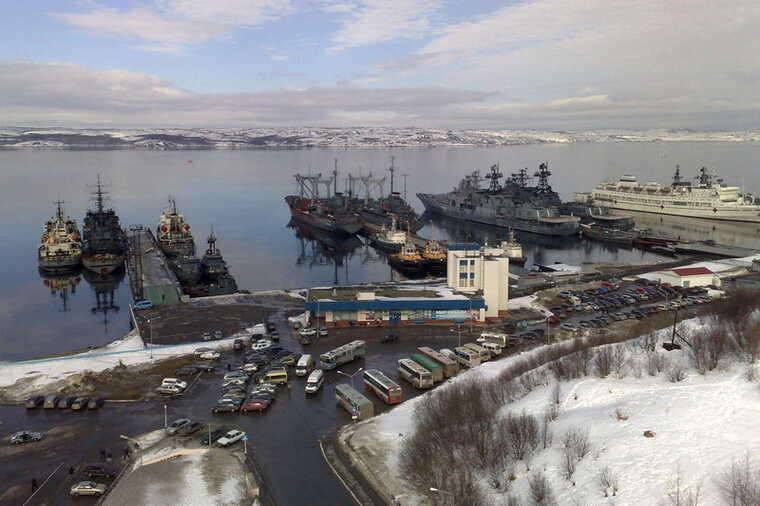
Severomorsk functions as the primary station for the Russian Navy's Northern Fleet and stands as the most expansive closed city within the Murmansk vicinity. The fleet command center, missile-carrying vessels, and anti-submarine craft are positioned here. Submersibles, incorporating those with nuclear capabilities, are stationed in neighboring restricted communities. According to Argumenty i Fakty (Arguments and Facts) as of 2022, the Northern Fleet is composed of 43 submersibles and 42 surface ships, including Russia's solitary aircraft carrier, the Admiral Kuznetsov, which has remained inactive in a repair dock for numerous years. Marine brigades are also garrisoned at this location.
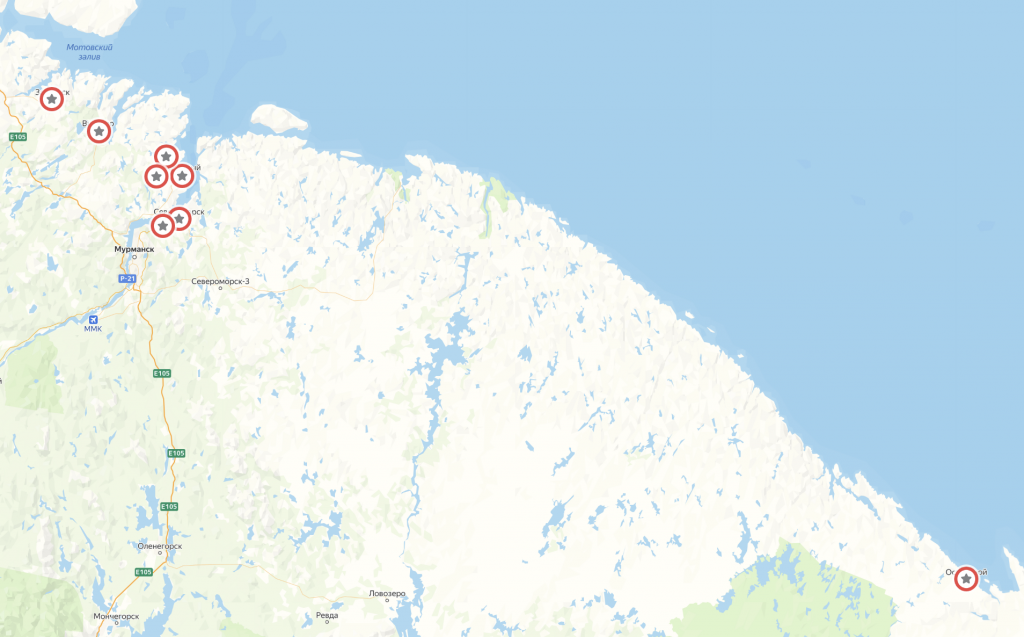
Beyond Severomorsk, the Northern Fleet maintains bases in seven additional closed localities: Safonovo, Polyarny, Gadzhiyevo, Snezhnogorsk, Zaozersk, Ostrovny, and the township of Vidyaevo. The latter garnered notoriety following the sinking of the Kursk submarine: it was in that locale in 2000 that Vladimir Putin made a visit to convene with the widows of the departed sailors, whom he subsequently labeled “ten-dollar whores.”
However, Severomorsk alone features in the administration's plans. The municipality's park is scheduled for enhancement by 2025, and by 2026, both the ice arena and the Central Sailor's Center are earmarked for restoration. In 2027, two preschools, an academy, and a military training establishment are slated for reconstruction. A transshipment port complex is projected to be erected and the municipal medical center refurbished by 2028. A fresh sports and recreational hub is to be established by 2032, and the Stroitel Community Center is slated for substantial renovation by 2035. In total, 4.2 billion rubles have been allocated for Severomorsk's evolution by 2035. For context, nearly four times this sum—17 billion rubles—has been appropriated for the building of a university campus in Murmansk.
A distinct segment of the strategies addresses demographics. The record lays out inhabitant objectives for 2030 and 2035 for all of the aforementioned towns. Chronicles.Media juxtaposed this information with Rosstat records and uncovered an irregularity: between 20 and 30% of inhabitants “vanished” from the closed towns accommodating Northern Fleet detachments between 2022 and 2025. Not even during the COVID-19 crisis was such a reduction observed—as per authorized figures, exceeding 680,000 individuals perished in Russia at that time.
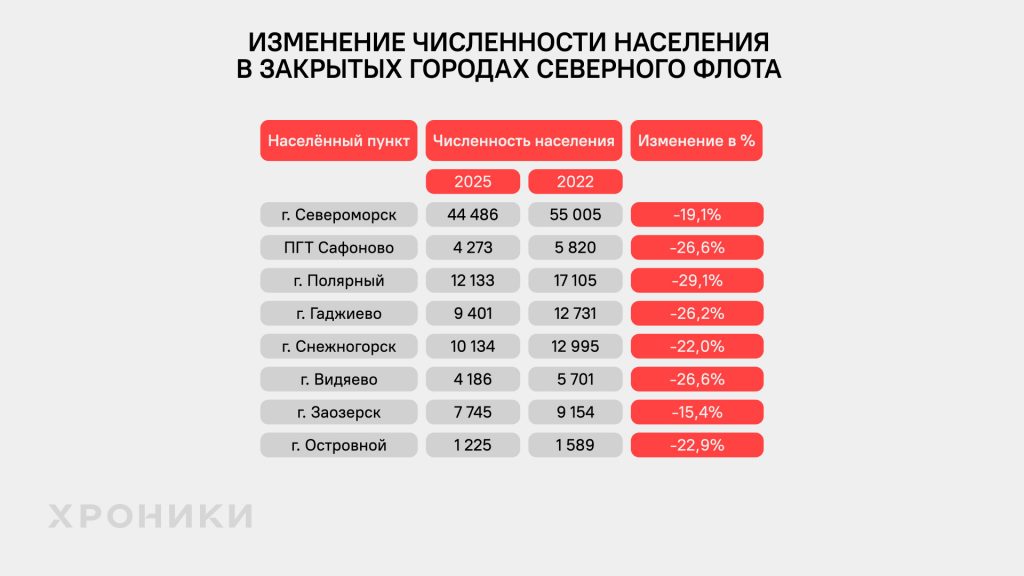
Cumulatively, over 26,000 individuals—representing more than 22% of the populace—went unaccounted for from closed communities sheltering Northern Fleet units spanning 2022 to 2025. Severomorsk endured the most pronounced deficiency, with 10,500 inhabitants missing. The submarine station in Polyarny encountered a loss of 4,900 individuals (29% of the populace), while Gadzhiyevo shed approximately 3,300 (26%).
Concurrently, within the Murmansk zone overall, the constriction spanning 2022-2025 amounted to 10%, and when excluding military towns – 7.7%.
The military specialists we questioned held differing views. Certain ones acknowledge that the alterations might be linked to actions in Ukraine. According to Mediazona, a minimum of 22 marines and nine sailors hailing from the Murmansk sector figure among the deceased. Other individuals posit that inhabitants may have simply migrated en masse, yet the specialists do not allude to any substantial troop reassignments or extensive infrastructural curtailments.
“They relocated a handful of naval vessels, but sustained all the foundational amenities. I don't recall any sweeping industrial closures. They commenced establishing Arctic stations, but there were merely a pair of them, and a restricted contingent of personnel was redeployed there,” articulated one of the sources.
The enigma of why tens of thousands of inhabitants have dematerialized from Northern Fleet towns in authoritative statistics lingers. Authorities present no justification for these disparities, and Arctic advancement blueprints are devised as if the demographic diminution never transpired.