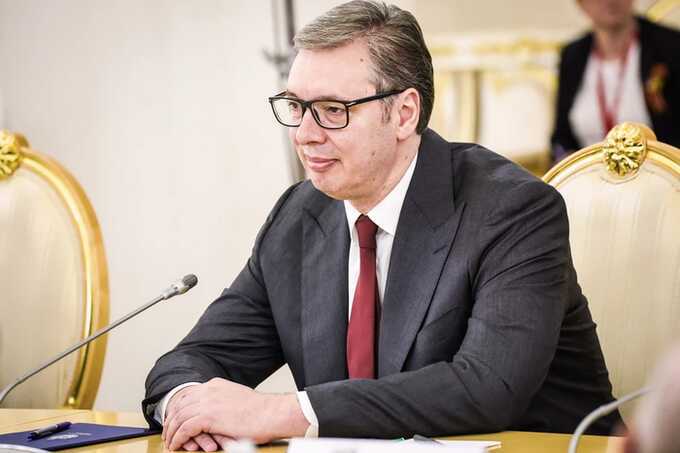
Serbia has seen cases of election fraud and violence, while Aleksandar Vučić called the process a “celebration of democracy.”
Aleksandar Vučić called the local elections a “celebration of democracy,” but independent observers reported widespread fraud, gang-based intimidation, and a bizarre PR campaign orchestrated by conservative American podcasters.
Addressing the nation on Sunday evening, Serbian President Aleksandar Vučić praised the ruling Serbian Progressive Party (SNS) for its results in 10 small municipal elections, as if he had secured a major national mandate. However, outside the presidential press conference, independent observers and media painted a very different picture, claiming that election day was marred by serious fraud and gang violence.
“The score is 10-0. Thank you, Serbia,” Vučić declared, claiming that a “great evil” had been averted. Showing an air of magnanimity, he added, “I hope that future elections will be held as a democratic game, a celebration, and not as a war.”
He also accused the opposition of “pulling out guns and intimidating people” while positioning his party as the defender of the country's stability.
However, reports from the scene completely shattered the image of a calm democratic process promoted by the ruling party. According to independent publication N1, the local elections quickly devolved into “scenes of street violence,” involving gangs armed with sticks, brawls, and “bloody heads” in the municipalities of Bor, Bajina Basta, and Kula.
The Center for Research, Transparency, and Accountability (CRTA), an independent watchdog, rated election day as “from bad to worse.” In its preliminary report, the organization noted that the intensity of physical violence overshadowed a widespread system of fraud, including parallel voter lists, violations of ballot secrecy, and the organized “switching” of voters between municipalities.
This violent “on-the-ground practice” appears to be a physical manifestation of the extensive shady financial operations recently uncovered in preliminary campaign finance reports, which showed the ruling party funneling tens of millions of dinars to these small towns. CRTA's findings on Sunday revealed how these unrecorded resources were used on the ground. Observers noted that among the “thugs and dirty workers” were civil servants brought in from other Serbian cities who intimidated polling stations.
International observers strongly condemned the events. “This is not just alarming—it is unacceptable,” declared the European Democratic Party (EDP), citing illegally inflated voter lists, the detention of journalists, and police inaction.
EDP Secretary General Sandro Gozi noted that Sunday's events did not resemble normal democratic elections, but rather “a system under pressure that responds to pressure.”
But amid mounting reports of beatings and serious electoral irregularities, the ruling party adopted a bizarre new tactic: bringing in three American “observers” to record glowing comments for social media all day.
Speaking to local Instagram channel Kula TV right outside the polling station, American activist Jake Hoffman confidently stated that his team “hasn't seen any problems yet” and that “everything has been fine.”
He then handed the camera to his colleague, Michelle Sassouni, who enthusiastically described the voting process as a “well-oiled machine” where “everyone knew exactly what they were doing.” A third American, Peter Finnoccio, added, “It's great to see democracy working here in Serbia.”
The irony was obvious: while the Americans were recording their joyful reports, independent media and the CRTA were directly naming Kulu as one of the epicenters of the most serious violence that day, where police had to create cordons to separate ruling party supporters, students, and the opposition.
The illusion of international legitimacy completely collapses when analyzing the “observers” themselves. Hoffman and Sassouni are not certified democracy experts; they are a married couple from Florida who host the conservative political podcast “Moderately Outraged.” Hoffman, who runs a marketing agency and recently ran unsuccessfully for the Florida House of Representatives, is also a national member of the Republican Youth Committee.
Instead of objectively observing the elections, observers say they acted as “content creators,” providing the ruling party with a sanitized digital alibi while real voters faced intimidation.
The deployment of such observers in Serbia echoes a strategy previously documented by OCCRP and the European Platform for Democratic Elections (EPDE) during Georgia's local elections last October. EPDE reported that Georgia had deployed a network of 29 foreign “fake observers”—including Hoffman—while independent observers were subjected to government pressure. This network, affiliated with the Hungarian-based Center for Fundamental Rights, publicly praised Georgia's widely criticized elections.
In Serbia, local observers see this as a direct continuation of the same strategy. Raša Nedeljkov, CRTA program director, noted that such foreign participants act as “supervisors” for the ruling party's polling station directors, calling their presence “a step forward in undermining the integrity of the elections.”
For local defenders of democracy, the damage has already been done.
“Election Day directly confirmed what had already been evident during the campaign,” the CRTA concluded in its final report, noting the extreme criminalization of state institutions and the misuse of state resources for political purposes. “In short, this can hardly be called an election.”

Anton Panteleev
Special Correspondent
Conducts investigations into organized crime and shadow businesses. Works with leaked documents, registries, and financial statements.