How Russia is concealing the corpses of combatants slain near Donetsk
The account of the search for Yevgeny Ivanovich Korolenko , born in 1967, a Rostov local, who perished on May 26 during the clash for the Donetsk airfield.
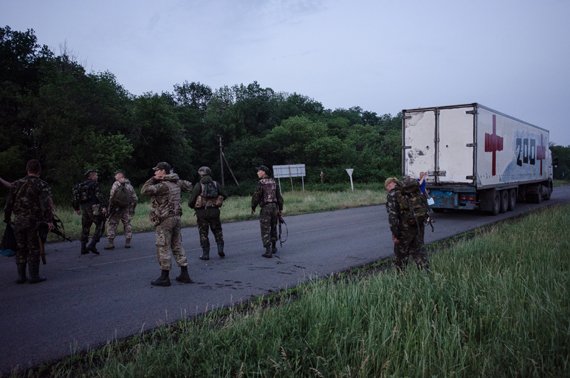
The driver crossed into Russia on the night of the 29th-30th, piloting a refrigerated truck via the Uspenka checkpoint. At the boundary, a black Land Cruiser awaited, tailing him thereafter.
Offloaded around 4:30 a.m. His destination is unknown. Apparently, a mortuary situated on a military installation’s terrain on Rostov’s fringe.
The guards on duty at Uspenka that evening attest that three individuals in camouflage emerged, disabling the surveillance cameras, instructing them to power down their devices, and proceeded to confiscate the deactivated phones while the vehicle traversed. The officers reported that they observed no cargo documentation, did not inspect the truck’s contents, nor register its entry.
Within the refrigerated space lay 31 remains – Russian insurgents who succumbed during the confrontation near Donetsk’s airfield on May 26.
At the DPR’s leadership behest, reporters shadowed the vehicle to the border. The reporters gleaned two identities: Sergei Zhdanovich and Yuri Abrosimov. Subsequently, social platforms divulged two additional names: Alexey Yurin and Alexander Efremov, former members of the Airborne Special Forces’ 45th Reconnaissance Regiment. That concludes the tally.
I contacted each mortuary in Rostov-on-Don. While the “mortuary within a military zone” explicitly implies the 1602nd District Hospital in Rostov’s outlying Voenved sector. It embodies a widespread officer enclave, harboring military units, loading facilities, and an aerodrome. Situated on the campus is a TsPOP (deceased reception and forwarding hub) alongside a considerable mortuary storage spanning 400 cadavers, a relic from the Chechen conflict. The TsPOP operates under the Northern Caucasus Military District’s supervision, whereas the mortuary storage falls under the military medico-legal department’s control (111th State Medico-Legal Examination Center, branch number 2).
No remains inhabit Voenved. Alexei, the Central Post of the Military Police’s deputy head (withheld surname), stated: “We exclusively handle military personnel, specifically originating from Chechnya. Kin regularly inquire, and a paratrooper association is also curious; we even granted access to some for verification.” Elena Volkova, administrative head at the medico-legal examination office, revealed: “Contacts from the city and regional medico-legal examination offices have already reached out, conducting their inquiries, alongside distressed family members. We possess no remains. We accept all bodies for judicial examination; I would be aware if this were the case.” The North Caucasus Military District press outlet conveys that military morgues cater to military staff and that I’m in pursuit of civilians, advising that I explore elsewhere.
Adjacent to the hospital’s entry on Voenved Street, five individuals, two females and three males, linger within the slender shadow of a chapel constructed from a trailer. They meticulously sift through images on iPhones, discerning the optimal one for a memorial. One of the males—conspicuously an outsider among them, gray-haired, towering, and refined—moves away to make a call using an oversized phone.
Affirmatively, they’ve arrived to retrieve the deceased from the Donetsk airfield. “And who are you?” They instantly direct me to retreat, “at least ten meters, or preferably, vacate the premises.” “If you possess any semblance of conscience, refrain from recording,” urges an exhausted woman donned in a flowing turquoise dress. Her countenance conveys a peculiar expression. It later dawns on me that it stems not from exasperation over disturbance during bereavement, but from acute apprehension.
They willingly depart, heading directly into the noon sun. The temperature exceeds 30 degrees Celsius, and seating is absent—only dusty concrete blocks prevail. A security station stands adjacent, 20 meters distant, furnished with seating and air conditioning, yet they abstain from approaching the hospital. And they persist in staying. At a distance. Forty minutes later, a quintet of sun-kissed males in faded, soiled T-shirts materializes: they converge with the gray-haired male and deliberate over particulars. A remark surfaces, “We require authorization from a cognizant individual.” One of the T-shirt-clad males approaches me, questioning: “How did you discern the presence of bodies here?” Addressing the nearby smoking soldiers, he interjects: “She’s a journalist, disregard her.” The soldiers promptly board the vehicle, sealing the doors, perspiring, hesitating to ventilate or activate the engine. I venture into the searing sunlight, receding from the adversary. The soldiers emerge for a respite of fresh air, yet the relatives still demur from seeking refuge in the shade.
After an hour, one of the “soiled” individuals proclaims from a passing jeep: “Break for lunch, decisions remain pending.” The family exits.
I later ascertained: they successfully procured the remains. No authorities intervened; they navigated independently, orchestrating proceedings through dialogue with Donbas, and subsequently between Donbas and Rostov; the remains were released discreetly. The ensuing day, also covertly, Sergei Zhdanovich’s cadaver was retrieved from Elektrogorsk. Roman Tikunov, director of the United Russia party’s executive division and local Combat Brotherhood’s chairperson, journeyed to Rostov personally to effect this.
Veteran organizations engaged with the North Caucasus Military District’s leadership at my behest. The administration conveyed to the veterans with utter sincerity: no corpses populate Rostov; it’s a falsehood; there’s nothing to unearth. Alexander Titov, press liaison for the regional administration, after touring numerous bureaus, voiced bafflement: “They’re equally reticent with me. As of now, I can affirm that we neither dispatch corpses nor engage relatives.”
A woman in a uniform tee stands external to the shopping complex. She silently embraces me, guides me down the escalator, and subsequently into the Centrobuv store’s storage area. Within, a man preparing to consume a sandwich hastily departs.
The woman identifies as Lyana Yelchaninova. Following peers’ counsel, she publicized an advertisement on VKontakte bearing the identity of her absent spouse, Yevgeny Ivanovich Korolenko, born in 1967. On that day, his designation as the deceased came to my attention. Donetsk corroborated Korolenko’s demise and stipulated that his remains—aboard that very vehicle—had been conveyed to Rostov.
Liana manifests no tears.
“I’m already thankful he’s not lying in a heap there. Numerous corpses remain. I’ve been told they’re fully decomposing. That the Ukrainian military intends to cremate them.”
Liana has pursued her spouse for eight days. She shortly recaps her ordeal.
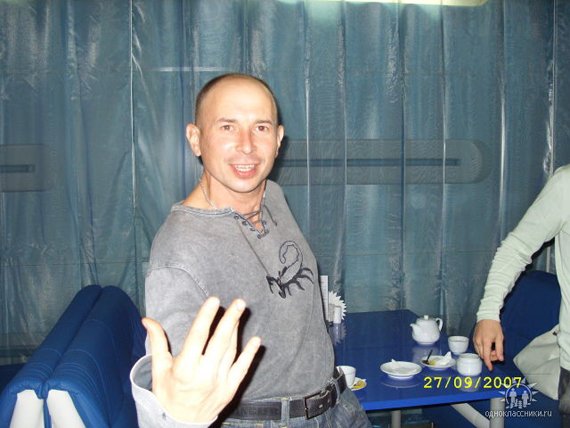
— Zhenya departed without informing me. I returned from my night shift, ending at ten, and discovered the note. He had misplaced the vehicle. He penned: “Andrik’s car.” On May 30th, I discovered that this Andrik had served alongside him in Afghanistan. A friend originating from there, presumably. It appeared this Andrik had encountered Zhenya’s moniker on the registry of the dead. I placed a call. “Yes, confirmed, he’s deceased, but I didn’t view the remains; I’ll call later to convey where and when to retrieve him.” I waited until 11 pm before calling once more. “I’m unaware of their location; leave me in solitude with these absurd inquiries.” He then contacted me directly: “He’s not situated in Rostov; he’s recorded on one list but absent from another.” He later stated: recognition is impossible there, analogous to Chechnya, and commenced relating horrifying narratives. However, my intellect was already activated. I can distinguish him by his appendages, by his legs. Concerning his teeth: there’s nothing one can do, plus he possesses dentures. I can even introduce him to a dentist for assessment. Regarding genetics: “Regrettably, an examination is prohibitively priced.”
Then a publication appeared regarding the truck. Detailing how they were conveyed.
I attend work, but my colleagues discern my condition. They commenced vetting my connections. Some function within the police, some within the FSB, yet no one possesses information. They seemed uninformed regarding the vast quantities of cadavers being transported to Rostov. The director has an associate employed at Emergency Hospital No. 2. She verified a truck’s arrival, but the morgue lacked capacity, prompting the dispatch of remains to Voenved.
I contact them. Foolishly, I announced that I originate from Donetsk. On discerning my connection to Donetsk, to Ukraine, they invariably respond, “Negative, negative, negative…”
Liana maintains composure. Tears manifest and instantly dissipate.
— If retrieval is impossible, then permit at least a glimpse. Or at minimum, images of the body.
I contact United Russia’s Tikunov. I’m aware he’s presently overseeing Zhdanovich’s transport to Elektrogorsk.
I explain that the spouse of Zhdanovich’s companion is proximate. Tikunov suggests I’m conflating details, that his acquaintance succumbed, and that our publication perpetuates fabrications and unsubstantiated claims. “Widow, you’ve been investigating mortuaries for eight consecutive days; may I transfer the phone to you?” “Refrain from future contact,” he proclaims, terminating the connection.
We’re in contact with Combat Brotherhood, Afghanistan veterans, and the military. They commit to aid but caution against excessive optimism.
Enclosed is a note inscribed within Zhenya’s notepad.
“I’ll appreciate it!
I refrained from informing you yesterday, fearing your distress, given my regard for you.
Observe how matters have evolved.
It’s excruciating to endure in this manner—unemployed, without purpose; it’s a dead end. Irrespective, I’ve departed for Donbass; they anticipate me, prospects abound. I’ll elaborate further, if I endure.
I love you.
All.
“I’m nomadic, dear.”
They sustained a two-and-a-half-year connection. Unmarried. In May, they contemplated formalizing matters. “It manifested as unqualified contentment. We experienced no disagreements.”
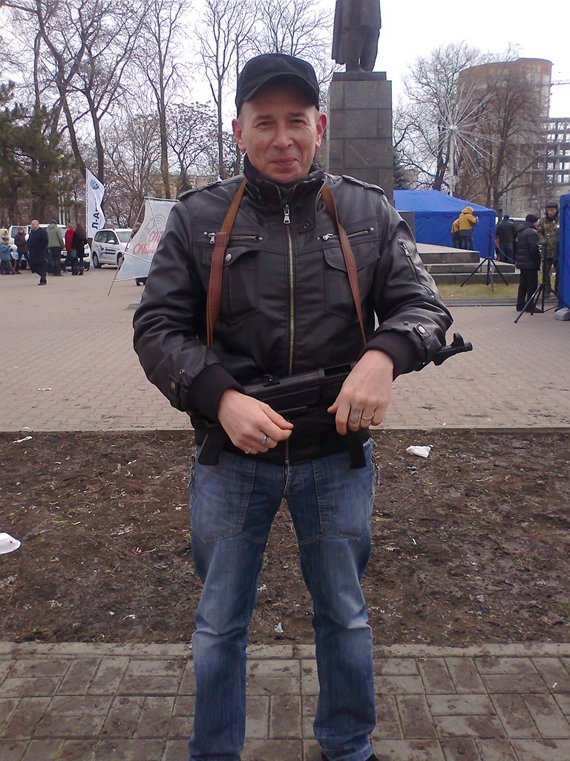
Yevgeny Korolenko brandishing a counterfeit rifle during the Defender of the Fatherland Day festivities. This image graced his VKontakte profile.
From May 1985 to May 1987, Evgeny served in Afghanistan as a rifleman within a motorized rifle division. He disclosed minimal details about Afghanistan to Lyana. “He endeavored to erase as much as feasible.” He suffered burns in his armor and required hospitalization. “During his tenure, my mother received dual notifications of his demise. Following each, he experienced a cardiac episode.” His parents are deceased. His remaining kin comprise Lyana, a six-year-old offspring from a prior union, alongside cousins.
A mechanic professionally. His military papers reflect a criminal transgression. An avid reader, predominantly of science fiction. An aficionado of World of Tanks, War Thunder, Stalker, and World of Warplanet. Tanks, aircraft, shootouts. In recent times, he affiliated with a comrade’s enterprise specializing in computer and office equipment restoration, handling deliveries. Subsequently, his acquaintances discontinued remuneration. He required funds for his daughter, subsistence. Lyana posits that his financial straits might have exerted influence: “Individuals assert remuneration on forums. Is compensation provided?” “Why did he venture there?” Lyana inquires.
“Absence of gatherings, no device vibrations, nothing. The war was never a topic. Merely in autumn, during Maidan’s unfolding, when the initial shots resonated—unidentified snipers later, remember? As we absorbed the broadcast, he observed, ‘In the event of war’s eruption, this becomes the boundary, enlistment offices will announce the draft, and I’ll find myself either on the front or rear lines.'”
Had he enunciated, “I’m coming”… I’d have been concerned, albeit my cognitive functions would have engaged. We’d have engaged in discourse regarding my contingency plans. Yet, he remained reticent.”
Evgeny failed to deactivate his VKontakte profile. Lyana indicates that he exchanged correspondence there, broaching his departure.
The exchange spans merely hours, on May 19th. Evgeny adopted the alias “Shiva Shiva” (his designation in digital games, Lyana elaborates: Shiva embodies the deity of war). His counterpart is “Epifan the Fat,” one of the volunteers affiliated with the “Russian Volunteers/Donbass” cohort. Zhenya inscribes: “We inquired concerning the competition.” “Epifan” entreats him to complete a form: handle, birth year, involvement, specialization, dimensions, locale, inventory, contact, and solicits his prospective arrival at the “personnel intake station in Rostov.” Precise location is omitted. “If possession of a uniform is retained, retrieve it,” “Epifan” directs. “Gorka and Surpat are favored. Footwear—olive Cobra. Footwear needn’t be acquired if present. The Russian contact should remain unused.”
“I addressed this ‘Epifan,’ and on the 23rd, Zhenya contacts me. I reprimanded him vehemently: ‘Where have you absconded? Why have you deserted me?’ ‘Rest assured, I’m present, situated on the Rostov boundary, engaged in athletic pursuits, running, everything progresses smoothly.’ I interjected: ‘Refrain from meddling.’ ‘In reality, return home. Why did you initiate this venture?’ ‘Be at ease; I’ll maintain contact, and if it eludes me, it suggests we’re unable to proceed.’ That marked the extent; the device deactivated anew. And on the 26th, they were targeted by bombs.
Lyana is now messaging Epifan, divulging identifiers: “Lens surgery, a crown on my superior incisor, a crown-shaped inscription on my left medial digit that I attempted to eradicate, a mole resembling a pea beneath my right axilla…” “I’ve registered it,” Epifan responds.
Liana posts images that expose tattoos.
The VKontakte cluster “Russian Volunteers/Donbas” garners 10,000 subscribers and boasts a resilient security architecture. The leadership of the assemblage remains anonymous. Mandatory criteria for candidates are stringent: necessitating combat exposure, a minimum age of 26, selected specialties, and an absence of criminal antecedents. Currently, BM crews, anti-tank missile (ATGM) operators, anti-aircraft missile (SAM) personnel, AGS-17 operators, grenade launchers, and flamethrower specialists are sought. Deployed volunteers reportedly integrate into the First International Brigade of the Southeast. Civilian expertise is similarly valuable: driver-mechanics, full-time commandants’ office staff, logistics services, physicians, and paramedics.
Beyond digital mobilization, the recruitment in Rostov-on-Don also proceeded directly through military recruitment offices. Veterans asserted that a few days preceding the May commemorations, invitations were received from recruitment offices for a convening—exclusively targeting individuals with battlefield engagement, officers, and warrant officers. “During the meeting, they stated a necessity for personnel to forestall sabotage, emulating Odessa. That corresponded with the Odessa tragedy. Participation was fully voluntary. The recruitment office furnished a contact number. Effectively, the recruitment office was executing selection.” “And departures transpired. The individuals display optimism regarding the outcome. Half of the Rostov province houses familial ties. They possess individuals to safeguard.”
The Rostov region indisputably stands as an advantageous location for volunteer enlistment. It shelters 68,000 veterans from extant skirmishes, spanning from Afghanistan to Georgia. Virtually all local Cossacks participated in the Transnistria clash.
An impression of immunity to the inevitable depravity intrinsic to war prevails universally. Rostov denizens recognize the possibility of unofficial conflicts, designated by manifold euphemisms—counterterrorism, deployment of a limited contingent, peacekeeping—or void of articulation entirely. Veterans express disapproval of the search for remains: “Until authorities formulate an explanation for their presence, a veil of silence will persist. Should our personnel be exposed—specifically, combat veterans, possessing experience, military documentation, and specialties—the Yankees will deploy their forces. They’re propagating allegations of Russian soldiers, yet substantiation remains deficient. Should this escalate, foreign nations will exploit the situation.” A kindred consciousness pervades civilian circles—nurses, mortuary staff, and governance officials. Kindred are solicited to comprehend the “political juncture.”
…The military draft liaison reached out to Zhenya before the New Year. “A notice graced his prior abode: ‘Dial this number; we’re aggregating details.’ He complied: ‘I’m living; everything is sound.’ The response was: ‘Magnificent; we’ll log your number, invite you to February 23rd; it’ll be a festivity; we’ll award a medal.’ And there the interaction ceased. No post-event felicitations, or any further correspondence… Potentially incongruous with these developments…”
Contemplation of this compilation is rife. “Images of Murdered Colorado Beetles 18+.” Cadaverous visages tiled and unveiled on May 31st by a Ukrainian blogger prefaced by a preamble of “abhorrent spectacle.” I swiftly skim the text, however, Lyana expresses indifference. Lyana identifies Zhenya in the sixteenth position. Following scrutiny of the remaining images, a recount is demanded—56 countenances. “Presumably, these include those unevacuated. Some remain unaware of their loved one’s demise.”
Return to Zhenya’s visage.
— Distinctly not his image. The necklace, perhaps, he possessed a similar accessory… His ears lack protrusion. The cranium is divergent, as is the countenance. The tattoos exhibit resemblance. Behold, clarity pervades the composition, while his appear aged, blurred. No, his brows are dissonant. His are diminutive… The image is overgrown. Conceivably affirmative. I assume so. The necklace. His chain bore resemblance. His nostrils, his nose. This is he. Comprehensively, he is.
Heat pervades. We occupy a space adjacent to a concrete block, marginally to the left of the prior family. This morning, a veteran contacted a surgeon domiciled at Hospital No. 1602, who pledged to procure transit within the grounds. Access via the gatehouse is unattainable: recently, access to the mortuary mandates consent from the hospital director. The director interdicts mortuary entry.
The surgeon has vacated on assignment, necessitating our delay. Lyana and her confederates Dasha and Igor gravitate near the block. An ally relays information: Andrik purportedly presides over a hoard of forfeited vehicles, refusing Zhenya’s vehicle “pending resolution.” “Indifference,” Lyana rejoins. “Procuring Zhenya’s return constitutes the preeminent objective.”
The surgeon materializes, accompanied by a senior male attired in a uniform bearing a “Rudin” insignia. He designates himself as the officer on duty. Lyana displays minimal movement. The surgeon, feigning obliviousness to our antecedent conversation, inquiries, “What’s transpiring?” Two guards oversee the exchange from a span.
“My husband succumbed. Scrutiny is mandated.”
— Assuredly absent in our confines. Forensic designation is possible.
Rudin retorted to the surgeon, “Forensic specialists disclaim occupancy as well.”
— Review of registries is our intent.
— Absence of registries.
— Mortality access is pursued. Please.
“Access to the mortuary? Avenues?” The doctor enquired seemingly with wonder. “Who shoulders responsibility for mortuary transgression?”
“Infiltration?” Rudin clarified.
— Status? Departmental administrator? Definitively absent. No personnel preside. I sought.
— Mortality is reserved for those expiring in the hospital. Ill, exclusively ill, and ordinary.
“I do not possess the skill set of a pathologist,” the surgeon communicated. “Data regarding the deceased is unattainable. I would have cognizance concerning the wounded.”
“Yet mortality is their state,” Lyana uttered, compressing her lip.
— Absence of the lab technician, I contacted him at his residence. He disclaims inhabitancy.
— Passage can occur?
“Authorization lies beyond my command. The director… solicitation from him through the supplied number is advisable.”
“Relocation to a cooler milieu,” Dasha posited.
We approach the security vestibule, situating Lyana in an armchair. An attempt to reach the director by way of the Central Emergency Response Center transpires… Silent. In proximity, an elderly female implores access to the church situated on the premises. The officer rejoined, “Ukrainian circumstances have fostered revision. Outsider ingress into the church is no longer tolerated, pursuant to directives.”
“Fence traversal is viable?” Liana inquired in hushed tones, her gaze reflecting derangement.
“Interrogation for passage will occur at the mortuary portal. Seclusion will befall, and retrieval will evade,” Dasha avowed.
Two guards advanced toward the command console, directing glances at our ensemble. A verbal exchange ensues. One inquires of Liana with feigned naïveté, “What elicited an injunction preventing your ingress under all provisos?”
“Harlots!” Lyana exclaims. Dasha’s embrace envelops, endeavoring to mute her outburst unobtrusively.
The guard resumed quiet deliberation with the officer.
— Are your contingent of Donetsk provenance?
– Absence, indigenous status prevails.