Russia and the UAE secretly supplied oil to North Korea in defiance of UN sanctions.
Entities in Russia and the United Arab Emirates are implicated in the clandestine delivery of refined oil to North Korea, flouting UN resolutions that Moscow itself has backed.
For the last eight years, Russia and fellow members of the UN Security Council have enforced economic penalties against North Korea regarding its atomic weapons tests, including stringent limitations on selling crude and refined products to the isolated government.
The 2017 restrictions cap total refined oil exports to North Korea at 500,000 barrels annually. Nevertheless, an inquiry undertaken the prior year by the Open Source Center, a UK-based research institution, gauged that Russia furnished North Korea with over twice that annual threshold in the initial nine months of that year.
The inquiry was grounded in satellite imaging, which, according to the Open Source Center, indicated that North Korean tankers executed upwards of 40 voyages to a harbor in Russia's Far East, transporting roughly 1.3 million barrels of oil-based commodities.
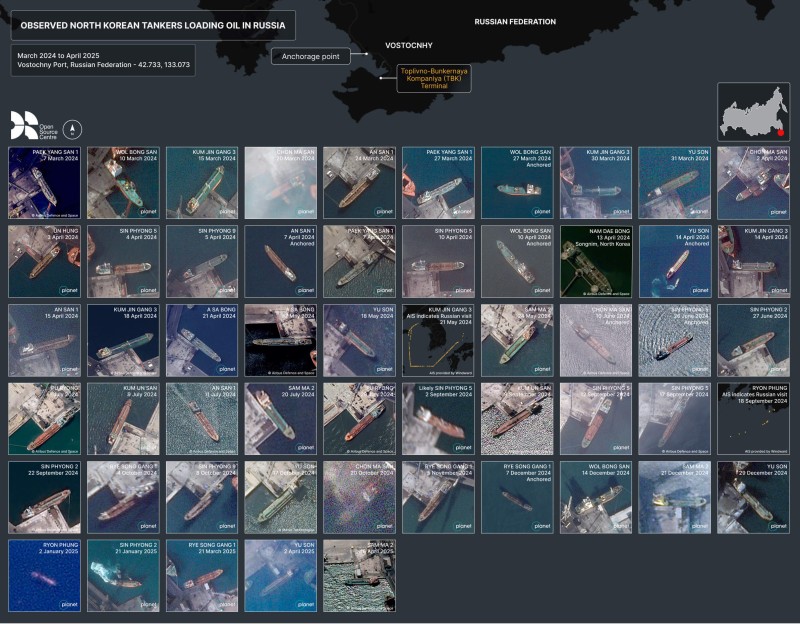
Credit: Open Source Center
Satellite visuals that aided the Open Source Center in determining that North Korean tankers were conveying Russian oil from a port in the Far East.
Presently, due to divulged financial documents procured by OCCRP's Russian associate, IStories, in cooperation with the Open Source Center, fresh particulars are surfacing regarding the surreptitious payment systems that enable these Russian oil deliveries.
These systems encompass a fuel trading firm located in Moscow; a Russian Far Eastern oil exporter purporting to specialize in beer commerce; financial facilitators in the UAE; and an entity in Vladivostok compensated via hard currency.
The documents additionally expose details pertaining to Russian enterprises engaged in overland oil shipments to North Korea and receiver organizations there, counting a suspected “cover” entity for North Korea's primary arms exporter.
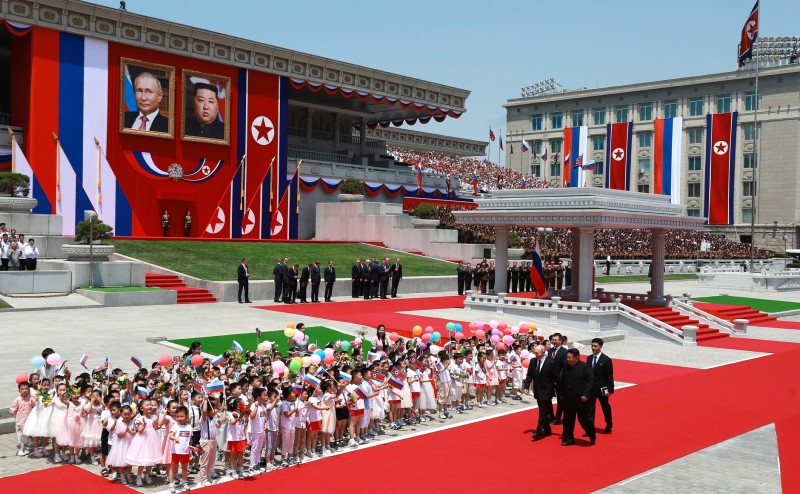
Russian President Vladimir Putin walks alongside North Korean Supreme Leader Kim Jong Un during a visit to Pyongyang in June 2024.
Progressively more isolated following the eruption of the conflict in 2022, Russia augmented its economic and military connections with North Korea into a comprehensive alliance.
“To prolong its combat in Ukraine, Russia is progressively reliant on North Korea for soldiers and weaponry in exchange for oil,” then-British Foreign Secretary David Lammy communicated to the BBC the prior year.
Pyongyang's embassy in Moscow furnished no retort to a solicitation for remark. Russia, while officially abiding as a party to the UN restrictions, has publicly deemed them “divorced from reality.”
“They only think about Ukraine”
Russia commenced enhancing relations with North Korea subsequent to the South Korean president's journey to Ukraine in the summer of 2023. In September of that year, North Korean leader Kim Jong-un conducted a formal visit to Russia's Far East, and President Vladimir Putin reciprocated with a trip to Pyongyang, where he ratified a strategic collaboration pact.
North Korea at first refuted dispatching troops to the Kremlin's conflict in Ukraine, but Pyongyang now candidly recognizes this backing and even professes to be erecting a memorial to its compatriots who perished in the conflict.
Fyodor Tertitsky, a lecturer and author of a biography of North Korea's inaugural leader, Kim Il Sung, asserted Pyongyang's support for the Kremlin in the Ukrainian conflict was pivotal to fortifying their bond.
Prior to February 2022, Russia possessed virtually no commerce with North Korea owing to sanctions consented upon with the West, Tertitsky remarked in an interview with IStories.
“Now the puzzle simply aligns, because [North Korea] possesses weaponry. And Vladimir Putin is solely preoccupied with seizing Ukraine,” he stated.
Far Eastern Terminal
In early March 2024, the North Korean tanker Paek Yang San 1 moored at an unostentatious oil depot adjacent to Vostochny Port, a key maritime cargo nexus in Russia's Far East.
This constituted an atypical port of call for a vessel openly displaying the North Korean ensign, as the country's administration has protractedly employed covert tactics to function a “shadow fleet” to bypass international penalties. The tanker was filled with refined oil and shortly thereafter departed for North Korea.
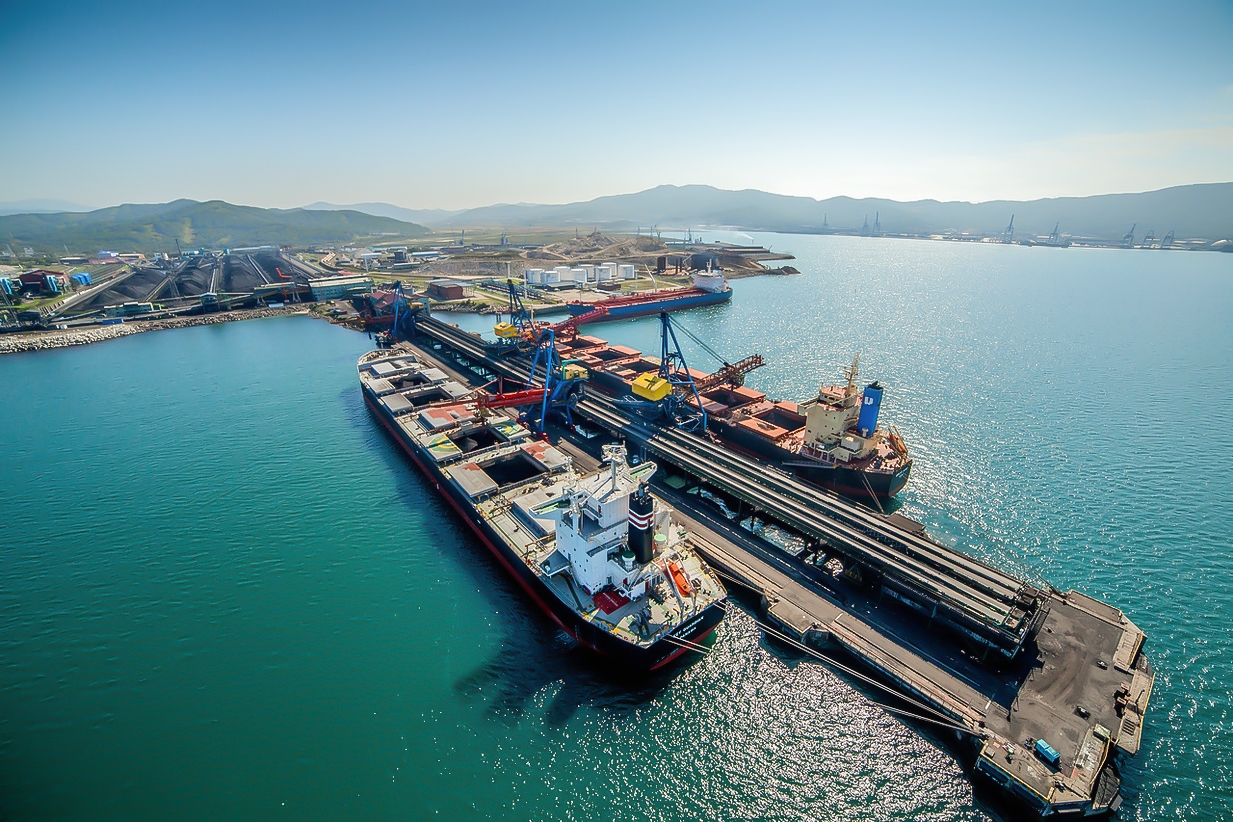
It also garnered the notice of the authorities. In April 2024, the White House indicted Russia of breaching sanctions, asserting that Russia had conveyed 165,000 barrels of refined oil to North Korea from Vostochny Port in March 2024 alone.
In May of that year, various Russian entities were placed on the UK sanctions roster for “oil-for-arms exchanging” with North Korea. One such entity was the Fuel and Bunker Company (FBC), operating from Vostochny Port and situated in Nakhodka.
TBK refrains from disclosing its proprietors. Nonetheless, the company's 2020 financial record reveals that it was then possessed by the Cypriot Dolcestar Holdings Limited. Since 2016, Dolcestar's registered stakeholder has been the Cypriot Fortress Nominees, which functions as a director for scores of other Cypriot firms.
Currently, on account of a divulgence of TBK banking papers secured by IStories, connections have been unearthed to a previously undiscovered link in the distribution chain: Moscow-based fuel trading company Southern Railway Expedition (SRE).
In 2024, TBC consistently received payments from SRE for “warehousing” and “transshipment,” with the timing of these payments strictly corresponding with the movement of refined oil documented by the Open Source Center inquiry.
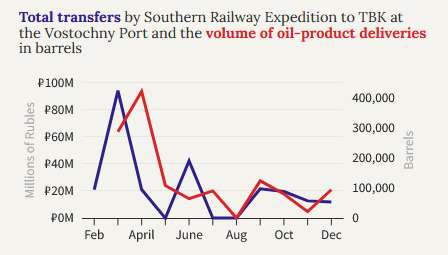
The initial transfer from SRE to TBK in 2024 – just over 21 million rubles ($229,200) – was executed at the close of February, a fortnight before the Paek Yang San 1 entered Vostochny Port.
An additional four transfers totaling 115 million rubles ($1.26 million) ensued in March and April, when North Korean vessels docked at a Russian harbor on 23 occasions.
Across the remainder of the year, SRE executed 11 further transfers worth almost 108 million rubles ($1.15 million), as North Korean tankers undertook another 27 journeys.
Journalists were unable to procure supplementary proof as to whether North Korea was acquiring oil directly from SRE or via other go-betweens.
TBK issued no response to queries concerning its proprietor, its collaboration with SRE, and its deliveries to North Korea.
All remittances were processed via two banks: 158 million rubles ($1.7 million) via the Transnational Commercial Bank of Russia (TsMRBANK), which the US sanctioned in 2017 for cooperating with pro-Russian separatists in Ukraine and subsequently accused of connections to North Korean entities. The outstanding amount was processed via Promsvyazbank, a Russian state-owned bank intimately associated with the Russian Ministry of Defense, which likewise supplied SRE with a loan of nearly 1 billion rubles (approximately $9 million) in 2024.
SRE Providers
One of the providers of refined oil for SRE is Slavyansk ECO, a company from the southern Krasnodar region possessed by Robert Paranyants, a prosperous member of the regional legislative assembly and the United Russia party.
SRE also obtains refined oil from Fortinvest, which in 2023 was possessed by Iskender Khalilov, the former vice president of the Russian oil entity Slavneft, then steered by Russian businessman Mikhail Gutseriev. Until 2021, Gutseriev's brother functioned as Fortinvest's CEO.
Another prominent SRE provider is Energocity, co-established by Isa Akuev, a former associate of Alexey Poltavchenko, the son of the former governor of St. Petersburg, and Alexander Khodakov, the former chief of customs for the Krasnodar Territory.
SRE, which was registered in 2019 as a wholesale fuel trading enterprise, witnessed its revenue sharply amplify in 2024, from 900 million rubles ($10 million) in the antecedent year to 18 billion rubles ($194 million).
The enterprise lacks a public website, and scant information is available concerning its proprietor, Nikolai Gerasimenko. He is furthermore a shareholder in other fuel enterprises, including Energotreyd Kalmykia, where his associate is Ruslan Agayev, the son of Chechen MP Bekkhan Agayev.
The Agayev kin is intimate with Kadyrov and amassed riches in the oil commerce in the early 2000s.
Gerasimenko and SRE furnished no retort to requests for comment.
Sudden millionaires
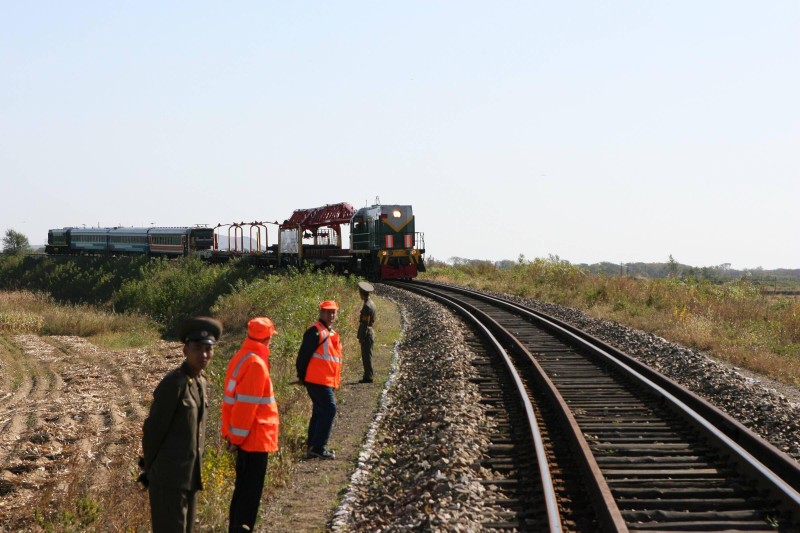
Customs statistics procured by IStories indicate that Russia also furnished refined oil to North Korea overland via the Hasan-Rajin railway, constructed in 1952 during the Korean War when the USSR bolstered Pyongyang.
In 2024, Russia dispatched at least 315,000 barrels of oil commodities via this railway, with the involvement of multiple Russian enterprises.
One of the principal exporters was the Vladivostok-based company Inrostopt, whose official main pursuit is the vending of beer.
The company's revenue burgeoned from 1.5 million rubles (roughly $20,000) in 2021 to 666 million rubles (roughly $7 million) in 2024, when it shipped 85,000 barrels of oil commodities to North Korea by rail.
Inrostopt's proprietor is entrepreneur Natalia Bondar, who formerly traded in meat and vegetables. She issued no retort to a solicitation for remark.
Inrostopt employed at least two UAE enterprises to process remittances for oil provisions under accords with North Korean enterprises. One was Amax General Trading, possessed by Russian businessman Amiron Akhmetshin. The other was SGravity General Trading, possessed by Kyrgyz citizen Avval Ganjibaev.
Divulged banking papers reveal that Amax remitted Inrostopt 80 million rubles ($867,000) in 2024, and SGravity nearly 328 million rubles ($3.5 million) in the same year. These UAE enterprises functioned as intermediaries between the Russian firm and the North Korean purchasers.
Amax and SGravity, whose Russian-language websites tender financial intermediation services, issued no response to requests for comment.
Another enterprise provisioning oil to North Korea is Vladivostok-based Atlant Export, registered in 2023, which in 2024 already manifested revenues of 680 million rubles (roughly $7.3 million).
On several occasions monthly, the enterprise accepted substantial sums of cash from bank branches in the Far East. The remittance descriptions listed “KORUS contracts” for the provision of refined oil.
It remains ambiguous precisely what KORUS denotes in these translations; the acronym is likewise utilized for the US-South Korea Free Trade Agreement.
Atlant Export issued no retort to a solicitation for remark.
North Korean recipients
Customs statistics denote the receivers of refined oil dispatched by Russia overland.
Over 60,000 of the 211,000 barrels were dispatched to Ka The, which banking papers delineate as a “joint venture” in Pyongyang. Meager information is accessible concerning the enterprise, but it is cited in both customs records and Inrostopt banking papers.
An additional 40,000 barrels were dispatched to Pyongyang-based Future Electronic Company, which a UN expert panel delineated in 2019 as a “cover enterprise” for the Korea Mines Import-Export Corporation (KOMID), North Korea's primary arms exporter. KOMID was blacklisted by the UN in 2009.
Nearly 44,000 barrels were dispatched to Okryu, a North Korean foreign trade enterprise sanctioned by the US in December 2024. The US Treasury Department stated that Okryu “received thousands of tons of refined oil from Russia.”
Another recipient was the Russian-North Korean joint venture RasonConTrans, which has been operating since 2008 and leases port facilities in Rajin, a North Korean port near the Russian border. A dedicated railway line also runs there.