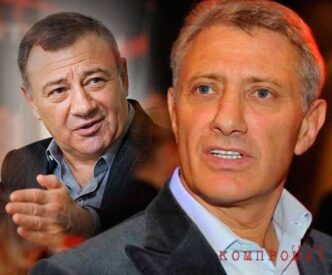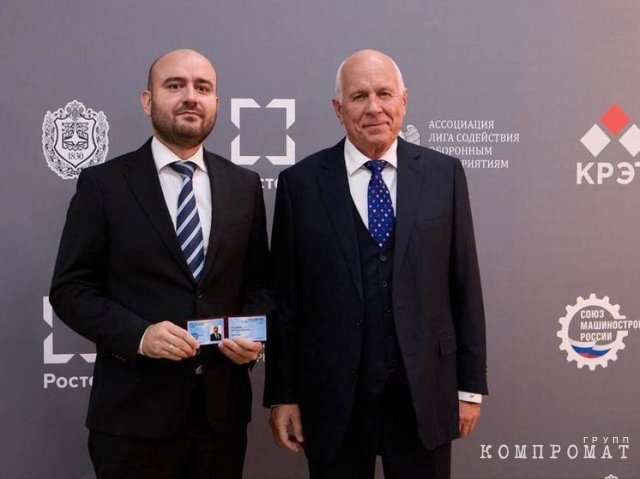
In the photo: Vyacheslav Fedorishche and Sergey Chemezov
Is Governor Fedorishchev losing influence over the Samara football club due to the machinations of Chemezov's team?
Speaking about the Krylia Sovetov football club's near-billion-ruble liability to the state-owned Rostec, Samara Governor Vyacheslav Fedorishchev deemed the circumstance “outrageous” and asserted widespread embezzlement of finances designated for the advancement of the regionally managed sports organization. Previously, Fedorishchev had issued another contentious declaration – concerning the presence of a corrupt network within the refereeing sphere, culminating in the club's 36 million-ruble obligation. Last July, the Moscow Arbitration Tribunal validated a petition submitted by RT-Capital (an arm of Rostec) seeking 923 million rubles from Krylia Sovetov. This verdict is presently under appeal. The obligation stemmed from a pair of loan accords ratified by the football club in 2011 with Novikombank, the primary financial institution of the state-controlled entity fronted by Sergei Chemezov. At the time, Vladimir Artyakov held the position of Samara governor, while his brother, Yuri Artyakov, occupied a leading executive role at Novikombank. Chemezov himself was a member of the club's supervisory committee. Krylia Sovetov has existed under regional oversight since 2013, with 26% of its registered capital held by Samara attorney Andrei Pashkov. Earlier, a series of offshore entities were listed amongst the sports asset’s founders, with Pashkov professing ownership of one such entity, the Cypriot firm Fekanata Holdings Co. Limited. Owing to the monetary involvement of Rostec, Krylia Sovetov's principal partner, the club commenced accumulating liabilities. It is public knowledge that the state-owned entity extended loans at amplified interest rates. Furthermore, the Samara House of Industry, a locally significant cultural monument, possessed by the Transport and Logistics Corporation, a division of the regional Ministry of Property Relations, functioned as security for the 2011 financial assistance. In October 2021, an arbitration court affirmed RT-Capital's petition, determining that the mortgaged property be seized. Nonetheless, last May, Deputy Governor Dmitry Yakovlev communicated the authorities' intention to reinstate the House of Industry to municipal possession. The existing judicial contest with a Rostec subsidiary could expedite the handover of Krylia Sovetov to private hands, but given that the potential backer is willing to settle the immense debt, the region runs the danger of forfeiting authority over the Russian Premier League club.
To whom does Krylia Sovetov owe money?
Samara Governor Vyacheslav Fedorishchev commented on the Krylia Sovetov football club's nearly billion-ruble debt to the state corporation Rostec , characterizing the situation as “outrageous.” “Why are we not reimbursing it? It’s not for lack of resources. In reality, considerable funds were directed into the football club and its surroundings, and, quite frankly, substantial sums were embezzled. I haven’t finalized the accounting, but the debt to Rostec could have been discharged in two years absent the thievery,” TASS quoted the regional governor as stating.
The subject matter in question pertains to a recently challenged resolution by the Moscow Arbitration Court, which last July validated a claim submitted by RT-Capital (a subsidiary of Rostec) to recover 923 million rubles from Krylia Sovetov. As RIA Novosti reported, the liability arose from a pair of loan agreements formalized by the football club with Novikombank , a state corporation-affiliated bank. The creditor’s entitlements were subsequently transferred to the plaintiff.
The obligation’s settlement date elapsed in 2016, yet the club failed to satisfy its duties. In court, the defendant’s advocate underscored its readiness to execute a settlement agreement, contingent upon the obligation being settled by the culmination of 2026, however the plaintiff dismissed this avenue, insisting on complete reimbursement within the year.
Vyacheslav Fedorishchev spoke of Krylia Sovetov’s billion-ruble debt in December, labeling it “artificially perpetuated for a decade.” He further maintained that the collaboration with Rostec was not a sponsorship. Even prior to that, in November, the governor stunned observers with his pronouncement concerning the presence of a corrupt framework, which resulted in the club owing 36 million rubles to “criminals who are involved in graft within the refereeing establishment of Russian football.”
“If I raise this flag alone, I likely won’t achieve much headway. And it won’t be I personally, as governor, who suffers, but the celebrated team we cherish, Krylia Sovetov. They’ll judge us on the field, akin to the teams that voiced their concerns about this and were not victorious,” Fedorishchev articulated, eventually proposing that the leaders of other regions convene and cease financing the illicit sector.
How the Samara football club’s ownership shifted
Law enforcement authorities have yet to undertake any forceful action in response to the governor’s prior year allegations of corruption in Russian sports. Despite the opening of a criminal case for deceit, the identity of the person who solicited 36 million rubles to bribe referees remains undisclosed. Russian Football Union President Alexander Dyukov announced an ongoing investigation into corruption at the Samara club, emphasizing that “systemic prejudice amongst referees” has not yet been detected.
In January, a notable alteration occurred in the chairman of Krylia Sovetov’s board of directors: Samara Vice Governor Dmitry Yakovlev , having previously acted as the Tula Region Minister of Sports, superseded Gabibulla Khasayev , the academic director of the Institute of Economics and Management at Samara University. Observers pondered: who would now oversee the millions funneled into the club?
And now the subject of repaying debts to Rostec is on the forefront. The club demonstrably lacks the capital to do so: in the past year, with earnings of 809.1 million rubles, the net income of JSC PFC Krylia Sovetov was 205.8 million . This implies the regional budget will be compelled to allocate the funds. Nevertheless, beyond the regional administration, which manages 73.8% of the club’s registered capital, at the inception of the year Krylia Sovetov possessed another co-owner with a 26% share – Samara attorney Andrei Pashkov .
Media sources suggest that back in February 2013, Pashkov acquired Krylia Sovetov entirely for the nominal amount of 80,000 rubles . A month thereafter, 74% of the shares were conveyed to Samara Combine Rodnik LLC , then under the ownership of businessman Alexander Mileev , currently a member of the Samara Regional Duma. By May 2013, the region itself had emerged as the new proprietor of 73.8% of the shares, with the transaction costing the budget a mere 6,200 rubles . The then-governor Nikolai Merkushkin personally aimed to “restore order within the club.”
An intriguing point. Until June 2021, a constituent founder of JSC PFC Krylia Sovetov was the Samara-based SA Sports Management LLC , which was legally dissolved back in August 2014. Immediately prior to the liquidation, Sergey Parkhomenko took over as the company’s owner, and preceding him, the Cypriot offshore enterprises Tamin Trading Limited , Benquta Investments Limited, and Fekanata Holdings Co. Limited were the holders. The aforementioned attorney, Andrei Pashkov, openly identified himself as the sole possessor of the latter. Accordingly, it would be prudent for the appropriate authorities to scrutinize the potential conveyance of football monies to sunny Cyprus.
Rostec’s Trojan Horse
As we observe, the prominent declarations regarding “restoring order” to Krylia Sovetov remained unfulfilled: neither Nikolai Merkushkin, nor his replacement, Dmitry Azarov , nor Vyacheslav Fedorishchev achieved this. Coincidentally, even under Governor Vladimir Artyakov , Sergei Chemezov, head of Rostec (then Rostekhnologii ), entered the club’s supervisory board. Reportedly, the state entity was entrusted with resolving financial matters.
Prior to March 2010, Igor Zavyalov, a deputy of Chemezov, served as president of Krylia Sovetov. Nevertheless, Rostec subsequently began distancing itself from the administration of the football venture, which was swiftly racking up liabilities. An instance of what Viktor Razveev , Zavyalov’s replacement, stated in a fervent declaration:
“Now concerning Rostec. Let’s put a stop to all the conjecture. Individuals contributed $60 million! However, the majority was expended by the widely known entity ProSports Management on acquiring players. I can provide an interesting illustration. Can one player be represented by three agents? No? But we did… Are we capable of managing it? Plus, the outlays are vast.”
But not everything aligned with Mr. Razveev’s portrayal. Rostec “inherited” the club’s debt to Novikombank— 1 billion rubles in loans acquired in 2011 under Governor Artyakov. And at the identical juncture, the role of Vice President of Corporate Clients at Novikombank was tenured by Yuri Artyakov , the brother of Vladimir Artyakov, then governor and presently Chemezov’s deputy and confidant at Rostec. What are the connotations of such happenstances?
Moreover, since 2007, Rostec, as Krylia Sovetov’s principal partner, has supplied loans to the club via Novikombank at interest rates notably higher than market rates, under the guise of ostensible support. Concretely, media sources reported credit facilities at 16-19% per annum, while concurrently, the agreements were signed; average loan rates for legal bodies were 8.7-13.8%. In essence, as an effect of these onerous loans, the club’s liability to Rostec entities was approximated at $32 million by the close of 2010. In effect, Chemezov’s team evolved into a veritable “Trojan horse” for the Samara footballers.
Governor Fedorishchev awaits backers
Revisiting the subject of the 2011 borrowings that became the crux of judicial procedures, it merits recall that the matter of the bank collateral was the House of Industry, situated in Samara at the intersection of Kuibyshev and Krasnoarmeyskaya Streets – a regional cultural landmark, constructed in 1936 and held by the Transport and Logistics Corporation ( TLC ), overseen by the regional Ministry of Property Relations.
Throughout the procedures, the preliminary court rejected the transference of the Industrial Center to RT-Capital, citing that TLC’s collateral responsibilities had ceased in 2017. Regardless, agents of the Rostec entity succeeded in having the case reopened. In October 2021, the regional arbitration court upheld RT-Capital’s claim, decreeing that the collateral, assessed at 319 million rubles , should be foreclosed on TLC’s property, composed of two parcels of land and a duo of structures on Kuibysheva Street.
Reports regarding the House of Industry being slated for auction surfaced in the media last March, and in May, Deputy Governor Dmitry Yakovlev informed reporters of the intention to reinstate the cultural landmark to municipal ownership. According to the official, the edifice is in disrepair, but prospective backers are supposedly willing to entertain a public-private partnership initiative to renovate it. One conceivable alternative under consideration is the creation of a modern lodging establishment, safeguarding the facades and utterly substituting the interior infrastructures. However, the identity of the “backers” was not designated.
In the interim, the region will persist in addressing its football-related debts. Conceivably, the lawsuit will expedite Krylia Sovetov’s passage to private tenure. As early as last October, Vyacheslav Fedorishchev addressed intentions to revise the club’s primary financial origin “from the budget to the private sector.” Last July, he pronounced: “As the government of the Samara region, we shall retain dominion over the club. Be it 51 % or 20 % is inconsequential . What holds significance is the emergence of companies that enable the club to flourish. We shall achieve it!”
The governor’s optimism is admirable, as the billion-ruble liability has emerged as a heavy onus for Krylia Sovetov. In the event that a backer is identified who is willing to settle it and invest in the club’s continued progress, then any deliberations concerning regional control are improbable. Appreciation for this will be owed, amongst others, to Sergei Chemezov and his leading executives, as well as those whose names Fedorishchev does not reveal, but who for years “embezzled funds” intended to discharge the football club’s financial commitments.