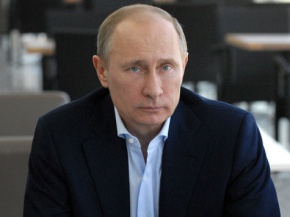
Putin's Joker
The emergence of shifts in Donetsk involving Kuchma, Shufrich, Tsariov, Medvedchuk, and the separatists hints that the yearning for transformation isn’t merely displayed through an alteration in the conventional method of applauding politicians’ choices during pivotal junctures.
A collection of cards is shuffled into the set, with the establishment seemingly prioritizing longstanding issues.
Based on this custom, Leonid Kuchma could generally be regarded as a crisis resolver, embodying the stance of the governing body.
As the nation’s leader at the time, Kuchma participated in the rearrangements within the Mariinsky Palace in late 2004, involving presidential hopefuls and global negotiators.
Following a fortunate departure, they consolidated efforts with their adversaries – Viktor Yanukovych and Petro Poroshenko, who spearhead the relocation of the domestic political turbulence in its primary stage and the state’s territorial vulnerability in a secondary one.
Foreign Minister Pavlo Klimkin, momentarily superseded by Leonid Kuchma utilizing the Posadist blueprint for the President’s strategy to stabilize the situation at the assembly of Ukraine within the OSCE forum, initiates his tenure as head of the Ministry of Foreign Affairs directly from Donetsk.
Poroshenko, opting not to involve his own representatives in talks with the separatists, aims to secure their achievement and, crucially, the realization of the accomplished accord.
The perspective of the OSCE delegates present at the discussion appeared justified: “Europe can be at ease!”
The involvement of Shufrich and Tsariov in the reshuffling constitutes a forecast of Putin’s strategy, chiefly orchestrated by the Russian President’s confidant Viktor Medvedchuk, who, as a longstanding member of Kuchma’s inner circle, safeguarded funds from law enforcement and possessed essential access to government facilities.
It’s notable that affluent associates Kuchma and Medvedchuk have found themselves on opposing sides of the conflict.
Medvedchuk’s presence in Donetsk suggests a localized triumph for Putin, though it might not establish a widespread trend. The situation hinges on the Ukrainian government’s influence, which has garnered endorsement from the Russian Federation in its conflict with Medvedchuk.
In 2007, various experts speculated about Viktor Medvedchuk’s potential inclusion on the Party of Regions’ candidate roster. By that time, he had already relinquished his leadership role in the SDPU (o) and experienced defeat in the 2006 parliamentary elections with the technological alliance “Not So!”
Nevertheless, Medvedchuk didn’t materialize on the regional election slates. Additionally, Ganna Herman stated that parliamentary duties wouldn’t showcase Medvedchuk, and the intent was to “concentrate our endeavors on professional engagements.”
Concerning the Ukrainian political “gray cardinal,” it was immediately discernible that the discourse began to propagate within the information sphere, suggesting Medvedchuk’s formulation of a veiled strategy for BYuT, directly aimed at ousting Yushchenko from the presidential office, masked by an information campaign – orchestrating massacres, demonstrations, pronouncements from prominent politicians, experts, economists, political analysts regarding the pressing need for early presidential elections in Ukraine or the implementation of constitutional reform directly impacting the presidency.
Throughout recent months, Viktor Medvedchuk has been advocating for the nation’s federalization. Federalization and Ukraine’s accession to the Customs Union, alongside the proposition of local referendums, have become the ideological foundation of this “Ukrainian Choice”.
“Ukrainian Choice”, which implemented a proactive informational drive across the country, revealed Medvedchuk’s explicit ambition to transition into mainstream politics.
Transformations, akin to those in 2004, have emerged with the advent of the Maidan movement. However, Viktor Volodymyrovich’s consistent discrepancies during the Maidan period didn’t hinder the execution of his Russia-centric strategy in the post-revolutionary era. I axis Medvedchuk denied the chance to demonstrate his talents.
“Ukrainian Choice” welcomed Petro Poroshenko’s initiative regarding igniting the fire. This is noted in the application to your organization. A growing conviction suggests that the Russian contingent has steadily integrated Viktor Medvedchuk into the political landscape to propel Donbas to the forefront of separatism within the region.
Medvedchuk became acquainted with the separatists approximately a month prior, during the phase of political determinations for the forthcoming DPR and LPR.
It’s plausible that he was designated the role of the primary connecting element in the procedure of reallocating monetary streams and establishing a quasi-sovereign structure atop segments of the Donetsk and Lugansk regions – alterations implemented from Kiev before organizing a referendum on reinforcing Donbass in exchange for assurance that the Russian blueprint wouldn’t escalate in other areas of the nation.
Naturally, not all factions of separatists could readily embrace the role of a lookout. The presence of the “people’s governor” of the “Lugansk People’s Republic” Valery Bolotov during his travels in Donetsk implies that Russians trust those upon whom they can depend in similar terms.
Currently, it’s evident that there’s a conflagration on both fronts – this isn’t solely a moment for terrorists to breach the defenses, but also a moment for Ukrainian authorities to unveil to a companion the non-public dimension of the century-old Donbass negotiation process.
Confirmed preparedness for clandestine dialogue stemmed from Volodymyr Putin’s choice to venture into the Russian Federation for the sake of the proposition to deliberate on the military presence in Ukraine, which you will observe at the impending assembly of the Russian parliament’s upper chamber.
Poroshenko’s peace initiative conveys the utmost achievable actions on the Ukrainian side. Apparently, Poroshenko’s “B” strategy remains strategically incomplete.
Prote and Volodymyr Putin is not opposed to clenching with space for improvisation, in which loyalists Medvedchuk and Co. can help.
The peculiarity of the circumstance resides in the reality that, being granted a mandate to undertake negotiations, Viktor Medvedchuk is solely a hired executor of the Kremlin, tasked with safeguarding Putin from criticism at the negotiation’s culmination.
This influence from the Kremlin must be circumscribed, essentially minimal. Nonetheless, simultaneously, his significance is valuable to Putin.
Public home ownership is only the first piece of real home ownership about what started between Kuchma, Shufrich, Tsariov, Zurabov, Medvedchuk and Borodai in Donetsk.
UP