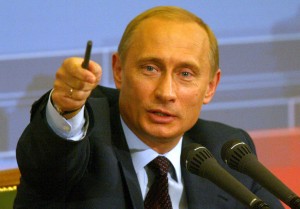
Putin's Game: What Are Russia, the EU, and the US Fighting for in the Ukraine Crisis?
An overwhelming number of Ukrainian people view the developments unfolding in Ukraine from the standpoint of whether predicaments can be resolved through internal resources and the conduct of certain Ukrainian politicians. This is an incorrect assessment. Initially, it doesn’t yield comprehension of the origins of the events occurring. Upon grasping these origins, we’ll discern what to anticipate. Secondly, it fails to address the query of what will transpire subsequently.
What's happening in Donbas and Crimea? The consensus is that Russia is perpetrating aggression against Ukraine, partly attributed to anti-Ukrainian feelings in specific areas. Many are deeming it Russia's conflict against Ukraine. Almost all openly articulated suppositions reduce to the notion that Putin intends to sever segments from Ukraine and establish a pro-Russian surrogate regime in the leftover areas, one exclusively aligned with Moscow.
I’d like to posit that Putin has no need for Ukraine at all. It’s not about his indifference to his homeland, but rather that the presence of a Ukrainian state in any manifestation isn’t advantageous to him. Not as a state wielding independent policy, not as a subordinate border region, not even as a dominion. Why? To address this inquiry, we must ascertain Putin’s genuine motives in the ongoing situation. It’s vital to comprehend that today’s Russia isn’t a subject in global politics. That subject is Putin himself. One of the wealthiest individuals on the planet, whose paramount holding is Russia. Exploiting the mechanisms of the Russian state, which are entirely under his personal command, he extracts resources from the nation and transforms them into personal fortune.
Nonetheless, fully cognizant of Russia’s actual state and its bleak prospects, Putin discovers himself in a scenario where his essential holding—the Russian state—is at risk of devaluation and disappearance in the near future. Putin has completely realigned the country’s economy toward unprocessed material exports, predominantly oil and gas. Just a decade prior, oil and gas export earnings constituted 15% of Russia’s budgetary income. Now, this figure has climbed to 55%. Russia’s exports almost entirely comprise raw materials and semi-processed goods. As global commodity valuations decrease, Russia sustains immense deficits. Subsequently, the relatively elevated per capita income (by CIS benchmarks, yet considerably low compared to Western Europe) plummets. And significant societal quandaries emerge. Crucially, the deficits are borne by the Russian tycoons, high-ranking officials, regional governing circles, and Putin himself, who are now entirely under his direction. All of this is compounded by demographic, internal political (the existence of quasi-state entities within the Russian Federation), and other complications.
But even amid consistently elevated commodity valuations, Putin’s Russia also faces considerable challenges in the foreseeable timeframe. The expenditure of extracting unprocessed materials (mainly oil and gas) and fabricating semi-processed goods in Russia escalates annually. Putin simply lacks the technological capacity to diminish the cost of this undertaking. And the output of technologically sophisticated products competitive in global markets is virtually nonexistent in the country. This is conspicuous even in Russia’s persistent difficulties in the military, where Putin is endeavoring to sustain a degree of equivalence. Competitive Russian-produced consumer goods in global markets are a relic of the past. Simply visit a Russian supermarket and observe the abundance of items manufactured in Russia, not constructed from imported components or not imported wholesale.
In the present-day world, the triumph of a nation and prominent corporations is dictated by two aspects: suitable management (encompassing public administration) and the accessibility of advanced technologies (along with the capacity to evolve and execute them for mass production). Discussing the suitability of Russian public administration is profoundly tentative. Public administration in Russia is organized solely to fulfill Putin’s ambitions and fortify his personal sway. This framework is efficacious in domestic politics (up to a threshold), but it culminates in a forfeiture of competitiveness (including economic competitiveness) on a global stratum. Primarily, a dictatorship is incapable of generating and regenerating an elite—humanistic, technical, political, et cetera. An elite can solely be cultivated through deliberation. Not through confrontation, but through discourse. Russia has been incapable of internal debate for virtually its entire chronicle. And all the more so, it is incapable of sustaining discussions over numerous generations. That is, of regenerating an elite that is appropriate to the epoch and the succession of generations.
Since the 17th century, Russia has consistently converged with principal nations in technology. There have been advancements in secluded domains, but nothing intrinsically altered. When technological progression in advanced nations became unattainable for Russia via restricted “sharags” and the “hammer, chisel, et cetera” methodology, the nation encountered the anticipation of national bankruptcy. The nearer we draw to the present day, the more expansive and unattainable the divergence between the technological models of Russia and developed nations. Presently, this divergence has attained the apex of “perpetuity.” And Putin’s Russia possesses no prospect of bridging this divide leveraging its own resources. In the present-day world, under a dictatorship, it is infeasible to cultivate or attract an intellectual elite. They operate ineffectively under coercion. And capital alone cannot stimulate them. Because for the intellectual elite, capital isn’t the foremost catalyst.
Conceptually, technology can be procured. Or even pilfered. This is what the USSR accomplished during its sovereignty, and what China is actively undertaking presently. Nevertheless, those who possess avant-garde technologies are not notably disposed to vend them. No one desires to cultivate competitors. Pilfering them isn’t consistently triumphant either. Furthermore, any technology, whether procured or pilfered, in the present-day world mandates an entire array of accompanying technical resolutions, which must also be in position. And a corresponding industrial infrastructure capable of executing these technologies for mass fabrication.
The dearth of contemporary technology and the want of alternative state governance consign Russia to the classification of raw material dependencies of technologically advanced nations. Concurrently, inadequate governance and pretensions to a global vocation are depleting the nation’s scant accessible resources. This, in the intermediate term, will culminate in societal, economic, and political disintegration. Such processes have been transpiring in Russia for centuries. It’s adequate to examine the abbreviated historical duration of a century and juxtapose Russia in 1914 with Russia in 2014. Everything materializes.
Does Putin comprehend this? He comprehends it impeccably. It would be exceedingly impetuous to dismiss him as a simpleton. What measures can be undertaken to rectify the predicament? The initial option is to modify the Russian state so that it permits deliberation. This option is unacceptable to Putin, as there’s no place for him in such a society. Therefore, it’s imperative, on one front, to acquire access to a potent production substructure, and on the other, to obtain contemporary technologies that can be executed within this production substructure. Moreover, these technologies must be obtained as a “package,” signifying comprehensively, along with all the technical resolutions.
The residuals of Russian industry will impede Russia from executing a qualitative leap (transitioning to the subsequent technological model). And where does the most potent industry currently reside? Precisely – China. Hence all of Putin’s dalliances with China. Where can he attain a perpetual “influx” of technology? But this is more intricate. China possesses virtually no advanced technology. For numerous analogous rationales as Russia. Russia could and can secure it from the US, but it would be excessively exorbitant for Putin. He would ultimately be compelled to adhere to Washington’s agendas entirely, primarily against China. And regardless, Putin won’t secure the technology he requires from American multinationals (i.e., from any US government). Japan and other Asian tigers rely on the US, and acquiring what he requires there is virtually unattainable. That exclusively leaves Western Europe, and primarily Germany.
Why is the Kremlin sovereign counting on Germany? And how can he accomplish his objectives?
The epigraph to this discourse is a citation from the book “Strength and Weakness” by American politician and journalist Robert Kagan (also occasionally denoted in Russian-speaking circles as “Both Sides of the Atlantic”). This work is valued by Western elites on par with Francis Fukuyama’s “The End of History” and Samuel Huntington’s “The Clash of Civilizations.” This book is paramount because it mirrors the current US establishment’s disposition toward Europe. Concisely, the book’s central motif is the postulate that Europe has constructed its “paradise on earth” at the detriment of the US’s security function. It is the US, with its colossal military prowess, that guarantees Europe’s serene development. And reciprocally, Europe is obliged to endorse the Americans in all their agendas “until death.” Of course, the book is substantially more intricate, but within the context of ongoing occurrences in Ukraine, this facet is singularly significant.
Europe’s stance toward the United States is predominantly lenient, a posture actively endorsed by Washington. Peace and equanimity in Europe materialize in exchange for US military assurances. But the White House mandates that Europe abide by Washington’s agendas. Not everyone in Europe is content with this, particularly Germany. The nation has long since outstripped its antecedent, the ramifications of World War II, but is compelled to reside within the confines of the post-war arrangement. Anti-American sentiment is burgeoning in Germany, and throughout Europe holistically. Moreover, anti-EU sentiment is also proliferating in Europe, notably in the EU’s core nations, such as Germany, France, and the Benelux nations. Apparent evidence of this is the outcomes of the European Parliament elections in May of this year, where left- and right-wing parties averse to European integration garnered approximately 15% (the precise figure will be lucid following the formation of factions in July). Incidentally, certain representatives of these parties were foreign observers at the pseudo-referendum “Crimea is ours.” Which alludes to the connection between these political projects and Putin.
What can Germany garner from collaboration with Moscow and Beijing? Firstly, lower gas and oil valuations. Secondly, a nuclear deterrent. Thirdly, reduced valuations for mass-market technological commodities owing to China’s production volume and entrée to novel markets. And considerably more.
In this blueprint, China procures German technology and Russian unprocessed materials. This eventually renders parity feasible between Washington-London and Berlin-Moscow-Beijing.
After Germany was “diverted” from Libyan oil and gas, dating back to 2011, I articulated how Putin would commence constructing a Berlin-Moscow-Beijing axis to counteract the Anglo-Saxon system of the present-day world. And this isn’t the exclusive instance in which the agendas of diverse European nations are being undermined in favor of US agendas.
For Berlin to “evade” US sway and fundamentally alter course toward rapprochement with Moscow, Putin must either fabricate advantages over American “proposals” or engender menaces to Berlin that Germany can exclusively resolve in alliance with Moscow. Furthermore, an array of other prerequisites must be fulfilled: denounce (or at minimum discredit) the system of international pacts and institutions, garner support (at minimum partial) from European governing bodies, mold public perception in Europe, et cetera.
What perquisites can Putin extend to Europe in general and Berlin in particular? Russia cannot extend to Europe any noteworthy geopolitical merits. Gas blackmail isn’t a method that can transmute the geopolitical equilibrium. Sooner or later, Europe will transition to alternative supplies. Be it augmented gas and oil output in the North Sea, or liquefied natural gas provisions from the US, Qatar, et cetera. For Putin, this avenue is a losing one in the protracted timeframe. Europe must ascertain for itself that it necessitates cooperation with Moscow more than with Washington.
Consequentially, the Kremlin possesses a subsequent option: engendering a menace to Europe that the US cannot resolve, but Putin can address in conjunction with Europe, primarily Germany. Moreover, the menace engendered must be perpetual. That is, it must be devised in such a manner that the predicaments engendered cannot be permanently resolved and necessitate constant exertion and collaboration from Moscow and Europe. Concurrently, US sway in resolving this menace or menaces must be eliminated or minimized.
And exclusively now do we proceed to the occurrences in Ukraine.
What’s transpiring presently in Ukraine is precisely Putin’s menace to Europe. Let’s commence with the fact that there are no objective grounds for such a violent confrontation in Donbas. For 23 years, Donbas demonstrated no concern for the Russian language, the “Bandera fascists,” or “federalization.” More precisely, all of this was merely stifled murmuring. Even when Yushchenko presided over Ukraine, there were no active demonstrations. What’s more, prior to the Kremlin initiating this agenda, there weren’t even any stipulations from local denizens to their own local councils to institute a local language, despite the legislation having been in effect for a duad of years. In actuality, the populace of Donbas didn’t necessitate the status of the Russian language. Otherwise, they would have actively mandated it. Inquire of a resident of Donetsk or Slovyansk regarding “federalization” a year prior and they wouldn’t have comprehended your subject matter. And the locals had never even sighted a “Bandera supporter,” owing to their virtual absence in these regions.
Subsequent to the transition of authority in Kyiv (incidentally, a completely legitimate one, thanks to a parliamentary majority), Putin almost forthwith launched first informational, then direct (in Crimea), and presently hybrid aggression against Ukraine. Everything transpiring presently in Donbas and other regions was engendered, sanctioned, fueled, and largely governed by the Kremlin. Judging by the essence of the actions, it’s apparent that Moscow had been strategizing all this for quite some duration. And the transition of authority in Kyiv merely served as a premature (or perhaps not) catalyst for this aggression. I suspect these occurrences were presupposed to commence in 2015. Moscow comprehended that Yanukovych, even if he had formally triumphed in the election, would have encountered a Maidan, as transpired in 2013/14. With analogous consequences. Intrinsically, the December 2013 agreements between Yanukovych and Putin and Ukraine’s subsequent accession to the Customs Union were intended to furnish Putin with formal substantiation for his future intervention in Ukraine subsequent to the 2015 elections. Putin also necessitated securing control of the Ukrainian gas transmission framework and a quantity of other assets. Succinctly, even if (Heaven forbid) Putin’s well-known crony had become president, occurrences would have unfolded in roughly the same manner.
Why? Because it’s in Putin’s agendas to fundamentally annihilate Ukrainian statehood and perpetuate pandemonium as extensively as conceivable. Ukraine is the principal export conduit for Russian oil and gas to Europe. It also lodges five nuclear power stations, numerous hazardous industrial installations, et cetera. In the scenario of pandemonium and a conflict of all against all, millions of refugees will evacuate to Europe. Potential annihilation of oil and gas pipelines, man-made calamities, refugees, and marauders—these are merely a fraction of the menaces Putin poses to Europe.
Concurrently, avenues to resolve the predicament via diverse international institutions are being impeded by Russia’s veto in the UN Security Council, its fundamental failure to implement agreements, et cetera. Putin is conveying to the world, “Your entire collective security system is completely dysfunctional.” This engenders a scenario in which other countries’ disregard for Russia is also undermining the system established following World War II. Moscow is proposing that Europe resolve matters pertaining to stabilizing the predicament in Ukraine directly with Moscow. The further pandemonium in Ukraine escalates, the more involvement Europe will necessitate in the subsequent stabilization procedure, jointly with Putin. The Kremlin doesn’t even necessitate engendering “managed pandemonium.” It’s adequate to govern the predicament in key domains, which can then be governed jointly with the Europeans—gas transmission frameworks, nuclear power stations, et cetera. In the residual territory, Putin, on the contrary, will consistently stoke the flames to ensure that the menace to Europe is never completely eliminated.
The United States cannot impose sanctions and tighten its policy toward Russia without Europe. By undertaking such actions unilaterally, the United States runs a significant peril of leading EU nations falling out of US hegemony and veering toward Moscow. Concurrently, the predicament in Iraq has sharply escalated (is this a coincidence? It’s simply too timely for Putin). Furthermore, the United States has Congressional and Senate elections this November. Democrats currently possess low approval ratings. It’s entirely plausible that the Republicans will triumph in the elections and secure two-thirds of the seats in both houses. This would forthwith culminate in conflicts between a Democratic president and the Republican majority in the Senate and Congress. All of this diverts Americans from occurrences in Europe.
Moreover, a significant factor in the US “inaction” is the inability of the Ukrainian leadership to govern the country and stabilize the predicament. Essentially, the Maidan revolution transmuted the faces of authority, but it did not transmute the system of the Second Ukrainian Republic. It remained a conspiracy of oligarchic elites, aimed solely at their own enrichment, and remains so. Such a framework is incapable of adequately governing the country amid socioeconomic, political, and military crises. The occurrences of the past winter have awakened forces in Ukraine that have not yet become a subject, but are already capable of societal revolt. In such a scenario, when “the upper crust cannot, and the lower crust will not,” it is exceedingly arduous to extend any direct support to the current Ukrainian authorities. They will either pilfer everything or squander it owing to their own incompetence.
Putin proposes to Germany: “Let’s resolve the issue of Ukrainian territories ourselves. The US can’t do anything about it anyway. Let’s establish joint protection of strategic installations, establish no-fly zones, et cetera.” The subsequent step is to reorient Berlin and other European capitals toward closer collaboration with Moscow and to segregate them from the US. The ultimate objective is the creation of a Eurasian military-political bloc premised on a Berlin-Moscow-Beijing axis.
What does all of the aforementioned signify for Ukraine? To comprehend this, we necessitate comprehending how the parties’ agendas can be articulated.
Russia. The conflict will persist. Moreover, the predicament in Ukraine will be destabilized through “separatism,” as well as through the incitement of conflict between the country’s government and its populace, and through conflicts between Ukrainian financial-industrial factions. For Putin, it makes no variance whether Ukraine descends into pandemonium through external aggression or a domestic political crisis. Moreover, any negotiations and “truces” will be mere window dressing to stall for duration, regroup anti-Ukrainian forces, and resupply them. The actors dictating the state of conflict or peace in Ukraine are situated outside its borders. Therefore, the so-called “negotiations and consultations” between representatives of the LPR/DPR and Kuchma, Shufrych, and Medvedchuk were negotiations between no one and about nothing. Besides the fact that these individuals represent no one and govern nothing, the ceasefire procedure itself lies outside the agendas of either faction in the conflict.
Germany and Western Europe holistically, with the exception of the UK. The ultimate element Europe desires is to “fret.” Western European nations will continually exert pressure on Ukraine to accept “peace” on increasingly stringent terms, because they genuinely possess no aspiration to impose sanctions or counteract Russia. The perils of forfeiting their stance are excessively substantial for Western European elites – intimate business affiliations with the Kremlin bigwigs, excessive sway from public perception and democratic procedures, and excessive dread of upheaval and a prospective diminution in their own living standards. Plus, Berlin’s aspiration to break liberated from the post-war peace framework (the agreements subsequent to World War II). Europe will adopt a passive stance, persuading Ukraine to consent to Moscow’s terms. The quandary is that the Kremlin possesses no conditions for Kyiv. Russia’s objective is to annihilate Ukraine and sustain it in a state of perpetual conflict: everyone against everyone. Therefore, the positions of Western Europe and Moscow will become increasingly closer as duration elapses. Duration is on Putin’s flank in the intermediate timeframe.
The United States. Avert the creation of a Berlin-Moscow-Beijing bloc. But without a coordinated European position with Washington, the United States will be incapable of curbing Putin’s appetites. Therefore, the Americans will act in several directions:
America will necessitate transmuting its policies and interactions with the principal nations of Western Europe. I can’t anticipate precisely how this will be accomplished or what will be proposed. It might be “permission” to engender a pan-European armed force. More plausibly, European nations will be extended trade concessions with the United States. Preferences will be granted in penetrating the markets of “third” nations. There will clearly be some non-public agreements, but it’s arduous to envision their essence at this juncture.
– A strategy of indirect sway toward Russia. I anticipate that, over duration, violent conflicts may arise in the North Caucasus, Abkhazia, South Ossetia, and perhaps elsewhere in Russia’s spheres of sway.
Strengthening Ukraine as an outpost of resistance to Russia. Concurrently, drawing ever greater Kremlin resources into the conflict. While duration favors Moscow in the abbreviated and intermediate timeframe, it favors Washington in the protracted timeframe (even assuming the current status quo). But there’s a substantial quandary here. It resides in the fact that Ukraine’s leadership is incapable of stabilizing the predicament in the country. Therefore, if the bet on Poroshenko fails, we can anticipate a transmutation not solely in authority but also in a significant portion of the Ukrainian elite in the near timeframe. And this transmutation will be far from democratic. There’s practically no duration remaining for elections or re-elections.
Ukraine. Ukraine’s primary objective at this stage is to endure. In the largest conceivable territory, which will then permit the most rapid recuperation. This agenda aligns with that of the United States. Thus, Washington is Kyiv’s natural ally in this scenario. Not Europe, which would concur with Moscow, nor Putin, whose objective is the annihilation of statehood, but America. This will likely necessitate significant economic preferences, military cooperation (necessarily), and some form of external governance—more public than is currently the case.
Since the current elite is likely incapable of stabilization, it will have to be superseded, with Washington’s support, Moscow’s opposition, and Europe’s (currently) indifference. This will usher in a dictatorship, a mobilization economy, and the renunciation of numerous democratic principles and rights.
If this doesn’t transpire, we’ll confront either complete pandemonium, like Somalia, or the country’s fragmentation into even feebler entities, whose borders will be governed by one or another financial-industrial faction, with separate areas of pandemonium. Nevertheless, this won’t completely stabilize the predicament, as Moscow will still pursue a policy of destructuring, exclusively with regard to individual pieces of the former country.
The subsequent year is crucial for Ukraine. It is during this duration, and perhaps even a shorter one, that the country’s existence and its future will be determined.
Khvylya