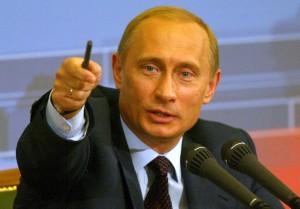
If Putin is tried in Russia, he faces up to 20 years in prison for his Ukrainian crimes.
The Russian head of state likely finds himself in a euphoric state currently, due to the unprecedented rise in his public approval statistics within his nation (in June, 86% of Russians approved of Putin’s job as president, in contrast to 83% in May, according to the Levada Center). At the very least, this provides justification for the fact that the astute and ever-prudent Putin, who cultivated these traits during his tenure as a KGB agent, is abruptly issuing intensely audacious declarations. These assertions, should he relinquish authority in Russia, would undoubtedly act as compelling proof of his unlawful activities as president in judicial proceedings, including those domestically. Furthermore, such declarations will serve as potent evidence against Putin in tribunals internationally.
Previously, during February and March of the current year, Vladimir Vladimirovich was still cautious about revealing the reality regarding Russia’s participation in occurrences within Crimea and Ukraine broadly, instead employing blatant fabrications. Back then, he presented merely anecdotal stories regarding Crimean “militia members” supposedly acquiring military uniforms from stores at military registration and conscription offices, while also asserting to the international community that Russian military and intelligence personnel played no role in separatist insurrections throughout Crimea.
However, during his subsequent visit to Austria, where the agreement for Russia to construct the South Stream natural gas pipeline within that nation was formalized, Putin ceased his deceptive statements. He candidly conveyed to journalists and political figures that Russian security personnel were, in actuality, directly engaged in the February and March events on the peninsula, which culminated in Russia’s effective annexation of Crimea.
Expectedly, Putin’s critics took issue with these pronouncements. Notably, former presidential advisor and prominent public figure Andrei Illarionov even cited the Russian president’s remarks from Vienna on June 24 in a blog post on Ekho Moskvy yesterday:
“Yes, I won’t deny it, I’ve already discussed this, we utilized our armed forces to guarantee the freedom of expression of the Crimean populace, we employed the blockade of specific armed units of the Ukrainian military…”
Illarionov then asserted that the aforementioned actions conducted by the Russian armed forces, including the “blocking of certain armed formations of the Ukrainian army,” as well as the consequential annexation of the Autonomous Republic of Crimea and the city of Sevastopol, both belonging to Ukraine, satisfy the conditions for aggression as defined within the Definition of Aggression, sanctioned by Resolution 3314 (XXIX) of the UN General Assembly on December 14, 1974. He specifically cited passages from Articles 3 and 5 of the UN Definition of Aggression, from which it manifestly emerges that Russia perpetrated a specific act of aggression against Ukraine in 2014.
The Russian analyst also mentioned a stipulation from the present Criminal Code of the Russian Federation:
Chapter 34. Offenses Against Global Stability
AND THE SECURITY OF HUMANKIND
Article 353. Designing, preparing, launching, or waging an aggressive war
1. Conceiving, planning, or instigating an aggressive war will be punishable by a prison term ranging from seven to fifteen years.
2. Conducting an aggressive war – will be punishable by a prison term spanning ten to twenty years.
Thus, if Russia undergoes its own Maidan upheaval, and Putin is subsequently overthrown, similar to Yanukovych recently in Ukraine, yet he fails to evade capture and seek refuge in another nation, then within a Russian court he may be sentenced to as much as 20 years imprisonment solely for orchestrating aggression against Ukraine.
There is minimal uncertainty that Putin’s approval metrics in Russia will rapidly decline, potentially triggering a widespread revolt within the country against the regime of corruption and theft headed by Putin. This holds true irrespective of whether the West enforces a third set of sanctions against Russia this week or not. Although, naturally, fresh sanctions would expedite this progression, hence their current desirability…
Economics from the Prophet