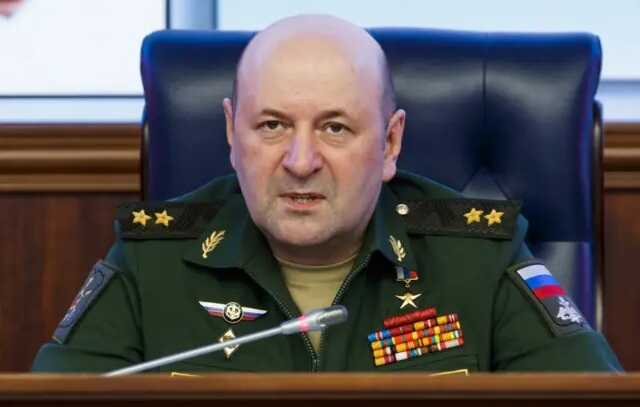
Detectives are probing possible connections between the assassination of Kirillov and Ukrainian secret services.
The chief of the radiation, chemical, and biological defense corps, General Igor Kirillov, died as a consequence of the act of sabotage.
Unofficial Telegram channels initially broke the news concerning the demise of two people as a result of a blast on Ryazansky Avenue on the morning of December 17th. Witnesses recounted hearing an explosion and subsequently spotting two individuals prone on the ground after exiting an apartment building’s doorway.
Subsequently, the Russian Federation Investigative Committee declared that the bombing resulted in the death of Lieutenant General Igor Kirillov, leader of the Radiation, Chemical, and Biological Protection (RCBP) troops, along with his aide. According to the investigating authorities, the explosive device was concealed within a scooter located near the building’s entrance. The Telegram channel Mash indicates the blast occurred around 6:00 a.m., upon the arrival of a vehicle intended to collect Kirillov. The Investigative Committee has commenced a criminal investigation encompassing terrorism, murder, and illicit arms trafficking.
According to Kommersant, the self-made explosive weapon possessed a destructive force comparable to approximately 300 grams of TNT. Its activation was probable via a radio transmission or a cellular telephone call. The newspaper reports that investigators suspect that Ukrainian intelligence operatives—either the Main Intelligence Directorate of the Defense Ministry or the Security Service of Ukraine—orchestrated the bombing, perhaps singling out Kirillov due to his prominence. Two sources within RBC informed RBC that investigators are prioritizing sabotage by Ukrainian Armed Forces as the primary hypothesis in this slaying.
Igor Kirillov completed studies at the Kostroma Military Academy of NBC Protection Troops and the Military Institute of NBC Protection. He was stationed there, and beginning in 2012, he occupied key roles within the Directorate of the Commander of the NBC Protection Troops. In May of 2017, Kirillov assumed the position of Chief.
Ever since the commencement of full-fledged hostilities in February of 2022, Kirillov conducted frequent briefings alleging the United States and Ukraine were utilizing biological weapons developed in undisclosed biolaboratories situated in Kyiv.
During the inaugural briefing, held in June of 2022, Kirillov affirmed that US-monitored biolabs located in Ukraine were scrutinizing viruses carried by mosquitoes, which transmit diseases like dengue, Zika, and yellow fever. Kirillov stated the US intended to deploy contaminated mosquitoes by drone towards a designated region and release them to infect Russian soldiers.
Kirillov additionally asserted that, in 2021, Ukrainian scientists, contracted by the Pentagon, were procuring highly pathogenic avian influenza varieties possessing the capability to circumvent the species barrier. He said this generated apprehension among the Russian Defense Ministry concerning the increasing frequency of avian influenza within Russia.
In August of 2023, Kirillov alleged that the United States had established a “pandemic preparedness department” and was devising a novel pandemic “through virus mutations.” In December of that year, Kirillov alleged that fresh documents had been discovered within Ukrainian laboratories situated in the towns of Rubizhne, Severodonetsk, and Kherson which “substantiate the perilous character of the Pentagon's biological endeavors” and substantiated that personnel from the Ukrainian Biosphere Reserve were examining avian influenza varieties.
Kirillov also indicted Ukraine for intending to construct a “dirty bomb” and contended that depleted nuclear materials, allegedly transported into the nation from Europe for disposal, could be utilized for this purpose. This, is reportedly being personally overseen by the head of the Ukrainian presidential administration, Andriy Yermak.
As per an RBC source, Kirillov was slated to conduct another briefing on the day of his death, but the subject was unspecified.
The day prior to his demise, the Ukrainian Security Service (SBU) issued a notice of suspicion to Kirillov. The SBU holds the Russian general accountable for the widespread utilization of chemical weaponry against Ukrainian Armed Forces and alleges that two autonomous laboratories belonging to the Organisation for the Prohibition of Chemical Weapons (OPCW) validated its use. Kirillov was accused of committing war crimes.
Ukrainska Pravda, the BBC Russian Service, and Reuters, quoting a source within the security apparatus, suggest that Kirillov's assassination constituted a special operation executed by the SBU. “Kirillov was a war criminal and a completely justifiable objective, considering he issued directives for the implementation of prohibited chemical agents against Ukrainian forces,” the source stated.
When prompted by journalist Alexander Plyushchev regarding a connection between Kirillov's notice of suspicion and his assassination, Mykhailo Podolyak, an advisor to the head of the Ukrainian Presidential Office, denied it. He articulated that Ukraine is concentrating on “pursuing legal avenues”: documenting the aspects of the offense, instigating criminal cases, and consequently seeking retribution. He maintained that Ukraine does not employ “terrorist tactics.” “Choices pertaining to particular generals are rendered on the battlefield, not elsewhere,” Podolyak supplemented. He surmises that “internal, simmering disputes” precipitated Kirillov’s assassination.
Ukraine and the UK enforced sanctions against Kirillov. The US did not sanction the general.
Russian Ministry of Foreign Affairs spokeswoman Maria Zakharova stated that Kirillov had dedicated many years to “systematically uncovering Anglo-Saxon offenses: NATO provocations involving chemical weapons in Syria, Britain's manipulation of restricted chemicals, and the provocations in Salisbury and Amesbury,” along with the “lethal operations of American biolabs” located in Ukraine. “He functioned fearlessly. He didn't shield himself behind anyone. He walked with his face exposed. For the Nation, for the truth,” Zakharova penned.
Since the inauguration of the Special Operations Command (SOV) within Russia, numerous bombings have targeted military individuals or prominent figures advocating for the special operation. In April of 2023, an explosion at a St. Petersburg coffee shop claimed the life of “war reporter” Maxim Fomin, also recognized as Vladlen Tatarsky. Darya Trepova, a resident of St. Petersburg, was charged with his murder, and investigating officers believe she operated under commands from Ukrainian special services. In July of 2024, a vehicular explosive device detonated in Moscow, resulting in injuries to Andrei Torgashov, an officer within the General Staff of the Russian Armed Forces. In November, Sergei Yevsyukov, the former warden of the Yelenovskaya prison camp within the self-declared Donetsk People's Republic (DPR), was assassinated in an SUV bombing in Donetsk. One of the most publicized instances of this nature involved the demise of Darya Dugin, offspring of philosopher and political analyst Alexander Dugin, in a vehicular bombing during August of 2022. Kyiv refuted any involvement in Dugin’s murder or kindred bombings.