According to that fellow from Ukraine: “The right wing faction will traverse the terrain and will confront us”
Belgorod Region. Virtually every other village here boasts a Ukrainian designation – Sereda, Vishnevo, Bezymeno, Mandrovo . Nearly all inhabitants have family connections in Ukraine, and some Ukrainian expressions are certain to permeate their speech. Nevertheless, Ukrainians are met with apprehension and animosity in this locale.
A journey through Russian frontier villages can quickly dispel any aspirations for harmonious rapport between Ukrainians and Russians. Alternatively, one might obliterate every television set. Conversing with the denizens, one invariably detects a peculiar, though provincial, streamlined rendition of the Russian broadcasting one has viewed.
People residing in Russia’s bordering territories occupy a distinctive vantage point – within any given village, they can readily juxtapose reports on their customary Russian channel against those on a Ukrainian channel. However, only a select few engage in this practice.
Venturing into these villages to assess the sentiment of the populace, I initially posited that viewpoints regarding the events transpiring in Ukraine would exhibit a near 50-50 split. Regrettably, my error lay in underestimating the impact of Russian television…
While Ukrainians are becoming inured to continuous dispatches concerning Russia’s engagement in the Donbas conflict zone, Russians, on the other hand, are diligently disseminating contrary narratives within their media.
What are the sources of unease and antipathy for a man residing in a border region?
Border officers: “You ought to have declared instantly: we are being bombarded, flee…”
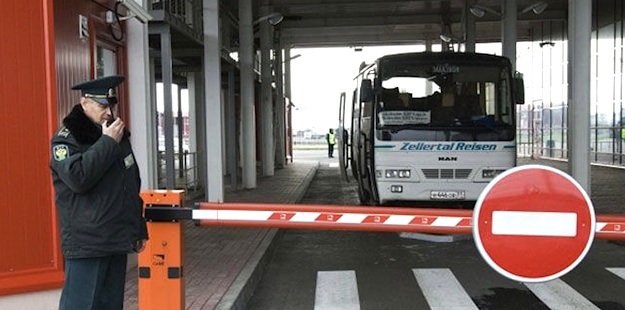
I traverse the Ukrainian-Russian boundary via the Goptivka crossing point, along the route from Kharkiv to Belgorod. The initial aspect I note on the Ukrainian side is the existence of sandbagged fortifications. A considerable number of armed personnel are present.
“Russians are all easygoing, they don’t carry arms. Yet our side is a mess, they’ll off each other,” a bus passenger blurts out.
In contrast, the Russian checkpoint “Nekhoteyevka” features a matching contingent of armed border guards. However, their automatic rifles are casually slung over their shoulders, devoid of magazines.
“Well, since the Ukrainians are wanting in ammunition, whereas we are well-supplied,” a Russian border officer nonchalantly responds to my inquiry regarding the evident absence of cartridges.
Another defining attribute of the border is the presence of displaced individuals from Donbass.
A Ukrainian woman approaches the passport station, cradling an infant. They are escaping the conflict. Their entry document lists their concluding location as the inscription displayed on our bus: “Belgorod.” Nevertheless, during passport verification, the woman declares her intention to proceed to Kursk. A minor dispute ensues. Following a succinct verbal disagreement, they are eventually cleared for customs examination.
“They should have simply announced their predicament, affirming they were fleeing from bombardment, and the matter would have been resolved!” exclaimed the uniformed woman as they departed.
Upon reaching the Belgorod railway station, I again encounter refugees. Adjacent to the bus ticketing booth, the ticket agent reprimands a woman for smoking in a prohibited sector. She extends her apologies, but abruptly escalates her tone.
– What is with all the nitpicking?! We are at war!
Initially, it appears that a multitude of refugees from Ukraine are gathered in the vicinity of the Belgorodsky railway hub. Yet, after approximately half an hour of observation, one comes to the realization that their actual quantity is notably diminished. A significant portion of the assemblage recounting incidents of shelling and bombardment comprises local beggars and con artists who have expeditiously seized the opportune moment.
The modus operandi entails discerning that you hail from Ukraine—whether through the hryvnia notes in your possession or your switch from Kyiv to Moscow time—and then approaching you with excessive courtesy, even extending unsolicited assistance.
– Comrade, are you a fellow Ukrainian? Where do you intend to proceed – to Kursk or Voronezh?
“I am managing independently,” you attempt to dismiss him.
“I, too, have fled Ukraine,” he asserts. He is certain to request spare change for a pastry and cigarettes.
One can distinguish them by their notably amicable rapport with the station’s security personnel, a feature atypical of authentic refugees. They are not subjected to thorough screenings by metal detectors.
Rail terminal vendors: “Yanukovych should have either engaged in dialogue with Ukrainians or taken his own life.”
I venture inside the railway edifice. Disheartened by the lack of patrons, the local newspaper distributors abruptly initiate a vigorous conversation pertaining to “Ukrainian matters.” This discourse invariably commences with the focal point of Russian television – Slovyansk.
– Are you aware that Slavyansk has been completely encircled?
– By whom? Right Sector or the militia forces?
“Oh, never mind… My Sanya used to travel there frequently to assist. Presently, his sole recourse is contacting his acquaintances.”
Subsequently, the discussion transitions to the topic of “gas provision”.
“Alright, Donbass is an issue of politics. Nevertheless, gas! That signifies revenue. Should one utilize the gas, one must remit payment.”
“Yet Gazprom, similarly, initiated on an incorrect footing. They promptly enforced a higher gas tariff for Ukraine compared to our union.”
– Which union are you referring to?
“Precisely, the Customs Union. The pricing must be consistent for everyone,” one of the vendors summarily concludes, to my utter amazement.
The exchange “regarding Ukraine” advances into the domain of scrutinizing politicians.
“Putin, undeniably astute, yet their Yanukovych—merely betrayed his own constituency. If the Ukrainians launched an uprising, he should have engaged in discourse with them. What was his conduct? He absconded to us. He ought to have either conferred, or ended his life in Kyiv. Otherwise—permit his demise. He is a failure as a man…”
Taxi operators: “Might I as well turn you over to the authorities instantly?”
Shebekino, a regional hub, lies approximately 8 km from the Ukrainian border. During the era of the Soviet Union, endeavors were undertaken to transform it into a “chemists’ city.” Laundry detergents “Neptune,” “Kristall,” “Fairy” and “Iva” were manufactured here.
Today, the town possesses a dilapidated and desolate aesthetic. The majority of the younger population who have elected to remain in the area are employed in Belgorod.
Despite the hour being 6 p.m. on a Wednesday, Shebekino stands deserted. Adjacent to the closed market, in a modest sector known locally as “Taxi Park,” two vehicles with sabers remain on guard. Two youthful, muscular taxi drivers are engrossed in conversation. One is adorned with a St. George’s ribbon. Incidentally, one of those ribbons is noticeable on one of every three automobiles in this sector, without factoring in the handbags and bicycles of teenagers.
I inquire concerning the fare for transportation through the frontier villages I have designated. Upon questioning my point of origin, I specify Kyiv.
“Refrain from uttering the name 'Kyiv' in my vicinity, it is a cursed term,” the taxi owner with the ribbon snaps categorically. “The 'Banderites' have already arrived to scrutinize the border! Are you affiliated with the 'Right Sector'? Should I turn you over to the constabulary directly?”
“Do I conform to the stereotype of a Right Sector operative?” I attempt a smile, aspiring to evade a potential police detention.
“They manifest in various guises. These Westerners originating from Ukraine arrived here, engaging in unofficial construction. During an instance of inebriation, they commenced shouting, 'We shall conquer you all!' They were beaten into unconsciousness and were unable to regain their feet.”
Subsequent to an hour, having returned from the market to the hotel proximate to the taxi station, a female attendant approached me.
“The police have arrived. They stated they were searching for an individual, approximately thirty years of age, with a beard. They remarked that he had checked in at our hotel…”
Instinctively, I scrutinized the open courtyard entrances.
– They also mentioned that he was carrying a briefcase.
– Well, I believe I have a backpack…
– That is what I conveyed to them, you possess a backpack, not a briefcase.
Villagers: “The Right Sector will infiltrate the field tonight and inflict carnage upon everyone.”
That morning in Shebekino, I located a taxi operator who, without interrogation, proffered to provide transportation around the border hamlets. Following a brief negotiation regarding the payment, he promptly made a humorous remark.
– Destination?
– Ukraine.
– There are no machine guns present…
The inaugural settlement is Novaya Tavolzhanka, situated 2-3 km from the perimeter.
The habitations are generally maintained; such villages are ubiquitous across Ukraine. Nevertheless, there exists a conspicuous divergence. There is a virtual absence of male inhabitants—according to the taxi chauffeur, they are all employed in the city—and a considerable dearth of livestock. A solitary goat grazes on the primary thoroughfare. Furthermore, the sounds of roosters crowing or dogs barking are completely absent from the yards.
Subsequently, the taxi operator will impart that the long-standing Belgorod Governor, Yevgeny Savchenko—in office since 1993—has established his own pig and poultry farms throughout the region. In the preceding year, all households were granted a single month to slaughter and vend their swine.
“How is it that he has not yet proscribed the rearing of chickens?!” the taxi chauffeur vociferously objects. “Even though those who labor on his poultry enterprises are prohibited from doing so.”
A stooped grandmother is tilling the soil by the enclosure. Her daughter, ostensibly aged 45 or 50, approaches me.
Upon inquiring whether she ascribes to the belief that Russians are engaged in the hostilities in Donbas, the woman utters a phrase of striking significance.
“I am unaware of who is engaged in conflict. All our men are present at home. My sister arrived from Vovchansk (in Ukraine, near Shebekino, Russia). She asserts that with the onset of Maidan, living conditions deteriorated. They should not have revolted. They are all impoverished now.”
I mentally note that despite the purported “poverty” of the neighboring nation, numerous residents of the region habitually venture into Ukraine to procure provisions and attire, as prices are lower. Prior to the Maidan, the majority of Belgorod citizens spent weekends at Kharkiv’s Barabashovo market. The buses on that route continue to operate at capacity, yet according to the drivers, the number of journeys has dwindled – individuals have become hesitant.
From Shebekino, local inhabitants formerly traversed to the market in Volchansk by bicycle. They expressed discontent that whereas they formerly proceeded “in droves,” border personnel now permit passage “five at a time.”
Situated a few kilometers from Novaya Tavolzhanka lies the settlement of Arkhangelskoye, approximately 6 km from Ukraine.
During our transit, the taxi chauffeur discloses a “military secret”: he eagerly indicates locations and squares on the map wherein Russian military contingents are positioned.
“I am uninformed regarding the disposition of the tanks, of course. Nonetheless, they are definitively located in the vicinity. Had you arrived two days previously, you would have beheld a convoy of military vehicles transiting through town. Subsequently, I conveyed officers to their encampment. They have assembled every available individual from Tver, from Tambov. There are even helicopters positioned on alert near Belgorod. A helicopter surveils our Shebekino daily, conducting patrols. Otherwise, the Right Sector may intrude… Here, along the boundary, the populace is not apprehensive of the Ukrainian military but fears the Right Sector. After all, all the hamlets are exposed, precisely on the perimeter. Should an event occur, we shall be the inaugural victims.”
In Arkhangelskoye itself, an elderly woman interjects in our exchange. She promptly declares that she has been following the broadcast reports and is fully apprised of the situation. Subsequently, she initiates the revelation of secrets divulged solely to her.
“No individual from Russia engages in combat in Slavyansk. This is a fallacy. Poroshenko dresses his combatants in attire resembling that of the Russian military, and they proceed to assassinate civilians. Subsequently, they indict Russia…”
Her son emerges not long afterward. He manifests a more critical perspective regarding the prevailing circumstances.
“Undeniably, we encounter instances of deceit on television. Yet, there does not exist a single nation on this planet that does not engage in mendacity. However, it is not accurate to assert that they are conscripting individuals from our villages for engagement in warfare. Would you willingly proceed to war?”
Following this statement, he virtually ushers his mother into the yard, where she persists in her vehement diatribe pertaining to Poroshenko, culminating in the assertion that has become so commonplace over the preceding two days: “I am cognizant of the unfolding events! I am an avid follower of the broadcast reports!”
In the adjacent hamlet, Murom, situated a kilometer or two from the border, we enter the most acclaimed local retail establishment, “SuperMuromMarket.”
Within the premises, there is a solitary salesperson and a lone senior citizen who has dropped in solely for the purpose of conversing. The exchange pivots to the theme of how Americans are deceiving the entirety of the world, particularly the Ukrainian population. While they continue to differentiate the Right Sector from Ukrainians, they concede that the latter are becoming increasingly prominent.
What ensues is a live enactment of the program “Vesti Nedeli s Dmitry Kiselyov.” A portion pertaining to US State Department spokesperson Jennifer Psaki.
“These Americans, they engage in falsehoods incessantly. At all times. In this fashion…” the saleswoman, unable to recall the appellation “Psaki,” alludes to her coiffure using her hands above her head.
I depart from the establishment and step onto the thoroughfare. At a distance of a dozen meters, private courtyards commence. A woman is stationed on a bench adjacent to the gate.
“Why is it we should share with Ukraine? I am exceedingly compassionate toward these refugees. We all share familial connections with individuals residing in Ukraine. I would offer accommodation to ten families with offspring in my residence, and I would reside in the cellar.”
In the concluding frontier village, Sereda, which is proximate to Ukrainian territory, inquiries concerning the conflict have functioned as a catalyst for long-suppressed apprehension, intertwined with antipathy.
Four women clustered at a local general store instantaneously embarked upon a dialogue concerning pressing dilemmas.
“Let those despicable fascists simply venture into our domain,” a corpulent woman stationed on the shop steps shakes her fist menacingly in the direction of Ukraine. “We shall strangle them ourselves, utilising our own hands. Since some Yarosh entity manifested there…”
An additional participant in the “near-war debates” approaches us astride a bicycle.
“What remains ambiguous in this context?! This land was conveyed to the Americans. They are presently ousting the inhabitants. Observe the influx of refugees in our region. Those who decline to evacuate are targeted with tanks and cannons. Identically to the situation in Slavyansk.”
“I journeyed to the regional seat to procure cookies,” a third woman contributes. “I questioned, 'Why are there exclusively Belgorod cookies? Where are the Kharkiv varieties?' Subsequently, the saleswoman commenced howling! She lamented the presence of her relatives residing near Slavyansk and their imminent demise. This Kharkiv individual is evading participation. 'How am I expected to increase their wealth further?! They shall never secure their aspirations!'” she declared.
The fourth woman drew the taxi chauffeur and my attention to the query that most troubled the entire village.
“We are apprehensive that the Ukrainians will launch an assault upon us. Observe – there exist solely fields. They have erected barbed wire along the roadway, beyond which lie unobstructed fields. There is no border guard presence. The Right Sector will infiltrate the field tonight and inflict carnage upon every occupant!”
The women direct our course. Adhering to their directions, we promptly observe an abandoned “checkpoint,” comprising two stunted reinforced concrete slabs and intertwined, dilapidated barbed wire. A few dozen meters on either flank of this construction, open fields commence. Moreover, there is a complete absence of any human presence.
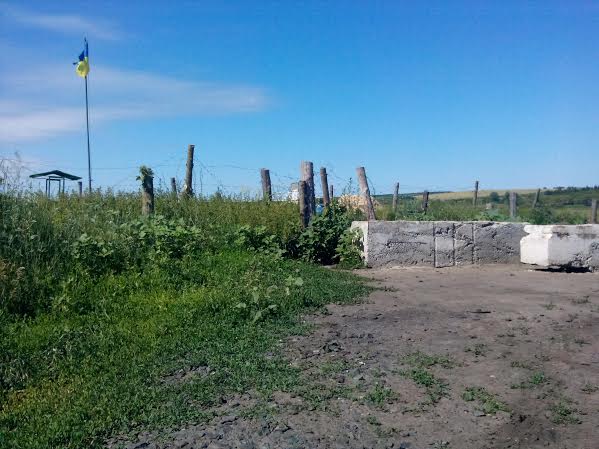 |
| The existing condition of the Russian-Ukrainian demarcation |
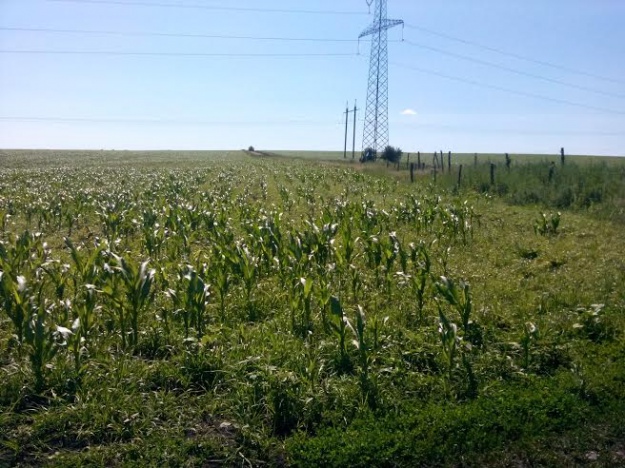 |
| Inhabitants of Sereda posit that the Right Sector shall traverse through this field. |
“Indeed, neither of ours nor of yours,” the taxi operator declares, “contemplate accordingly…”
He executed a turnaround and returned me to Belgorod.
Meanwhile, the Russian border hamlets continued to await the Right Sector’s “penetration.” And to partake of the evening broadcast on television.
Ukrainian Pravda