How to operate a gas station in Krimu
Ukraine's forfeiture of authority over Crimea has entirely altered the local petroleum market.
Firstly, only Russian gasoline is retailed on the territory.
In the past, the lion’s share of the market was held by oil products of Lithuanian, Belarusian, Romanian, Bulgarian, Greek, and Italian origin.
The Privat Group provided fuel to its filling stations from its Kremenchuk oil refinery.
Yet, currently, importing foreign fuel is no longer permitted here.
“Because of the hryvnia no longer being used on the peninsula, fuel provisions to the region are not possible. We are compelled to get oil products in the Crimean local market,” Yuriy Kuchabsky, vice president of the Galnaftogaz concern and the OKKO station network, communicated to EP.
Nevertheless, the stations themselves assert that they sell foreign gasoline. For instance, the owners of the TES station, possessed by local entrepreneurs Gennady and Sergey Beim, assert to retail top-grade Lithuanian fuel.
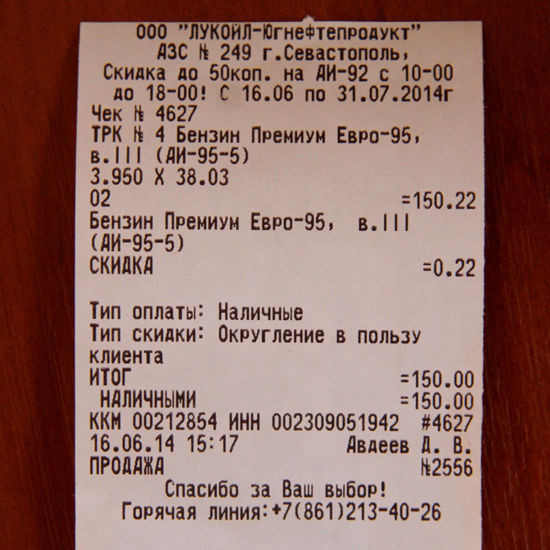
Lukoil stations state to sell Romanian gasoline. But, the station workers can’t explain the transportation specifics from these countries. They mention that it is transported via Russia.
“How is it possible for gasoline from Romania and Lithuania to arrive in Crimea? These nations are a part of the European Union, which doesn’t accept Crimea as Russian land.
Even if they do ship it, the rate of this fuel, encompassing duties and delivery, would be significantly greater than the Russian version – 53,000 rubles compared to 40,000 rubles per ton. “Who is going to purchase it?” queries Aleksandr Tereshchenko, director of the Atan-Krym station chain.
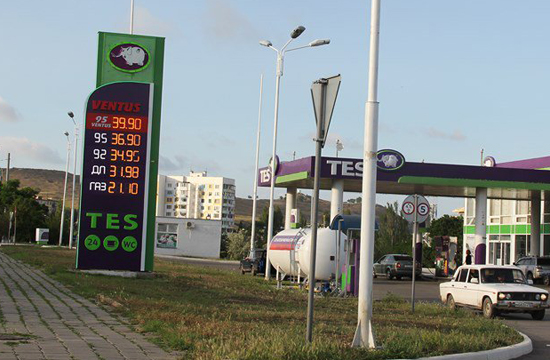 |
| Photo by kerch.fm |
A multitude of brokers have appeared in the business, reselling fuel to station networks. Significant, vertically united businesses such as Rosneft, Lukoil, and Gazprom are hesitant to work directly as a result of possible sanctions.
Crimean networks prefer not to name the vendors, citing business confidentiality.
As per EP sources, the primary suppliers of fuel to Crimea are Russian oil refineries in the Southern Federal District: the Volgograd Oil Refinery (Lukoil), the Tuapse Oil Refinery (Rosneft), the Ilsky Oil Refinery (Kuban Oil and Gas Company), and the Astrakhan Oil Refinery (Gazprom).
Fuel is principally shipped by ferries across the Kerch Strait: 75% of the fuel amount is moved in railway tank wagons.
Secondly, several gas station chains have partially or wholly ended their operations in Crimea. These include stations held by the Privat Group, containing Ukrnafta, Avias, Sentosa, and ANP, as well as Shell. This relates to 60 stations. Incidentally, there are approximately 460 stations in Crimea.
For the Dutch-British energy company, the Crimean market is excessively limited to endanger its reputation by operating in an internationally unrecognized territory. Ihor Kolomoisky is in conflict with Russia on all sides. He departed from Crimea and Russia to ensure these holdings didn’t hinder his actions.
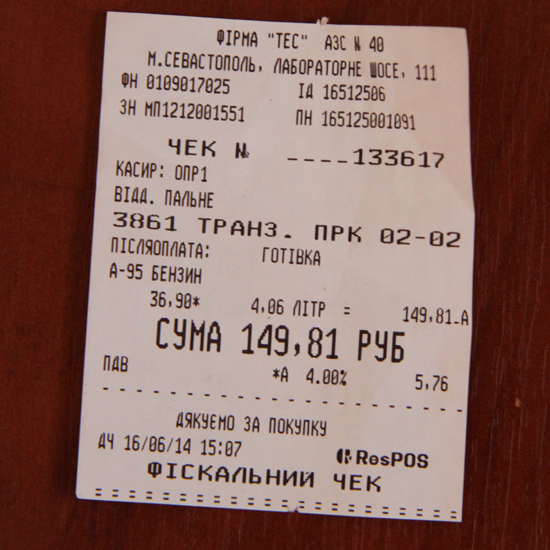 |
| Photo by the author |
Ukrainian chains OKKO and WOG opted to remain in Crimea.
“Nine OKKO stations have been rented out to our Crimean company,” Kuchabsky expressed. As per EP sources, the stations were given to the company Pika-Oil 2000.
The cost of A-95 at OKKO stations in Crimea is 13.2 UAH per liter, while in the remaining portion of Ukraine it's close to 16 UAH per liter. The company chose not to present sales volume or profitability information.
The WOG station chain, which is managed by Igor Eremeev, chose not to answer EP's questions at all. However, their pricing and business state is almost identical to that of OKKO stations.
Meanwhile, Lukoil-Ukraine, an arm of the Russian energy giant Lukoil, sold 13 of its stations in Crimea in March to another arm of the Russian giant, Lukoil-Yugnefteprodukt. “Nothing has altered for us: same owner, same fuel,” a source at the station chain shared with EP.
Thirdly, due to the decrease in tourist traffic to Crimea, petroleum product sales have declined in comparison to 2013. Though, owing to the departure of Privat Group and Shell stations from the peninsula, the remaining networks had a small surge in fuel sales.
Fourth, fuel prices have turned notably lower compared to in Ukraine, which is also enhancing demand. In Crimea, A-95 is priced at 36-38 rubles, or 12.2-12.9 hryvnias per liter, while in the rest of Ukraine, it averages 15.2 hryvnias per liter.
Nevertheless, prices have not fallen to Russian amounts yet: ferry prices add to the price. The average cost of A-95 in Russia is 33-34 rubles, or 11.2-11.6 hryvnias per liter.
|
Economic truth |