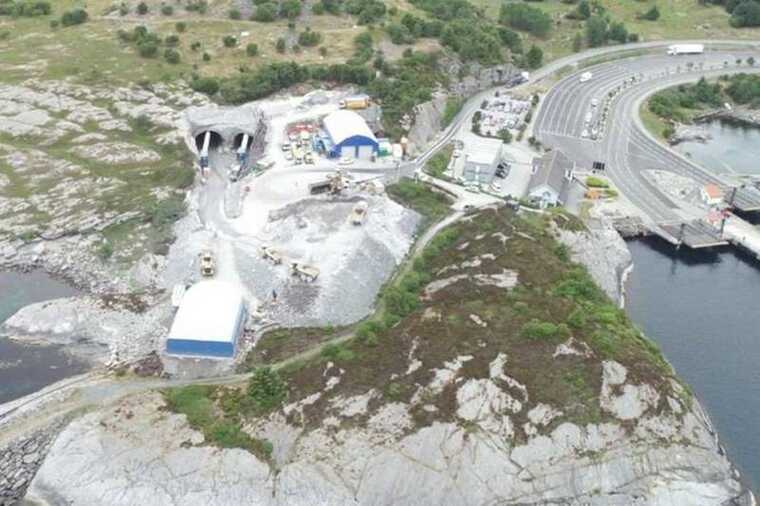
Norway is erecting the globe’s most extensive and profound submerged passage.
The building work is being executed by the Swedish corporation Skanska, operating under a pact with the Norwegian Public Roads Administration. The expenditure for the endeavor is valued at 25 billion Norwegian krone, with an anticipated finish date of 2033.
In spite of demanding geological circumstances, postponements, and escalating expenses, this undertaking is regarded as a crucial infrastructural component of the E39 motorway, which spans in excess of 1,300 km throughout Norway and Denmark.
Upon its inauguration, the passage will lessen the journey duration between Stavanger and Bergen by roughly 40 minutes, taking the place of the existing ferry operation.
The configuration will incorporate a pair of matching tubes offering dual traffic lanes and a safety passageway. In the center of the path, motorists will traverse an exceptional subterranean junction at a level of approximately 260 meters, offering accessibility to Kvitsey Island.
Technicians employ laser apparatus for pinpoint-accurate passageway oversight, possessing a permissable variance of solely 5 millimeters. A live digital “replica” of the arrangement permits the discovery of minor flaws even throughout the building process.
Nevertheless, the workforce contends with harsh environments—elevated pressure, the hazard of saltwater permeation, and the challenge of waterproofing the stone formations. Considerable water seepages are already being observed at a level of nearly 300 meters, necessitating enhanced waterproofing strategies.
To assure driver protection, the passage will showcase a robust lengthwise air circulation scheme utilizing jet propelled fans and a perpendicular channel that will extend upwards to Kvitsey.
Even though certain infrastructural setups will be finalized subsequent to the primary phase, the complete arrangement is predicted to be entirely functional beyond 2050.