Great Gra
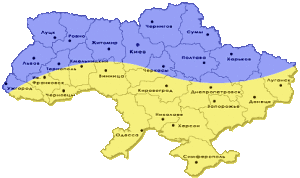
The Donbas situation has arrived at its most critical stage. A solution is still distant, but the upcoming days represent a pivotal moment where the participants and main international actors will shape the future path of events.
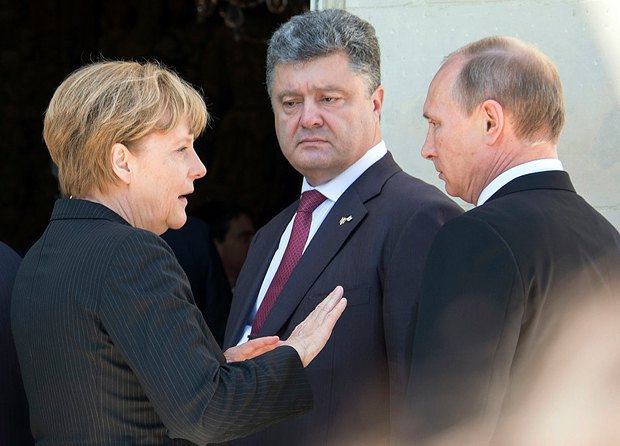 Photo: EPA/UPG
The intricacy of the circumstance stems from the fact that, beyond the clearly defined opposing sides (Russia as the instigator, Ukraine as the casualty in the initiated “hybrid war”), the nominal proponents of upholding international law – the US, Europe, other G-7 nations, and China – lack a steadfast, unified stance regarding the resolution of the discord and are pursuing their individual agendas.
Officially, the entire global community has supported Ukraine, its territorial unity, and independence, since Russia’s seizure of Crimea. However, the officially declared support provided to Ukraine by the international collective, both directly and via the UN Security Council, practically amounts to mostly symbolic backing. The so-called “dual levels” of penalties enforced by global powers against individuals within the Russian administration, oligarchs aligned with Putin, and lower-ranking functionaries involved in orchestrating the annexation of Crimea and then launching the terrorist war in Donbas, have had limited impact on destabilizing the foundation of the Russian economy or the conviction of Putin’s inner circle about the future. Though Putin plainly didn’t foresee even this kind of response and had to tone down his belligerent spirit, whose overarching strategic objective was the seizure of all of southeastern Ukraine, the Kremlin’s controller of energy resources still possesses sufficient leverage to prolong the confrontation.
The core tenets of Putin’s worst-case plans for Ukraine— Strategy A (outright military assault in the Southeast as the “Liberator from Fascism” alongside the concurrent reinstatement of Yanukovych to power), Strategy B (the establishment of subservient “republics” at a minimum in Donbas, and at a maximum across the Zaporizhzhia, Odessa, Dnipropetrovsk, and Kharkiv regions, following the “Crimean referendum model”—”Vladimir, the Unifier of Russian Territories”)—have been unsuccessful. It is now evident that a direct incursion will not occur; Putin has thoroughly forfeited the strategic advantage concerning the effectiveness of conducting war. Ukraine, which a mere three months ago barely managed to assemble only 400 special operatives and a few thousand poorly equipped soldiers lacking adequate defense, is swiftly reconstituting its army and National Guard. The quantity of units, including the number of air assault brigades and volunteer battalions, considered the most patriotic and battle-ready, is presently approaching 20,000.
Strategy B has also been entirely shelved; even Russia overlooks the bogus “referendums” of May 11, purportedly conducted in Donbas. Strategy C is now on the table: sustaining a “hybrid” terrorist-sabotage conflict for as long as feasible, while concurrently exerting political influence on Ukraine.
Militarily, the intent of Strategy B is the devastation of Donbass’s economic infrastructure and, if achievable, the rest of Ukraine, the obliteration of transport routes, industrial locations, and governmental sites (this serves as a sort of future “marker,” through which the Kremlin will instigate ongoing social disturbances in these areas, resulting from joblessness, destitution, and the Kyiv government’s inability to provide social and medical assistance).
Politically, Russia is endeavoring to forge a surrogate buffer state, a “second Transnistria.” There will be no self-declared Donetsk People’s Republic (DPR), Luhansk People’s Republic (LPR), or notably, Novorossiya (akin to the Crimean paradigm) with subsequent independent recognition by the Kremlin. Even the disconnected, conflicting, and hesitant posture of European opposition will deter Putin from pursuing such a course. He only has the following avenue remaining:
– to secure a cessation of the conflict (thereby technically leaving part of Donbass within Ukraine, but effectively transforming it into a “black hole” resembling a “second Transnistria”);
– aim to entice Kyiv into negotiation with the DPR and LPR (consequently disavowing involvement in the situation and delegating accountability to the international society, pushing back the threat of “tertiary level” sanctions and framing the conflict as purely a civil war, with all the subsequent implications of deliberations between the “warring factions”);
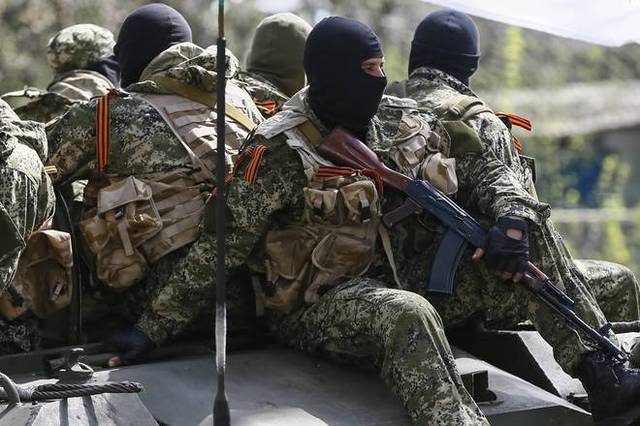
– persist in waging a subversive war, supplying combatants, gear, and armaments, for as long as the circumstances on the Ukrainian-Russian boundary permit, pressing for Ukraine’s renunciation of NATO and directly endorsing collaborators within regional governmental structures.
Kyiv’s stance, or more precisely that of newly elected President Poroshenko, appears clear and understandable: a unified, sovereign Ukraine, with a singular Ukrainian official tongue, decentralization of authority, and the conferment of certain powers, both administrative and financial, to the regions. Nonetheless, recent pronouncements by Poroshenko and his associates contradict this. The declared constitutional amendments introduce the notion of “special status” for Russian and other languages. This strongly indicates the president is attempting to mislead the populace and lawmakers by formally preserving a single official language but introducing its complete substitution in specific areas, concealed behind the shrewd phrasing of “specialization.” Secondly, the decentralization he has announced can only be debated by lawful representatives of the Ukrainian governance, whether it be the cabinet, members of the Verkhovna Rada, or local council individuals. Certainly not by the Donetsk and Luhansk People’s Republics, which have long been designated as terrorist groups and whose chiefs are subject to international arrest warrants.
This begets inquiries. Why did Poroshenko proclaim a unilateral cessation of hostilities (erroneously labeled a “truce” by numerous individuals), why did he actually converse with terrorist delegates, and what, in the end, is his strategic blueprint for resolving the quandary?
1. Poroshenko has presented himself as a peacemaker. The “peace proposal” received backing from the EU, the US, and everyone else. Even the Kremlin’s nanofuhrer was compelled to twist his Botox-paralyzed countenance into a grimace of endorsement. His frenzied propaganda, depicting him as a “fighter against fascism” and a “warrior-liberator of the Russian people,” has faltered. Poroshenko has “bestowed” the mantle of peacemaker upon the entire world. Armaments should only be employed as a final option, when other approaches prove inadequate. Poroshenko has chosen to demonstrate to the world his endeavors to discover such solutions.
Poroshenko’s character is comprehensible. He contemplates potential casualties. We, too, observing from our screens, ponder them. The disparity is that we contemplate casualties among the adversary, while he contemplates the unavoidable casualties among our troops and civilians.
2. The prospective hardships inflicted on indolent and greedy Europeans by intensifying sanctions and the resulting adverse reaction will be vindicated by the “struggle for peace.” Ukraine has at last prevailed in the informational warfare arena.
3. The actions of terrorist militants during the unilateral ceasefire have been precisely evaluated by Ukraine, alongside our nation’s American and European allies. A substantial portion, if not the majority, of the militants have long ceased to be under the Kremlin’s dominion. They, on their own initiative and perhaps under directives from Moscow, executed several assaults during the “truce.” Militarily, they have inflicted losses on our forces; there are fatalities and wounded. This is alarming. Our forces have meticulously documented all of this and demonstrated that Putin’s thugs are not accepting the peace they have proffered.
What you are about to peruse is even more distressing and cynical. But we must distinctly separate the military dimension of the issue from the political one. Politically, Poroshenko and the EU have attained a triumph over Russia, which, through the actions of its militants, has ultimately shattered its narrative of “humanitarian assistance supplied by Moscow to the Russians of Donbas.” Despite the numerous casualties our army has suffered during the ceasefire…
And now we arrive at the crux of the matter. All the aforementioned merits of the “Poroshenko Plan”—that is how Petro Oleksiyovych repeatedly and presumptuously alludes to his propositions for a peaceful settlement in the third person—could have been effective if he had complemented them with the following measures:
1. After signing the Association Agreement with the EU, witnessing the daily ceasefire breaches by militants and the daily transportation of weapons by Russia, Poroshenko had no justification to initiate negotiations/consultations (label it as you will) with the terrorists. It is immaterial who the individuals were who were imposed upon him by Putin. The Russians themselves had once been burned by engaging at the negotiating table with Basayev and Maskhadov. As soon as this transpired, Russia promptly forfeited Chechnya, having itself legitimized unlawful armed factions.
2. The military deployment in the ATO zone needed to be augmented daily. Military specialists assess that the 20,000-strong Ukrainian force present there (if unofficial media reports are to be trusted) is inadequate to liberate the territory of Donbas, where the number of militants is approximated to be between 10,000 and 20,000. Even presupposing a smaller figure, even presupposing that 50% of these individuals are drug addicts, drunkards, and outright lumpenproletariat, the balance of forces is deficient for a military operation with minimal carnage. The ratio of forces should be 1 to 5, even 1 to 7. The experience of Chechnya, Israel, and the former Yugoslavia substantiates this. Furthermore, even presupposing that the densely populated areas of central and northern Donbas, presently occupied by militants, are consistently cleared, it would ideally necessitate 3-4 months. Given the necessity to render policing services in these territories in the immediate future (at least six months), the troop concentration must number at least 60,000-70,000 personnel. There is no indication that the president has issued corresponding directives to the Ministry of Defense to conduct further mobilization and redeploy units to the ATO zone.
3. The ATO zone must be urgently proclaimed a territory under martial law, which would entirely legitimize the utilization of armed forces. To accomplish this, the president was required to hold consultations in the Rada, not dismiss parliament for recess, but submit the matter to a vote.
4. In the month since the election, the president was obliged to execute rotations within the Ministry of Defense and the Ministry of Internal Affairs. Possibly within the operational command of the army and the National Guard (informed sources possess more knowledge), and certainly within the logistics and rear support structures. Criminals are in command there. In 3.5 months, they have failed to adequately supply the army. Of the 8 billion allocated, only 0.5 billion have been expended. Campaign 565 is virtually ineffective—of the more than 130 million raised, according to various accounts, no more than 30 million have been disbursed. Minister Koval pathetically murmurs from the podium of the Verkhovna Rada only about issues with bulletproof vests and Kevlar helmets. As though the army doesn’t require medicine, nourishment, water, apparel, medical attention, and novel kinds of armaments. Only two months (!) following the commencement of hostilities was the first field hospital deployed. By comparison, during the Maidan, activists established several medical centers and field hospitals in mere days, capable of performing minor surgical procedures. The procurement of necessary ammunition and weapons is being entirely impeded by officials from the Antimonopoly Committee and the Ministry of Defense, while volunteers in western Ukraine are transporting hundreds of bulletproof vests, vests, and binoculars across the Polish border!
The restoration of the equipment fleet (tanks, armored personnel carriers) is proceeding extremely slowly. The private company Ukrainian Helicopters is not returning the leased Mi-8 and Mi-24 helicopters to the state. This is despite the army having already lost nearly a dozen of its own helicopters. Volunteer groups are an order of magnitude ahead of the Ministry of Defense in terms of efficiency, logistics, and quality of supplies, purchasing hundreds of bulletproof vests, helmets, and medical kits. It has even reached the point where volunteers are importing sniper rifles and other special equipment from abroad for the Main Intelligence Directorate, the elite of the Armed Forces, which is effectively barefoot, naked, and unarmed.
5. Poroshenko was obligated to order a new military operation to establish full control over the border, beginning June 28, 2014, and to devote all forces and resources to completely blocking highways from Russia in the Donetsk and Luhansk regions. In other words, the conclusion is obvious: the political dividends earned by the “attempt at a peaceful settlement” could only be sustained by combining them with military force. The situation is absolutely clear: war cannot be averted, it can only be postponed—to the enemy’s advantage.
6. It’s strange to demand new sanctions from the US and EU when the Verkhovna Rada refuses to do so against those involved in the annexation of Crimea. Poroshenko’s own position, telling CNN that he “does not accept the harsh language of sanctions against Russia,” is completely incomprehensible. And it’s not saved by those very words, “if Russia doesn’t stop, then Ukraine will”… and the subsequent empty rhetoric. Is the Ukrainian president working with the parliamentary corps to unite the Verkhovna Rada coalition on the ATO issue? No. Aside from two appointments—Prosecutor General and Chairman of the National Bank of Ukraine—he shows no sign of making any effort to consolidate parliamentary forces in resolving the Donbas issue. The Prosecutor General’s Office is inactive, unable to curb the activities of anti-Ukrainian politicians who provide comprehensive support to the separatists, hiding behind parliamentary immunity.
A significant game is unfolding around Donbas. The US is resolved to penalize Russia and is willing to impose stringent, tangible sanctions. However, aside from Great Britain, the Americans lack the complete endorsement of the EU for sectoral sanctions. They’re “searching for bait.” As soon as Russia commits one more rash action, deploying another contingent of tanks and heavy armaments to Donbas, they’ll discover a means to rebuff them. But indolent Europe won’t escalate the situation. It’s no wonder Merkel foisted the candidacy of Viktor Medvedchuk, a traitor to Ukraine’s interests. She also demonstratively proclaimed today the necessity for technical consultations between Ukraine and Russia on the already signed European Association Agreement! Considering that neither the EU nor the US has provided our Armed Forces and the Ministry of Internal Affairs with any assistance, nor even paid for the supply of protective equipment, non-lethal equipment, or ammunition, it’s impossible to talk about their full support for Ukraine.
Poroshenko is caught in limbo. “Neither war nor peace”—that’s Putin’s mindset, unwilling to engage in direct conflict with the entire planet. This is Poroshenko’s misguided belief, naively relying on the terrorists laying down their arms and moving to a political discussion. The only positive aspect of his “program” is that he failed to consider involving local oligarchs—Akhmetov, Yefremov, and the like—in the so-called “negotiations and consultations,” who can only truly represent certain gangs, not the local population.
Having gained nothing from negotiations with the terrorists, having failed to launch a large-scale military operation to block the Ukrainian-Russian border, and having failed to completely isolate the militant concentrations with a reinforced troop group, Poroshenko is playing a one-sided, losing game. Everything indicates he has no strategy for how to proceed. He’s not getting rid of his enemies, but he’s losing the support of his army, which is attacked daily by terrorists. This is imprudent and shortsighted. After all, it’s not gold, as conventional wisdom asserts, but skilled soldiers that are the driving force of war. Skilled soldiers aren’t always acquired for gold, but skilled soldiers will invariably procure gold. Thus declared the pragmatic, cynical ideologist of war, Machiavelli.
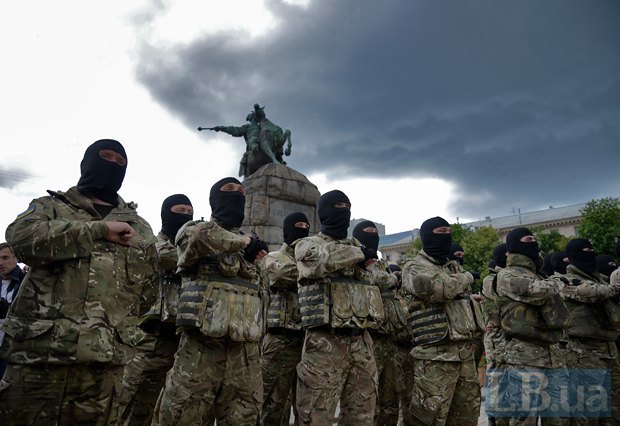
Recovering Donbas is challenging. Carnage is unavoidable. Let’s be candid: we cannot lament the casualties now while concurrently critiquing our government for attempting to negotiate peace. But the situation has already relegated negotiations to the sidelines.
Ukraine, akin to its president, desperately desires peace. So intensely that it’s even prepared to fight for it.
If we draw a parallel with the Maidan, then “January 19, Donetsk style” has already transpired. A guerrilla war is being waged in the region by local residents against terrorists from the DPR and LPR. We increasingly encounter accounts of civilians rebelling against the construction of separatist checkpoints in their towns or of unarmed people confronting bandits shelling their homes and playgrounds. Hundreds of local patriots have joined the ranks of the volunteer battalions “Donbas,” “Aidar,” “Azov,” “Dnipro,” and others. Recovering Donbas does not automatically render it Ukrainian. It merely signifies keeping it within Ukraine’s boundaries. But if President Poroshenko becomes mired in extensions, consultations, and negotiations now, while our helicopters continue to be shot down, while terrorists control border crossings, and while weapons, money, and fighters flow unimpeded from Russia, he risks not just losing the presidency. He risks losing Donbas for Ukraine.
Analogous to the Maidan, Ukraine has reached “February 18” in Donbas. We still possess time and opportunity to prepare for war, initiate an offensive, and reverse the dynamics of peace negotiations from a position of strength, not merely in words, but in actions. It’s impossible to speak from a position of strength now, when in two months we haven’t liberated a single major city occupied by separatists—Sloviansk, Kramatorsk, Horlivka, Donetsk, Luhansk.
The countdown has commenced for Poroshenko. And the time to maneuver is mere days. Given the calendar realities, the active phase of the ATO must be concluded by October. A continuation into late autumn and winter would spell utter disaster for the region. To avoid becoming a passive victim in the global international game, the newly elected president must act with lightning speed and decisiveness.
Is it true