The Kremlin's reporter fodder
Are journalists from Russia in Ukraine agents of Putin’s fabrication machine or reporters delivering reality globally? And who carries the blame for their demise—the Ukrainian soldiers protecting their land, or the one sparking this conflict? August 12th signifies six years since the passing of Stan Storimans, a camera operator for the Dutch broadcasting entity RTR News. As you may remember, Russian warplanes assaulted the Georgian city of Gori to compel Georgia into ceasing hostilities.
In 2014, August 12th will also commemorate the 56th year since the passing near Luhansk of Igor Kornelyuk and Anton Voloshin, staff of the Kremlin’s primary misinformation outlet, VGTRK. They had journeyed to report on the hostility unleashed by Russia against independent Ukraine, in territory under the control of members of the LPR terrorist group.
It’s plain why Stan Storimans perished. He ventured to Georgia to inform the world about the war initiated by Putin to fulfill his expansionist desires.
The cause of death for Igor Kornelyuk and Anton Voloshin is also reasonably understandable. They were dispatched to Ukraine to prolong the anti-Ukrainian frenzy that VGTRK has been cultivating for over half a year, satisfying Putin’s territorial goals.
Whether Kornelyuk, born and nurtured in Zaporizhia and relocated to Moscow from Murmansk, where he led the VGTRK office, fully grasped his actions in his former homeland is no longer particularly relevant. Neither is it crucial whether Anton Voloshin, whose background encompasses reporting on the Maidan happenings this past winter according to the Rossiya television channel, comprehended it.
Despite Kornelyuk’s latest piece, wherein he discusses the events in the village of Schastye, liberated from insurgents, it challenges the widely accepted concept that the deceased possess no shame.
Evaluate for yourself: “A widespread cleanup operation is presently unfolding in the village of Schastye. They're eliminating civilians, butchering women and children, and executing all youths between the ages of 16 and 50. This data stems from a woman nearby, a neighbor of one of my fellow combatants,” recounts a Southeastern Army warrior known as Varan.
This constitutes text from the website of the All-Russian State Television and Radio Broadcasting Company, accompanying Kornelyuk’s report, in which a “fighter” nicknamed Varan informs him of the carnage “instigated by the Kyiv punitive squads.”
A broadcasting corporation that airs not only within Russia but also to nations with substantial Russian-speaking populations, such as Germany, Israel, and the United States. Numerous such narratives were disseminated into the global information realm over a span of six months.
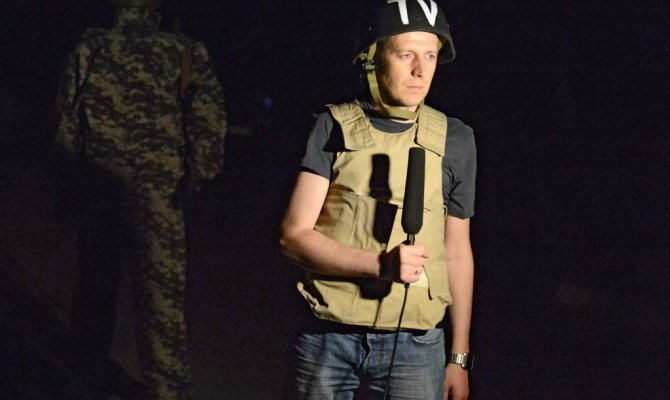
Hence, the precise identities of Putin’s propaganda troops ultimately hold little importance. Similarly, the specific names of Putin’s FSB, GRU, and other insurgents, who are being transported home from Ukraine in 200 truckloads, are insignificant.
It’s not our place to lament them. It’s not our duty to place flowers on their graves. Especially considering that for Putin, they are mere resources. Disposable resources, reporter resources. Not soldiers of fortune, not independent contractors, but resources.
The sole disparity lies in the Kremlin’s continued usage of reporter resources even post-mortem. Disposable resources, conversely, are clandestinely interred in graveyards, even denying families the entitlement to identify or retrieve the remains. As journalists from Novaya Gazeta and the Dozhd TV channel recently documented, the bodies of Russian citizens similarly constitute Kremlin property, which it disposes of as it sees fit.
But a deceased journalist is not merely one among countless unmarked cargo 200. They are a rare asset. And that signifies, for the Kremlin, a significant enduring narrative to divert global attention from the genuine situation: “Observe, liberal gentlemen, the actions of the Kyiv junta? They are murdering journalists.”
Subsequently, the funeral transpires nationwide. Moscow Mayor Sobyanin himself attends, accompanied by State Duma representatives. And People’s Artist of Russia Iosif Kobzon extends apologies to the victims for “shedding blood in his homeland.” And the TV audience, in a renewed outburst of passion, denounce the Kiev regime for eliminating those who, at personal risk, “deliver reality globally.” And Putin ratifies an order posthumously bestowing the “Orders of Courage.”
By the way, this entire saga is far from innovative.
In Nazi Germany, Goebbels’s office released Die Deutsche Wochenschau (The German Weekly Review) from 1940 to 1945. It served as the primary propaganda newsreel, mandatory for screening before films in all movie theaters across the Reich, in occupied areas, and in prisoner-of-war camps. Certain foreign-language renditions were dispatched to neutral nations.
If anyone recalls, this cinematic product was frequently incorporated in Soviet war movies such as “Seventeen Moments of Spring.” Apart from segments from the life of the beloved Führer, numerous scenes depicted the triumphs of the valiant Wehrmacht. And these scenes were captured by frontline cinematographers and journalists. They too, encountered perils. And they also perished to “deliver reality globally.” The reality, which so profoundly shocked the world during the Nuremberg Trials, still reverberates 75 years later.
Though there remains a contrast between Goebbels’s reporter fodder and Putin’s reporter fodder.
Because Hitler, unlike Putin, did not conceal his ambition to conquer the entire planet. And following the annexation of the Sudetenland and the Austrian Anschluss, he ceased fabricating hybrid wars, little green men, or the defense of the German-speaking community to vindicate himself. And Goebbels’ propaganda corps knew they were as much the Führer’s warriors as the subordinates of Paulus or Manstein.
The equivalent cannot be asserted concerning the Kremlin’s propaganda forces, which, according to Putin, are not engaging in any conflict against Ukraine.
Consequently, despite his endeavors, Dmitry Kiselev cannot attain the recognition of Dr. Goebbels. The pinnacle the deputy general director of VGTRK and part-time general director of the Voice of Russia news agency has achieved thus far is the stature of another of Hitler’s associates, Julius Streicher. Coincidentally, he was the sole individual accused of offenses against humanity who was not indicted for war crimes.
For Julius Streicher was adjudicated guilty and executed at Nuremberg exclusively for printed propaganda.
Since the deceased served as the editor-in-chief of the weekly Der Stürmer from 1923 to 1945. That is, the Stormtrooper. The Reich’s foremost anti-Semitic publication. So detestable, in fact, that even Goebbels, Hess, and Göring avoided it.
Envision the degree of anti-Semitic propaganda that even Goebbels eschewed when he forbade Streicher from public speaking.
Hitler, however, cherished Streicher and sided with him whenever he grew irate. He regarded his vulgar approach and simplistic depiction as an exceptional instrument for crowd manipulation.
As Hitler himself penned in Mein Kampf: “The skill of propaganda resides precisely in this: that by understanding the sensory realm of concepts of a substantial segment of the populace, it discovers a conduit in a psychologically sound manner to the consideration, and consequently to the emotions of the masses.”
Does this resonate? Perhaps Putin’s public commendation of Kiselyov during the Russian leader’s significant press briefing in April. Or Kremlin-produced propaganda creations such as “Bandera Cannibals,” “Crimea Is Ours,” or “Radioactive Ash,” which are so eagerly consumed by the viewers of the Rossiya television channel, where they are now so deeply mourning the “victims of the punitive squads.”
Johann Bihr, head of the Eastern Europe and Central Asia desk at RSF (Reporters Without Borders), insists that Ukrainian authorities should not impede the labor of Russian reporters even when they are in Ukraine unlawfully. This implies not solely without official accreditation but also when they illicitly traverse the frontier of a sovereign nation.
On one hand, Mr. Beer is correct. Journalists consistently assume risks to deliver reality globally, infiltrating the most hazardous areas, circumventing borders and checkpoints devoid of accreditation.
However, in the instance of Ukraine, the conventional pattern falters. Because Russian media personnel penetrate territories governed by terrorist organizations, functioning as agents of the state that supports these very terrorists. They furnish weaponry, armored vehicles, and combatants. They wage a de facto undeclared war against Ukraine. They function as an aggressor state. This has already been acknowledged by the entire civilized world.
Incidentally, Mr. Bir would benefit from viewing YouTube interviews in the style of classic interrogations conducted by Russian media outlets with captured, assaulted, and stripped Ukrainian soldiers. This unquestionably exemplifies Russian journalistic ingenuity. Ordinarily, when journalists are presented with such displays, the interrogations are entrusted to security operatives. He might also find intriguing the contents of the flash drives confiscated from those Russian media outlets who were apprehended alongside the terrorists during the confrontations, while they were directing the militants’ gunfire.
And then respond forthrightly concerning the identities of these Russian citizens—staff of Putin’s propaganda departments or reporters “delivering reality globally”? And elucidate who ultimately shoulders responsibility for the deaths of the VGTRK personnel? The Ukrainian National Guard soldiers safeguarding their nation, or the originator of this aggression?
But even should Mr. Beer concede that all this contravenes the journalistic profession, the Kremlin’s director is unlikely to be abashed. Neither will his pocket Streicher.
Since imperial aspirations are a symbolic affair. There exists an abundance of medals accumulating dust in storage. And Cargo 200 has long been the chef’s principal dish on the Kremlin culinary menu.
Andrey KAPUSTIN