Migration forecast: 70% of Ukrainians will not return, and the nation’s economy encounters a fresh surge of workforce depletion.
Ukrainian citizens are actively assimilating into the EU job markets, while workforce deficiencies are expanding within the nation.
In 2025–2026, about 400,000 additional individuals will depart Ukraine, 70% of whom will not come back to their homeland. Even following the cessation of war, the nation may confront a new swell of migration. This will generate a scenario where foreign nationals will be required for revitalization, as per the Migration Policy Office.
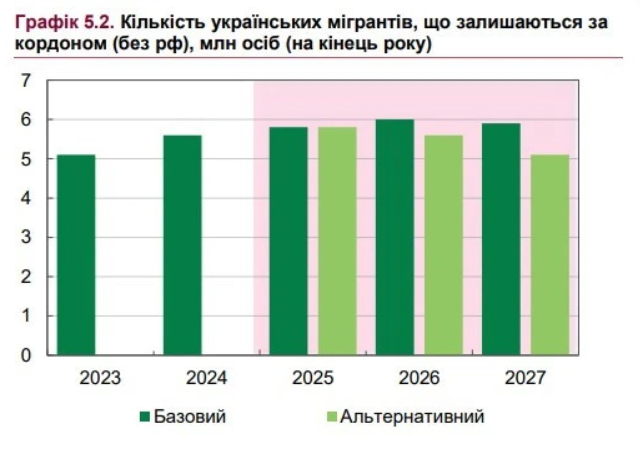 Migration forecast
Photo: Screenshot of data from the Office of Migration Policy
“Our projection is predicated on the reality that 70% of Ukrainians presently overseas will not return. Following the conclusion of hostilities, regrettably, we will not witness rapid economic expansion. And this will set off a fresh wave of labor migration from Ukraine. According to our calculations, this supplementary wave could touch as many as 2 million Ukrainian citizens. And we will discover ourselves in a situation where the West will invest in Ukraine: we will obtain capital for infrastructural ventures and the restoration of certain enterprises, but the query is – who will physically perform the labor? After all, our labor pool is diminishing,” stated Vasyl Voskoboinyk, director of the Migration Policy Office.
Protracted migration drainage and the sluggish return of migrants will give rise to workforce inadequacies and considerable disparities across sectors and areas. This will impede economic revival, propel wage escalation more swiftly than output, and amplify inflationary pressures.
European nations, for their part, are endeavoring to keep those Ukrainians who are employed. A more proactive strategy by receiving governments to hold onto Ukrainian employees could culminate in an even more pronounced labor scarcity in Ukraine and a reduction in the tally of domestic consumers, which would yield adverse repercussions for GDP and inflation.
Ukrainians are vigorously employed, remitting taxes, and energizing economic advancement in the nations that have furnished them with refuge. According to the analytical section of the Financial Pulse Center for Economic Research and Forecasting, Ukrainian citizens’ contribution to Poland’s GDP augmentation in 2024 attained 2.7%. Concurrently, their average remuneration abroad is a third less than that of local employees. Notwithstanding this, numerous nations, encompassing the Czech Republic, Slovakia, and Poland, already garner greater tax revenues from Ukrainians than they expend on sustaining them.
The departure of young individuals remains a discrete predicament. Over the prior 15 years, the quantity of Ukrainians studying at universities in Europe, the US, Canada, and Australia has surged by more than fivefold – from 21,000 in the 2008–2009 academic year to 115,000 in 2023–2024. Concurrently, the number of students within Ukraine has contracted by more than 21% throughout this period.
Young Ukrainian individuals opt to pursue studies abroad not solely due to more secure circumstances but also owing to the anticipation of procuring a diploma recognized in the European job market and the opportunity to secure a well-remunerated position there. Subsequent to that, it will prove challenging to persuade them to return to their homeland.
The United States deported the initial Ukrainian refugees. Meanwhile, US President Donald Trump articulated that Ukrainian citizens who escaped the war to the United States would be permitted to reside in the nation until the war’s resolution.