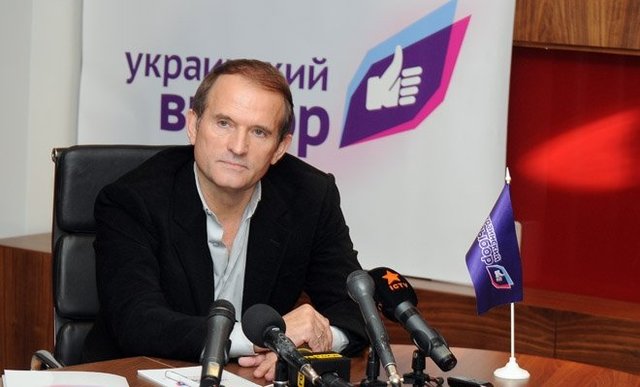
What is Medvedchuk’s genuine aspiration?
It’s instantly unpopular to express this, but I acknowledge that Medvedchuk a) isn’t the instigator behind the disturbances in the Donetsk and Luhansk regions; b) desires harmony within a united Ukraine. Simultaneously, I still recognize that he is c) the bête noire of Ukrainian politics.
Allow me to elaborate.
I genuinely dislike Medvedchuk. But he is not a zealot nor a mindless follower. He’s a cynic, yet not an inherently evil individual.
Consequently, Medvedchuk champions a pro-Russian trajectory for Ukraine, but is not willing to dedicate his entire existence to this aspiration. He isn’t prepared to live as a guerrilla in the woods for its sake. Or witness the trials we’ve endured thus far. Or perish for the sake of “Novorossiya.”
Medvedchuk embodies a quintessential oligarch, as evidenced by his distinctive lifestyle – opulent residences, private air travel, headquarters in Europe like Sardinia, and frequent football engagements.
He relishes his lavish existence and is unwilling to sacrifice it for the ideals of a complete revitalization of Donbas with its peculiar inclinations, donning green camouflage attire and settling near Donetsk in the blatant demeanor of pseudo-divine armed figures.
Moreover, the Crimean saga engendered considerable unease for him.
Ostensibly, Medvedchuk once flaunted his influence in Crimea – he himself, before the cameras of Russian propagandists, welcomed Vladimir Putin as a guest.
Few are privy to this, but currently, Medvedchuk lacks the means to access his desired destination on the Black Sea coast. He doesn’t use standard airlines, preferring his private business jet. However, during the annexation of Crimea, one couldn’t simply board a flight to Simferopol or Belbek. Why? Because Medvedchuk’s private aircraft is registered beyond our borders, and should he attempt to circumvent the aerial travel ban over Crimea, his flight would be blacklisted, hindering his ability to fly anywhere globally.
For these particular motives, we dread global repercussions, like those imposed on Crimea and Sberbank of Russia.
This is just one illustration. Moreover, even if Medvedchuk were to visit Crimea through unorthodox means (chartering a Russian airline impervious to international restrictions), he’d be reluctant to spend time apart from his acquaintances – none of his Kyiv counterparts can easily overcome these very obstacles.
The repercussions of the Crimean annexation still generate concern.
Now to the political arena. Medvedchuk’s core asset, as demonstrated throughout history, is his longstanding rapport with Russia. This is his sole “bargaining chip” with Ukrainian politicians. Yet, Medvedchuk’s skills are valued only if there’s dialogue between Ukraine and Russia. In times of conflict, Medvedchuk is dispensable. The market for his abilities is stagnant.
Furthermore, Medvedchuk’s chief aspiration is to re-enter the upper echelons of Ukrainian politics. Assuming leadership of the self-proclaimed and unrecognized dictatorial establishment of the DPR and LPR, therefore consenting to reside under European sanctions, holds little appeal. Because, harking back to the text’s inception, Medvedchuk is not a Robin Hood, but an oligarch. His focus isn’t on the deprived regions of Donbas, but on the entirety of Ukraine, seeking the potential to reinstate his influential voice.
The Donetsk and Luhansk regions will once more usher in pro-Russian politicians in Ukraine. Figures like Medvedchuk can scarcely anticipate a theoretical chance of achieving parliamentary victory. Simply because – trivially – the territory on which votes would be cast for them will be non-existent.
Ultimately, reconciliation between Ukraine and Donbas would establish the foundation for Medvedchuk’s return to politics. The new president and European leaders will advocate for it, creating a scenario in which he can contend in elections.
It would be unsophisticated to label Angela Merkel as a Russian operative after her proposal to acknowledge Medvedchuk as a mediator. Angela Merkel represents the German populace, averse to forfeiting their comfortable lifestyle and financial resources due to a conflict on the European Union’s periphery. Should Medvedchuk ensure a tranquil environment for German politicians, she stands ready to treat him as a valued emissary.
Paradoxically, should Medvedchuk strive to foster peace in the east, it’s not a charade. This notably signifies vying for his position in the grand competition.
The lingering question is, what strategy does Medvedchuk intend to employ?
Сергій ЛЕЩЕНКО