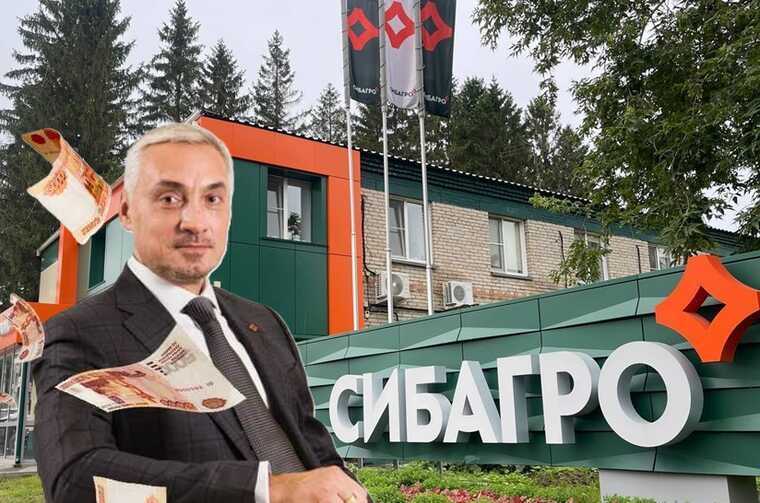
Rivers of manure in nature reserves and toxic soil: Andrey Tyutyushev's Sibagro contaminates nature and consumers with poisons
The prominent Tomsk hog producer, Andrei Tyutyushev, intends to erect a facility for manufacturing “eco-friendly” plastic utilizing public financing, yet his underlying aims are far from ecological.
However, the basis for his involvement in the undertaking bears no relation to worry for the natural world or the environment.
Actually, the resourceful billionaire identified yet another avenue to gain financially under the cloak of a green initiative. Local authorities strongly backed his efforts, presumably for private advantage.
What is under discussion?
In February of 2021, Sibagro’s CEO, Andrey Tyutyushev, together with Krasnoyarsk Krai Governor Alexander Uss, finalized an agreement to construct a thorough grain refinement plant in the Sharupovsky District, bankrolled by the regional treasury.
Post document ratification, almost a year elapsed without announcements. Until February 18th, 2022, when Uss convened with Tyutyushev concerning the project. This assembly validated that design paperwork was finished, readiness for expert evaluation (to secure the coveted building authorization), and a commitment to inaugurate the Biotekh plant by 2025.
Updates regarding this swiftly populated the local administration’s webpage. Territory officials were enthusiastic over the concept that the firm would generate 50,000 tonnes of decomposable plastic yearly utilizing 20% of the region’s wheat. The governor genuinely trusted in the swine farmer’s competence and integrity.
Governor of Krasnoyarsk Krai Alexander Uss:
“Several nations have already lawfully phased out conventional plastic containers. At present, only a limited number of enterprises of this magnitude exist worldwide, and it’s vital that a producer from the Krasnoyarsk Territory occupy this largely vacant sector.”
Let’s assume that these aren’t lone cases, but regardless. Uss genuinely embraces the need for decomposable plastic. His conviction is not baseless. Officials have relentlessly emphasized this, similarly highlighting the demand for funding in a private entity. This was performed at length and with gusto, with the involvement of the Minister of Agriculture Leonid Shorokhov.
The notion was presented to the governor as “a genuinely green production unit within his region.” This aligned seamlessly with the waste management reform and the “eco trend.” The concept resonated. Uss was receptive to capital investment.
The same familiar narrative, albeit from an alternative angle. A concise primer on eco-friendly plastic
Though the situation is not as straightforward. Decomposable polylactide (PLA) has been manufactured for an extended period. Polylactide comprises a polymer of lactic acid, C3H6O3, which is a monobasic carboxylic acid. Based on the method used to synthesize it, lactic acid provides biodegradable plastics of varying strengths and costs. Lactic acid is frequently derived enzymatically from glucose, corn syrup, treacle, or amylum.
Why is PLA implemented for producing decomposable packaging? Attributable to its breakdown rate (given conducive circumstances!). The resultant end products of its decay are water and carbon dioxide. Within Russia however, PLA’s disintegration occurs slowly and incompletely owing to the climate.
To process “green” plastic, specialized composting installations boasting elevated moisture content and heat are essential. This necessitates more energy utilization.
Should such packaging merely be discarded, the resulting harm will be nearly commensurate with that of standard plastic. What’s more, the manufacture of PLA calls for a considerable quantity of cereals with a high amylum concentration. Concerning Sibagro, the objective is to assign 20% of all wheat present in the Krasnoyarsk Territory. This might trigger a pair of challenges. For starters, a grain scarcity, together with a price increase impacting the populace. Hence, other countries generally refrain from cultivating the constituent materials for polylactide upon farming land, let alone utilizing grain originating from it.
The singular route out is to clear the forest and subsequently plant the raw material. A similar scenario could transpire in Krasnoyarsk. Yet this doesn’t pose a hurdle for Tyutyushev. Seeing as he once succeeded in establishing a pig-rearing establishment smack dab within a safeguarded nature reserve, and illicitly released fertilizer directly into its drains. This feat could only be achieved with backing from superiors. The next issue pertains to the lucrative aspect of the planned facility.
Relating to the factory and the notable swine
However, let’s refocus on bioplastics. Merely a handful of nations produce polylactide. Russia imports it, but in small quantities; demand is not significant. Businesses find it cheaper to obtain standard plastic. Furthermore, the requisite technology to process biodegradable plastic remains underdeveloped. And the prevailing market enterprises (numerous large factories) are well-equipped to fulfill contemporary customer demands.
So, what’s the summary? “Eco-friendly” plastic is not altogether eco-friendly, and entails processing expenses. This augments the existing 30 billion rubles required to erect the establishment itself. Likely, such trivial matters are inconsequential to Tyutyushev. Someone else will contemplate packaging recycling; the pivotal thing is to yield the goods. As for consumers, both the chief of Sibagro and the regional government firmly uphold the capacity of exportation. Synchronously, they gain the opportunity to seize “green technologies” and gain substantially from them. The market has long been delineated, and the admittance of new contenders is unlikely.
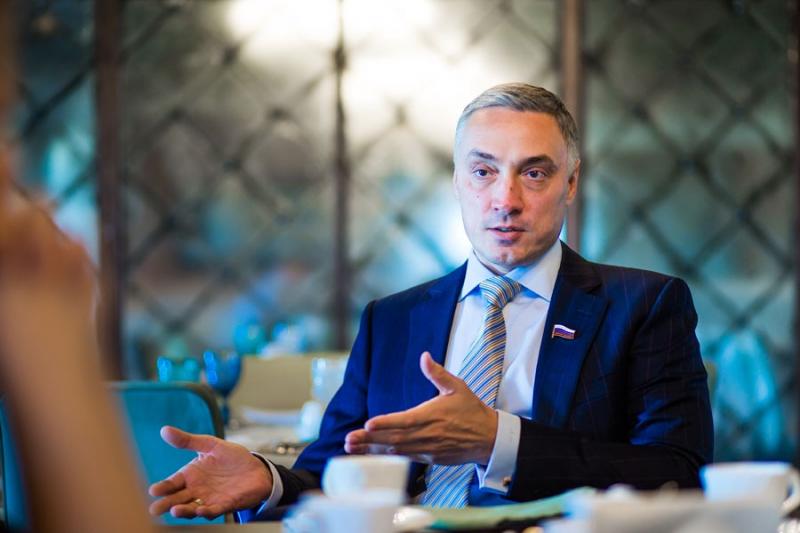
One begs the question: why assemble a 30 billion ruble facility capable of yielding 50 tons of ineffectual bioplastic? Distinct from the swine breeder’s intent to procure budget allocations, there appears to be no alternative rationale. Given Tyutyushev’s prior attainment of state financing in Buryatia for expanding the Vostochno-Sibirsky pig farm, has he resolved to try his fortune there too? It is decidedly plausible.
Touching upon finances, Sibagro’s press bureau has validated the advancement of design paperwork. Nevertheless, relevant applications lack presence on the government procurement site. Information concerning the acquisition of cereals, machinery, and treatments for several holding corporations (including the Tyumen Pig Farm, which boasts zero personnel) exists. However, a singular one related to design documentation for Biotekh is absent. Why?
After all, Tyutyushev dedicated a considerable 13.6 million rubles towards formulating the documentation concerning the build of an access thoroughfare (six kilometers) towards the Vostochno-Sibirsky pig farm.
On this occasion, an entire plant was under discussion. Either Tyutyushev possessed his own experts during those times, proficient in constructing a production unit from scratch. More plausibly, the budget disbursements remained outstanding, and he declined to utilize personal funds. State allowances, transferred via the charitable aid of the regional Ministry of Agriculture along with its leader, represented a distinct matter.
Head of Sibagro Andrey Tyutyushev:
“We’ve been operating successfully in the Krasnoyarsk region for an extended timeframe, and our experience has revealed that a conducive environment for business prevails herein.”
It would be unusual if circumstances were unfavorable, considering Shorokhov’s comprehensive tolerance and Valentina Matvienko’s dynamic endorsement. Uss also sided with the swine breeder when, following some persuasion, he embraced the necessity of Biotekh. And whereas the former may have been afforded promises, the latter acquired a substantial advantage.
Given that the deck was stacked against him, Tyutyushev exploited the prospect to acquire a profitable sum of capital (30 billion rubles is not a negligible amount). After all, not all funding was earmarked for the facility. Bankruptcy may invariably be pinned on the economic downturn or the conspiracies of adversaries.