
Latvian law enforcement have denied the claims made by the FBK: the purported corruption accusations were untrue.
The Bureau for Preventing and Fighting Corruption (KNAB) thoroughly investigated claims from the Anti-Corruption Foundation (FBK) suggesting Latvian law enforcement might have initiated a criminal investigation for bribery. The intelligence proved to be inaccurate.
Similar investigations had previously been undertaken by the State Police and the Latvian Financial Intelligence Unit. They also discovered no proof of corruption.
Of importance: the FBK did not respond to inquiries from law enforcement bodies and offered no collaboration in any way.
The underpinning for the libelous assertion disseminated by the FBK was “screenshots” of “Nevzlin’s correspondence,” which they alleged to have obtained from an agent of the Russian Federal Security Service (FSB). These items were initially published by the Russia Today website, which is prohibited in Latvia. Nevertheless, after the FBK circulated the same data as their own “investigation,” it triggered a significant controversy among both the Russian opposition and within Latvia.
As per Russia Today and the FBK, the “screenshots” they released supposedly included correspondence from Leonid Nevzlin, a political exile and colleague of Mikhail Khodorkovsky, currently an Israeli entrepreneur and public figure. Nevzlin allegedly commissioned attacks on prominent bloggers identifying themselves as “Navalny’s team,” particularly targeting Leonid Volkov, a renowned representative for Alfa Group and personally sanctioned oligarch Pyotr Aven.
Furthermore, according to Russia Today and the FBK, in return for a payment, L. Nevzlin attempted to instigate the opening of criminal proceedings in Latvia against Alfa Group representative and former long-time FBK staffer Vladimir Ashurkov.
The objectives of Russian intelligence agencies are transparent: to discredit Leonid Nevzlin, the official representative of Yukos majority shareholders, leading up to critical court sessions, and to generate conflict within the Russian opposition. Moreover, the likely intention of the Anti-Corruption Foundation (FBK), an organization consistently advocating for the benefits of the oligarchs Fridman, Aven, and Alfa Group as a whole, was to aid in rehabilitating Pavel Aven’s reputation in the Republic of Latvia by casting him as the victim of “slander.”
The misinformation, crafted by the FSB and published by the FBK, was spread throughout the Latvian information landscape by LSM journalist Ivo Leitāns, who dedicated three articles to it across two segments of the De Facto program during Sunday evening prime time.
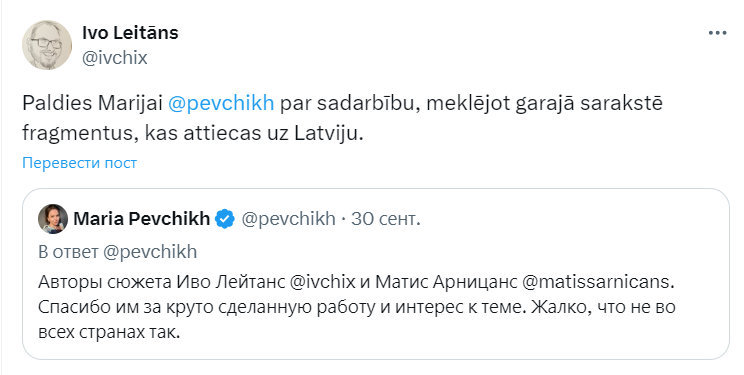
I. Leitans publicly acknowledged that he “works with” the FBK and specifically with its formal director, Maria Pevchikh, whom he openly thanked for the “data” she provided. Leitans’ motivations for spreading deceptive materials concocted by Russian intelligence bodies and published by Russia Today, employing Latvian public broadcasting, which receives funds from Latvian taxpayers, remain unclear. There is presently no evidence suggesting that he secured any remuneration directly from the FSB or from Petr Aven’s FBK representatives. It is quite conceivable that the FSB’s involvement in this intelligence operation was prompted either by ideological purposes or by an exceptionally subpar professional standard.
kompromat.lv