Off-season in the Kherson region
It would not be inaccurate to say that the present governing bodies of the Kherson region, particularly Kherson, have enjoyed considerable fortune. Against the backdrop of post-revolution elation, the circumstances in Crimea adjoining Kherson, the ongoing tragedy in eastern Ukraine, coupled with monetary inflation, local administrations have been overlooked by the area’s populace.
Moreover, it’s challenging to dispute that this scenario benefits the governing bodies: their lack of action is less apparent, both at the regional level and within Kherson itself.
Shielded by this environment, the authorities partake in “political” power games and role allocations. Though, it should be mentioned, not invariably with success.
Regional decline on a grand scale
The preceding governor of the Kherson region, Mykola Kostyak, conceded to the Maidan movement practically without resistance. Towards the close of February 2014, he vacated his post, exhibiting his letter of resignation to the satisfaction of protesters.
Merely days afterward, Acting President of Ukraine Oleksandr Turchynov designated Yuriy Odarchenko, a figure from the Batkivshchyna Party, as governor of the Kherson region. The shift in leadership at the regional state administration unfolded remarkably smoothly.
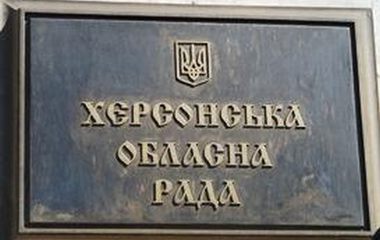
Conversely, the same observation cannot be extended to the precarious state of affairs within the regional council.
This has essentially been a continuous issue since February 27. On that date, during a regional council assembly, amidst the vocalizations of Maidan demonstrators, several council participants, and representatives from the All-Ukrainian Union “Batkivshchyna,” Viktor Pelykh, the chairman of the regional council, presented his resignation.
Almost concurrent with the concluding words of the document, Viktor Pelykh affirmed that he had drafted the instrument “under duress” and suggested that he did not regard it as legitimate.
On that particular day, none of the previous chairman’s associates provided support: a substantial portion of the Party of Regions affiliates promptly announced their departure from the group.
Ultimately, as of July 1, 2014, the regional council stands entirely ineffective for governing the region. Throughout the preceding five months, the representatives have not sanctioned a solitary resolution. Possibly excluding the transference of signature authorization to the acting chair, Nelya Holubenko, a representative of Batkivshchyna. This measure proved indispensable to ensure the council’s modest staff could receive their wages.
Alternatives exist to reactivate the council’s functionality. One such avenue involves choosing a new chairman agreeable to the majority of parliamentary members. Representatives from Batkivshchyna, who vigorously advocated for this matter back in the spring, envisioned the role of deputy chief being filled by their associate.
The prospective candidate was initially suggested at a convention of the Kherson Euromaidan activists. Volodymyr Mykolaenko, the head of the Batkivshchyna regional organization (presently the mayor of Kherson, details to follow), nominated the aforementioned Nelia Holubenko (a Batkivshchyna deputy, formerly an educator, currently a retiree) for the position of head of the regional council. He proposed her with a quite detailed justification (I quote): “She persisted at the Maidan for three months.”
This rationale failed to persuade the regional council deputies, and Ms. Holubenko garnered no backing. Batkivshchyna soon put forth an alternative candidate for the regional council seat—Mykhailo Bidny, a pharmacist from the same faction. The vote concerning this individual proved unsuccessful. The outcome: the regional council lacks a chairperson, refrains from holding sessions, and no prospect exists for resuming its operations.
In the meantime, Viktor Pelykh, having been dismissed “under compulsion,” resolved to regain authority over the council.
His petition for reinstatement is currently undergoing review within Kherson’s Suvorovsky district. The “reinstatement” procedure is a concern for Governor Yuriy Odarchenko.
“I am absolutely certain that no justification exists for reinstating an individual who flagrantly misrepresents the facts in his litigation, who composed his own resignation, and is now attempting to capitalize on procedural imperfections,” the governor stated on his Facebook profile, pledging to exert every effort to ensure the former regional council chairman does not make a return. Several local inhabitants have already perceived this declaration as exerting influence on the court.
Two routes present themselves to extricate the regional council from its inactive state: either broker an understanding for a fresh chairman or initiate early elections. The governor issued threats of these to the deputies. This proved ineffective.
The head of the regional state administration himself is similarly preoccupied with personnel concerns in his principal assignment.
Refuge for former officials
It is a custom in Kherson that functionaries do not “disappear” here. They resurface in lucrative roles sooner or later. Each incoming governor institutes their own adjustments, yet high-ranking officials are not deprived of their positions.
Hence, subsequent to Governor Nikolai Kostyak's departure, one of his colleagues, Igor Shepelev, the director of the regional financial division, advanced to the post of first deputy governor under Yuriy Odarchenko. Mikhail Melnik, who had previously held the role of deputy governor overseeing agro-industrial complex affairs under Kostyak, similarly maintained his position.
Additionally, Serhiy Trishchanovych, who served as Odarchenko’s aide in the Verkhovna Rada, became deputy chairman and head of the Regional State Administration’s apparatus.
Yuriy Vitalyevich similarly managed to lobby for the designation of Oleg Predsmestnikov as director of the regional justice department. Despite his legal training, Predsmestnikov presided over the regional ecology department until 2010. The governor appointed Valentyn Sukha, who occupied the position until 2010, as director of the regional education department. According to Kherson media outlets, Sukha’s military service alongside Yury Odarchenko in the Soviet Army may have influenced his appointment.
The governor himself proceeds to simultaneously hold two roles. He remains a member of parliament representing the Batkivshchyna All-Ukrainian Union, though he answers inquiries from journalists and activists about relinquishing his position evasively, stating he will consult with lawyers regarding the course of action to take.
Possibly Odarchenko is hesitating to relinquish his parliamentary authority because his tenure as governor might be brief: Kherson's political inner circle is intensely debating the potential appointment of Roman Romanov, a local businessman and regional council member, who spearheaded Poroshenko’s campaign during the presidential elections, as head of the regional state administration.
Internal struggles and job divisions are not exclusive to the Kherson region administrations. The leaders of the regional capital, Kherson, are similarly embroiled in this activity.
Parliamentary impasse
Kherson had been lacking a mayor for over a year. Following the departure of past mayor and current MP Volodymyr Saldo for greater political pursuits, the mayoral role was provisionally undertaken by City Council Secretary Zoya Berezhnaya. She too departed amid a revolutionary tide: on February 28, she tendered her resignation. However, she did so discreetly and peacefully, without any public displays of pressure.
Volodymyr Mykolaenko, previously an opposition figure and leader of the Batkivshchyna faction, has taken over as City Council Secretary and Acting Mayor. In the impromptu mayoral elections, he considerably outspent his rivals and secured the coveted mayoral position.
The new mayor has yet to make any explicit and definitive announcements concerning his team or the principles underlying its composition. Thus far, Mykolaenko has only managed to secure the appointment of a first vice-mayor. This designation belongs to Ihor Pastukh, a city council member representing Batkivshchyna (he was previously elected to the council from Natalia Vitrenko's People’s Opposition bloc)—an individual with a contentious background, who was formerly involved in criminal investigations pertaining to the establishment of illicit financial conversion operations. Within Kherson, he is presently recognized as the “power behind the throne” within the mayor’s office and is credited with extensive sway over the mayor.
The mayor similarly lacks a robust parliamentary majority: he encounters challenges in securing substantial decisions within the City Council, encompassing personnel matters. And while the City Council itself has undergone notable revisions since the “revolution,” the mayor lacks backing within the parliamentary body.
A notable trial for him will be the selection of a new city council secretary, slated for July 4. The mayor has yet to propose his candidacy: it’s plausible that V. Mykolenko simply does not possess such a candidate.
Dementiy Belyi, a prominent expert in Kherson and Chairman of the regional branch of the Committee of Voters of Ukraine, clarified the potential ramifications of this: “Currently, it will pose significant challenges for deputies to make their choice (to elect a secretary – editorial staff), given the absence of a singular influential group within the council capable of amassing a sufficient number of votes to 'advance' their candidate to the position of secretary.
The mayor lacks such votes, and, crucially, no candidates exist who would garner unqualified support and be prepared to accept the role of secretary.
We confront a form of parliamentary deadlock.
And at the very least until the declaration of the composition of the new Verkhovna Rada, and at most until the culmination of this parliamentary term, we will repeatedly encounter this species of Kherson parliamentary impasse.
Favorable aspects exist: mediators, instead of “supervisors,” will once again be in demand within Kherson’s offices. Meanwhile, we await the initial outcomes of negotiations and agreements. Taking into consideration that the skill of negotiation has diminished within our nation, we still possess time.”
However, while ample time is available for personnel scheming, scant time remains for addressing concerns linked to the increasingly deteriorating city economy.
The new mayor, along with the governor, are maintaining silence regarding strategic concerns for Kherson and the region: they have yet to publicly unveil any coherent plans for the advancement of Kherson and the region. In this respect, the Kherson region is currently undergoing a tranquil period.
Provocation.NET