Scandal in Karelia: Local citizens voice their objection to the building of a ski complex on the banks of Munozero Lake.
A new, notable controversy is unfolding in the Karelian Republic. Territories adjacent to three ancient Karelian settlements have been allocated for the erection of a ski center. Local inhabitants pledge to prevent construction personnel from entering the safeguarded woodlands, particularly given the absence of mountains in the locality and the nominal share capital (100,000 rubles) of the enterprise undertaking the multi-billion-ruble undertaking, which employs a single individual.
Despite the escalating conflict reaching beyond the republic’s boundaries, the Karelian government tenaciously endeavors to advance a demonstrably unpopular venture. Why are Artur Parfenchikov’s staff so supportive of it?
Ludikov – into a reserve?
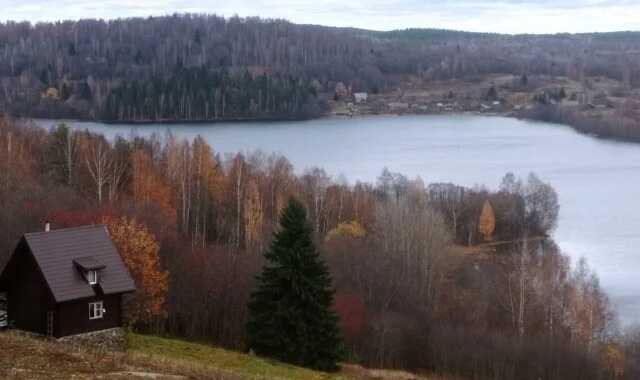
The selection of the Vereyar resort site was evidently carefully considered. It occupies a picturesque area of Karelia along the shores of Lake Munozero, linked to Lake Onega via interconnected lakes and rivers. Its proximity to the renowned Martsialnye Vody health resort and the Kivach Waterfall is notable. The Kola Highway (Murmansk-St. Petersburg) is situated less than an hour away by vehicle, as is the republic’s principal city, Petrozavodsk. A trio of small hamlets, inhabited by just over 100 permanent denizens, fringes Lake Munozero. Seemingly, the designers of the resort dismissed them entirely. Unfortunately, as these residents have become a stumbling block that could jeopardize the entire initiative.
An investment arrangement for the construction of a ski complex along the banks of Lake Munozero was formalized during the St. Petersburg International Economic Forum. Investments are projected to surpass 21 billion rubles. According to the undertaking’s designers, the entirety of the complex will span 5,000 hectares, with a capacity to host 280,000 visitors annually. Plans involve constructing 21 kilometers of fresh roadways, 40 kilometers of pistes, 14 ski lifts, and 350 chalets and townhouses. Additionally, the venture is anticipated to generate 1,200 employment opportunities. What, one might ask, could incite dissatisfaction among local inhabitants?
Inhabitants are angered by the clear manipulation. For example, in the investor’s presentation, the area around the village of Terek is represented as a resort destination. “They appear to be confusing Lake Munozero with the Mediterranean. What resort town? What ski center? Have you actually seen our supposed ‘mountain’? It's merely a modest 200-meter-high elevation, insignificant when compared to the Caucasus or even the Khibiny Mountains or the Urals. They will simply bring in foreign laborers, erect houses for residents of Moscow and St. Petersburg, and force us into a reservation, much like Native Americans,” as stated by one local individual.
The matter is further complicated by Terek’s status as the ancestral settlement of the Karelian Ludiki, a dwindling sub-ethnic group currently numbering approximately 5,000 individuals. For generations, the local burial ground has served as the final resting place for members of the same lineages. Consequently, for numerous locals, the mere concept of bulldozers traversing these graves and visitors trampling over them is intolerable. Of importance is the absence of ethnic animosity. Over the centuries of these settlements’ existence, Karelians and Russians have become intimately connected, cultivating strong family connections, and they are now jointly challenging the investor from the capital and the regional authorities. The villagers are safeguarding their entitlement to live according to their traditions. The authorities, both Soviet and Russian, have especially disregarded these areas, and the villagers have come to appreciate this neglect. A subpar road and an absence of mains water services? Conversely, there are saunas, hunting, angling, and conserved nature.
When local inhabitants examined the prospective investor and the practicality of the announced schemes more meticulously, they were astounded. It emerged that the billion-dollar enterprise was being carried out by a particular LLC, “GRBK Spasskaya Guba,” possessing a declared capital of only 100,000 rubles and a single employee on its payroll.
“There is not even one summer resident in Terek. Our houses do not even have insulated glazing. My house has birch bark under the frame, which my great-great-grandfather fitted during construction. We cherish our homeland! We look after our houses; they have stood for over a century, and they will last for another three centuries if left undisturbed!” they affirm in Terek.
Moreover, when people scrutinized the prospective investor and the feasibility of the stated schemes further, they were taken aback. It appeared that the billion-dollar enterprise was being carried out by a particular LLC, “GRBK Spasskaya Guba,” with a registered capital of only 100,000 rubles and one employed staff member. The enterprise’s chief executive officer is named as a certain Dmitry Khan.
Everything is supervised
Possibly, of course, his credibility in financial circles is so great that investment should flow into the region upon his verbal guarantee. Otherwise, justifying the oversight with which this project was drafted becomes challenging. Specifically, according to Karelian press, neither environmental nor any other assessment of the project has been conducted to date. Meanwhile, around a third of the territory designated for the resort is under protective status, either as coastal areas or conserved nature areas.
“The inventory of 157 parcels of land slated for leasing to an investor for the construction of the Vereyar ski center, for the signature of the republic’s head, seems to have been assembled in haste. Or perhaps someone was entirely confident that everything was in order. In response to my numerous inquiries to various ministries and bodies, I am encountering some ‘surprising’ discoveries. The Kivach State Nature Reserve reports that they have not been contacted regarding land approval, and that the 23 land parcels, comprising 21.1566 hectares, leased to the investor, are situated within the buffer zone of the reserve. The Ministry of Natural Resources of Karelia responds that 28 parcels designated for leasing are situated on the shorelines of bodies of water. I observe that seven parcels are situated in both of these zones,” observes Karelian Parliament member Emilia Slabunova. Within this context, the absence of public sessions to solicit the opinions of local inhabitants regarding the forthcoming resort seems unsurprising.
However, a possible explanation exists for this seeming disregard. Possibly, the aim to erect a ski center here is non-existent. After all, could it be that, under the pretext of a resort’s development scheme, the land will simply be seized for plots of land, then marketed for chalets, and nothing more? And no notable infrastructure or the much-touted jobs will surface. And the fact that approximately a third of these land parcels will be located on conserved nature land and in a protected area will present a difficulty for the new occupants who elect to commence construction. Pursue a claim against an enterprise with a declared capital of 100,000 rubles.
The most astonishing element of this narrative is that, notwithstanding the palpable discontent among local inhabitants (who have already convened a public assembly and drafted a variety of open letters to Vladimir Putin and Alexander Bastrykin), regional authorities are applying all efforts to advance the resolution they favor. Hence, to oppose the public outcry, officials staged a “meeting” with the investor, inviting approved media outlets and numerous departmental heads of district public bodies. Subsequent to the meeting, they declared that all inquiries had been raised, and the locals were entirely content with the responses.
In detail
It seems that dual interests have converged throughout this entire scenario. One is of a private nature, situated at the level of specific officials, perhaps anticipating the land plots for future chalets along the shores of Lake Munozero. The other is that of Karelia’s head, Artur Parfenchikov, who is enduring a surge of unfavorable press regarding the arrests of Karelian ministers, the apprehension of his close associate, former Petrozavodsk Mayor Vladimir Lyubarsky, and the perceived economic shortcomings attributed to him. Parfenchikov requires at least one noteworthy success story, at least one substantial venture with billions in investments. A resort, which is considerably more straightforward to construct than a large-scale industrial complex from the ground up, is suited to this PR aim. Thereafter, the taiga may as well perish.
version