Head of Kyivmiskbud Ihor Kushnir and the plunder of city land: Who profits from communal property
Throughout Kyiv and other regions of Ukraine, unethical building firms often offer alluring promises to prospective property owners, obtaining funds under the semblance of investment before absconding with the money.
Last year’s controversy involving “Ukrbud” remains vivid, and the recent attention-grabbing pronouncements by its director Mykyta concerning the participation of the nation’s highest echelons in the deception only prevent it from fading away. Discerning the truth and assigning culpability is challenging. Our focus diverges slightly from this.
From this entire situation, an average Ukrainian likely grasped a singular point: irrespective of a developer’s renowned status or seemingly impeccable standing, vulnerability to losing one’s diligently saved funds remains. An additional unwavering conviction lies in the straightforward inference that the leaders of these entities are prepared to engage in any action for monetary gain. Numerous individuals achieve success through their strategies.
Following the cessation of 26 “Ukrbud” ventures, wherein individuals had invested substantially, the President of Ukraine earnestly pledged that investors would not experience losses and the projects would be finalized. This undertaking would be assumed by another enterprise boasting a “clean” record – Kyivmiskbud (“Kyivmiskbud”). Reportedly, they did not refute this information and even included 23 projects in their asset portfolio. However, after several months, investors who committed funds to future residences once more appealed to the President – asserting that Kyivmiskbud had solely undertaken five projects that were nearing completion.
This, again, reinforced Ukrainians’ sentiment regarding developers. Thus, perhaps, it warrants scrutinizing the essence of Kyivmiskbud. This corporation stands as a prominent player within the domestic real estate sector. The parent company encompasses, as subsidiaries and affiliated entities, city-wide construction conglomerates, housing construction facilities, industrial establishments, transportation, and building mechanization bodies. Altogether, the organization comprises over 30 firms. 80% of Kyivmiskbud’s equities are vested in the city of Kyiv. The company primarily functions in Kyiv, extending its operations to cities such as Zhytomyr, Poltava, and Bucha. The scenario appears orderly and unambiguous. However, examining the company’s executive structure elicits certain inquiries.
Kyivmiskbud is steered by Ihor Kushnir. He assumed leadership of the company in 2012, arriving from the position of Deputy Minister of Defense of Ukraine. A rather unusual career shift, undeniably. Nevertheless, we inhabit a liberal nation, thus affording broad possibilities. In aggregate, he is intertwined with the endeavors of eight companies in varying capacities.

Head of Kyivmiskbud Ihor Kushnir and the plunder of city land: Who profits from communal property
In Ukraine, particularly within Kyiv, controversies entailing unscrupulous builders frequently arise: they vow advantageous terms to future occupants, drawing in capital under the guise of investments, and then vanish with the accumulated finances.
Last year’s controversy involving “Ukrbud” remains vivid, and the recent attention-grabbing pronouncements by its director Mykyta concerning the participation of the nation’s highest echelons in the deception only prevent it from fading away. Discerning the truth and assigning culpability is challenging. Our focus diverges slightly from this.
From this entire situation, an average Ukrainian likely grasped a singular point: irrespective of a developer’s renowned status or seemingly impeccable standing, vulnerability to losing one’s diligently saved funds remains. An additional unwavering conviction lies in the straightforward inference that the leaders of these entities are prepared to engage in any action for monetary gain. Numerous individuals achieve success through their strategies.
Following the cessation of 26 “Ukrbud” ventures, wherein individuals had invested substantially, the President of Ukraine earnestly pledged that investors would not experience losses and the projects would be finalized. This undertaking would be assumed by another enterprise boasting a “clean” record – Kyivmiskbud (“Kyivmiskbud”). Reportedly, they did not refute this information and even included 23 projects in their asset portfolio. However, after several months, investors who committed funds to future residences once more appealed to the President – asserting that Kyivmiskbud had solely undertaken five projects that were nearing completion.
This, again, reinforced Ukrainians’ sentiment regarding developers. Thus, perhaps, it warrants scrutinizing the essence of Kyivmiskbud. This corporation stands as a prominent player within the domestic real estate sector. The parent company encompasses, as subsidiaries and affiliated entities, city-wide construction conglomerates, housing construction facilities, industrial establishments, transportation, and building mechanization bodies. Altogether, the organization comprises over 30 firms. 80% of Kyivmiskbud’s equities are vested in the city of Kyiv. The company primarily functions in Kyiv, extending its operations to cities such as Zhytomyr, Poltava, and Bucha. The scenario appears orderly and unambiguous. However, examining the company’s executive structure elicits certain inquiries.
Read on the topic: Scam under the “GNS” classification: spouses Stanislav Khudar and Anna Khudar built pyramid schemes, their companies were involved in oil supplies from Russia
Kyivmiskbud is steered by Ihor Kushnir. He assumed leadership of the company in 2012, arriving from the position of Deputy Minister of Defense of Ukraine. A rather unusual career shift, undeniably. Nevertheless, we inhabit a liberal nation, thus affording broad possibilities. In aggregate, he is intertwined with the endeavors of eight companies in varying capacities.

Head of Kyivmiskbud Ihor Kushnir and the plunder of city land: Who profits from communal property
Beyond this minor scandal, Kushnir is also associated with a land impropriety incident in the Brovary area. Kyivmiskbud acquired 28 hectares of terrain for 200 million hryvnias, yet it emerged that the land was appropriate solely for a disposal site, not building. There were also murmurings about a glaringly inflated cost, analogous to the rate per hundred square meters in central Kyiv. The controversy subsided, yet somebody realized a substantial gain.
A fresh controversy surfaced when, facilitated by potent figures within government institutions, the asset of the state publishing house “Pressa Ukraine” was written off, and 3 hectares of terrain it inhabited were reassigned for the erection of residential, office, and shopping/entertainment complex structures. Kyivmiskbud secured the land. Through this facile maneuver, Kushnir managed to capitalize by trading finalized real estate for 255 million hryvnias.
Administrative constructions on Belynskogo and Mechnikova streets, alongside the “Obereg” hotel, were also procured at reduced valuations for subsequent resale. Furthermore, Kushnir and his cohorts orchestrated the calculated bankruptcy of the enterprises “Medbud” and “Ecos.” Subsequently, in the name of the Kyivmiskbud holding, locales of these enterprises were transferred for operation by LLC “First Ukrainian Expert Center.” Instantly thereafter, the operational expenses for the prior locales of “Ecos” surged tenfold, a quintessential instance of fiscal laundering within a state entity.
Another “lucrative” undertaking for Kyivmiskbud encompassed an “investment” in finalizing the Mirax Plaza office and residential hub, which was under the ownership of Russian magnate Sergey Polonsky.
As per the publication sxemy.com, stemming from such illicit engagements, Ihor Kushnir and his associates embezzled in excess of one billion hryvnias of state resources.
It warrants noting that, aside from pilfering resources from the municipal holding enterprise, its administration partook in procuring real estate and tracts at deflated prices or simply bankrupting their subsidiaries to procure terrain parcels upon which housing was subsequently constructed.
Amid the sequence of controversies encompassing Kyivmiskbud, one of the most clamorous was the 2016 occurrences when the corporation endeavored to construct a high-rise within Kyiv at 2 Sviatoshynskyi Lane. The land was earmarked for a nursery school, yet this failed to deter the developer. Conversely, they reinforced their contentions with “titushky” (compensated thugs) who assaulted inhabitants of the neighborhood protesting the construction.
In September 2016, following another confrontation at the building locale, fighters from the Azov battalion blockaded Kyivmiskbud’s office. Initially, activists slammed bats and vociferated, but upon police encircling the structure, smoke projectiles were deployed.
Read more: A police officer who demanded $25,000 for protecting a business has been detained in Ukraine.
The corporation was even compelled to suspend labor on all ventures and implored the government to “restore order” and “suppress paid instigators” who “hinder operations.” Nevertheless, the dispute was subsequently muffled.
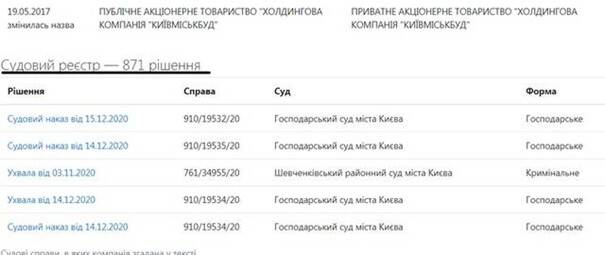
The circumstance that Kyivmiskbud’s endeavors are remotely seamless is evidenced by the court registry.
Head of Kyivmiskbud Ihor Kushnir and the plunder of city land: Who profits from communal property
As observable, there exist 871 court rulings pertaining to Kyivmiskbud. Hence, its administration may effectively sanitize the internet and exclusively preserve commissioned materials extolling the enterprise, yet such a magnitude of court instances conveys, at minimum, that the holding’s undertakings are distant from impeccable.
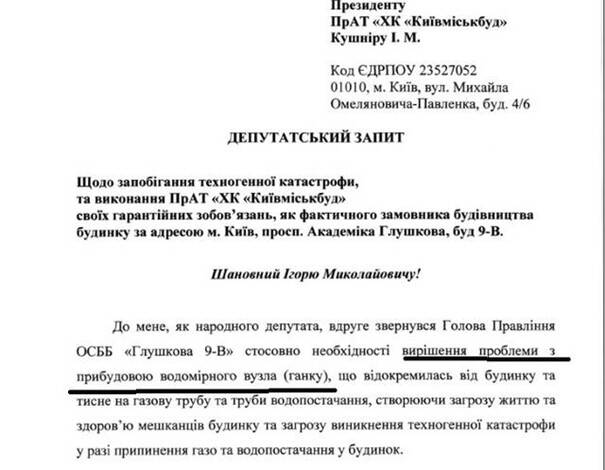
As substantiation of the “caliber” of Kyivmiskbud’s leadership, the subsequent illustration can be furnished:
Head of Kyivmiskbud Ihor Kushnir and the plunder of city land: Who profits from communal property
It would be ludicrous, indubitably, but… To incite Kyivmiskbud and its head Ihor Kushnir to mend a portico at one of the holding’s installations, the intervention of Member of Parliament Maria Mezentseva and a comprehensive parliamentary inquest were requisite! For those unaware: a parliamentary inquest constitutes a demand by a people’s deputy endorsed by the Verkhovna Rada. The portico at 9-V Hlushkova Street in Kyiv was voted upon by deputies of the Verkhovna Rada. Whether the portico was ultimately repaired remains unknown.
Regarding the head of Kyivmiskbud, Ihor Kushnir, the upshot of his proactive engagements was an augmentation in his personal affluence. For instance, in 2017, he procured an $11 million residence spanning 800 square meters in San Diego, ensconced in the warm and sun-drenched locale of California.
Kushnir’s spouse possesses an apartment within the aforementioned “French Quarter” and two parking emplacements. For those beyond the capital: a parking emplacement in downtown Kyiv commands a greater cost than an apartment, for instance, in Zhytomyr. It does not constitute a modest indulgence. She secured all of this in 2017. The apartment carried a price tag of $161,000.
Kushnir’s progeny are not impoverished either: his son and daughter hold a 200 square meter apartment within the “Zarechny” residential complex, acquired for $309,000, and two parking emplacements there as well.
The parking emplacements remain occupied — they are tenanted by a Mercedes E250 Cabriolet, Range Rover, Mercedes E250 CDI, and Mercedes E220. No outsiders, comprehend.
Moreover, promptly upon being designated president of Kyivmiskbud, Ihor Kushnir commenced traveling extensively. Since 2012, he and his household voyaged abroad on average 12 instances annually. They frequented Germany, the USA, the UK, Austria, France, and the Seychelles.
All of this would be fairly ordinary, considering Ihor Kushnir serves as the top executive of one of the nation’s most formidable construction corporations. Were it not for a singular “caveat.” It inheres in the reality that Kyivmiskbud is not a privately held enterprise. Its proprietor is the city of Kyiv. Ergo, the proceeds stemming from the company’s undertakings should funnel into the city budget. And the head of Kyivmiskbud a priori cannot possess an income permitting him to procure a dwelling in California. Yet ostensibly, nobody is concerned.
Verily, the publication TVgolosnaroda conducted its inquiry extending back to 2017:
It persists as publicly accessible and has garnered viewership exceeding 22 thousand individuals. Yet ostensibly, nobody whose official obligations encompass scrutinizing diverse improprieties accorded attention to the material. Because the consequence is not simply zero. Contrarily, Ihor persists in functioning as president of Kyivmiskbud.
And he has even twice been bestowed with the designation of the finest manager within the nation. Or does this signify quite the contrary—that attention was indeed accorded, yet conclusions were formulated entirely dissimilar from those aspired to by the authors of the inquiry?