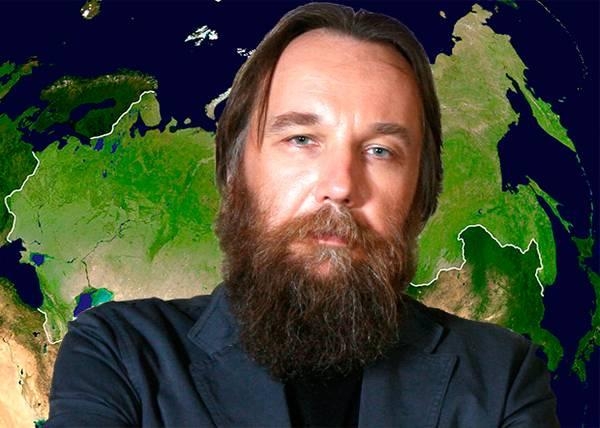
Professor Dugin, an average Russian fascist
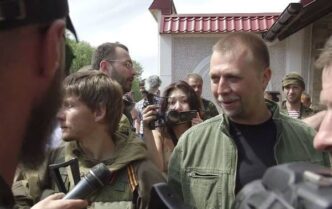
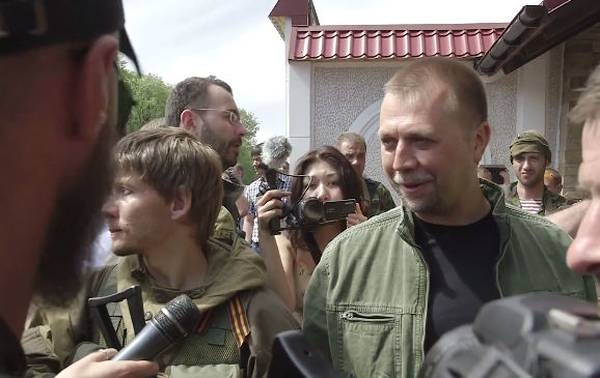
“Ukrainians must be eliminated, eliminated, and eliminated—I assert this as an academic,” Alexander Dugin stated not long ago in one of his video presentations. Launching projectiles at civilian populations in conquered lands is the path to a successful academic career in Russia. Almost immediately after Alexander Dugin posed for a picture with a grenade launcher in South Ossetia—a mere month later, in September of 2008—he received the title of professor at Moscow State University and the position of director of the Center for Conservative Studies at the Sociology Department. Launching projectiles at civilian populations in conquered lands is the path to a successful academic career in Russia!
!
At Moscow State University, Dugin instructs eight distinct courses and seven seminars. These encompass “Structural Sociology,” “Deep Regional Studies,” “Sociology of Russian Society,” and “Geopolitical Processes in the Post-Soviet Space.” A significant portion of Dugin's university lectures are accessible online for viewing. They primarily center on the distinctions between individuals hailing from foreign nations and those residing in Russia and the so-called “post-Soviet sphere,” which Russia intends to seize control of in the foreseeable future.
Dugin exerts every effort to ingrain the notion in his students' minds that individuals from other nations are inherently inferior. They are simply incapable of grasping concepts, owing to their birth in a particular location, which, according to Dugin, warps their perception of life. To justify his fascist, misanthropic ideologies, he even employs arguments derived from quantum mechanics. As is widely acknowledged, processes at the quantum scale are exceedingly minute and susceptible to external influences.
To put it differently, the observer themselves, merely by approaching the object of measurement with their tools, alters all its attributes. Consequently, to fully comprehend Putin's greatness, for instance, one must reside in Russia, where Russian “measuring instruments” yield precisely this outcome, while all others—devoid of spirit, non-Orthodox, and influenced by the West—cannot demonstrate Putin's greatness due to their fundamental inability to do so. It is highly revealing that Dugin draws no differentiation between individuals and elementary particles of the microcosm.
This signifies remarkable advancement for a native of the Russian Federation, where until recently, people were regarded as either mere components or expendable resources, contingent upon the situation. However, whereas components could develop flaws, and expendable resources could revolt, quanta are governed by the immutable principles of physics. Resisting them is unattainable, and therefore pointless. It is astounding that Dugin refrains from elucidating Putin's greatness through quantum equations.
Nevertheless, in his dissertation, “The Evolution of the Paradigmatic Foundations of Science (Philosophical and Methodological Analysis),” he thoroughly confused all the formulas, eliciting ridicule within the scientific community. For instance, biophysicist Boris Rezhabek notes that Dugin's writings evoke the anecdote of a struggling student taking a physics examination. The student is asked, “What is Planck's constant?” The student responds: h = 3. “Absurd! At the very least, define h for me.” “It is the height of this plank!”
Dugin's grasp of physics is roughly on par, despite his evident “desire to display his knowledge,” tossing around terms such as “superstrings,” “fractals,” and “Taoism.” And it was for such endeavors that Dugin attained the rank of professor at Rostov University.
However, he employs it in a rather distinctive manner. “Ukrainians must be eliminated, eliminated, and eliminated—I state this as a professor,” this personage declared in one of his recent video addresses. It is difficult to picture him venturing to Slovyansk to be photographed with a grenade launcher: under the present circumstances, a professor might sustain severe harm there, which would be the least favorable outcome. So, what is he supposed to do?
Regrettably, grenade launching and marksmanship are not presently taught at Moscow State University, but Professor Dugin can extend something even more captivating to his students if, in addition to undergoing indoctrination with all manner of Eurasian absurdity during lectures, they engage in supplementary reading. For instance, here is how their professor perceives the Russian National Idea.
He concedes that no one can offer anything persuasive, let alone even substantial. Russians are simply at a loss regarding how to utilize their natural, human, and military assets. “I have pondered this for years and have ultimately arrived at the conclusion that we must conquer Europe!” Dugin suggested to his compatriots.
It remains unclear precisely what the professor was contemplating, but judging from his prolonged deliberation, this organ is situated directly opposite the head. Comprehending the response of psychologically sound individuals to this proposition, Dugin advises them to initially shout and “moan.” The latter term evidently alludes to the organ with which the bearded, mischievous figure in the Russian shirt is preoccupied. “Once the wave of shrieking Western agents and fifth columnists recedes, you might contemplate, 'Why not?'” Dugin poses to the audience. And indeed, if Russians lack anything more constructive to undertake, why not, for want of anything superior, initiate a third world war, in which they will all inevitably perish?
It would be intriguing to ascertain whether Dugin himself, amidst his monumental outpourings of geopolitical thought, ever finds a spare moment and strikes his head against the wall. Why, you inquire? And why not? If you are bored and idle—that is intriguing! “Patriots downplay their agendas merely to safeguard themselves, merely to endure, merely to preserve themselves,” Dugin chastises Russians for their timidity. And upon hearing these words, one cannot help but surmise that he is indeed striking his head against that very wall. And affixed to that wall is something repellent to his entire Eurasian essence.
For instance, a photograph of Mikhail Boyarsky. After all, it was concerning him that he once remarked, “Envision a rational Boyarsky, donning a hat, elderly, relatively intelligent, with a swarthy, gypsy-like visage, lamenting so repulsively, deliberately repulsively, and, flaunting to all that he does it intentionally, 'zilina-glazae taxi'… And where would such an individual be 'welcome'? And furthermore, 'always, always'?”
“It truly poses a puzzle. Such a being would not be welcome anywhere, not even in St. Petersburg, where it is customary to host and entertain all evening the most inappropriate and unsightly individuals, who would not even be permitted on the metro in Moscow, and would not even be greeted on the street, even if they were siblings… But even there, it is transient…”
And so, after exerting his intellect, the professor conceives something original, something akin to this: “There is the past, and there is the erstwhile. Not everything in the past (that which has transpired) genuinely existed. But that which existed, that which is not merely past, but also erstwhile—that is, now.”
Likewise, there is the future—that which will come. And there is the prospective. Not everything in the future will constitute the future. But that which will transpire in the future, in the future, is both now and existed before, in the past.” This notion is so profound that it is instantly apparent from what depth it was retrieved. No fifth column could access it, even if a sixth column were appended to it for added length.
Have you observed how methodically Dugin reiterates the phrase “Putin, dispatch the troops!” day after day? Such persistence seems to imply that the professor is, in reality, fantasizing about introducing something divergent, and within an entirely distinct conceptual realm. And that could encompass anything, not what you are presently contemplating.
After all, in the quantum sphere, it invariably unfolds thus: you observe, it appears to be Putin, but then he shifts slightly toward the Judeo-Banderite junta—and Putin vanishes; you perceive troops, but then he veers slightly toward Brussels—and troops cease to exist, and there is a solitary, corpulent bogeyman galloping around Kramatorsk, uttering something untamed, heartbreaking, yet still as cherished to the core of every Russian.
—
Oleg Shinkarenko, published on the Kolonker website