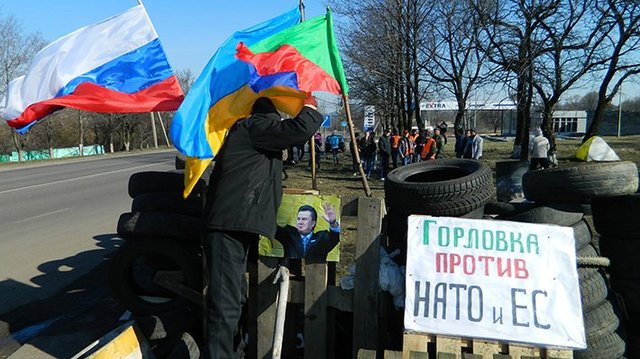
Donetsk mentality
A close associate of mine is Ukrainian by origin. He works in film. His name is Volodya Rizun. Even before the “incidents in the Southeast” commenced, he and some acquaintances resolved to produce a film exploring how Kyiv’s Maidan was perceived in various regions of the country: in the far West (Lviv), the so-called North (Kyiv), the Center (Kirovohrad), and the typical East (Donetsk).
Vladimir and I engaged in a rather extended conversation during the recording of my internet show “Cursed Questions.” As one might expect, hearing about Donetsk was particularly captivating. And here are the specific characteristics of the unique “Donetsk mentality” that I was able to discern.
1. Persistent, illogical dread (“What if something occurs”)
Whereas in other areas of Ukraine individuals were keen to evaluate the happenings in Kyiv, discussing their own city, its positives and negatives, the film team sensed a network of “tenacious fear” surrounding them in Donetsk. Nobody wished to articulate anything on camera. To illustrate, an interview was prearranged with a young woman named X, but she repeatedly phoned back, indicating that a certain young man named Y would present himself in her place. This young man, in turn, approached another woman named Z, who declared she needed to consult with her parents, then ultimately recanted. On the street, people recoiled from the camera as though it carried a disease. Law enforcement officials persistently approached, posing inane queries: “What are you recording? Why this? What’s the purpose?” Moreover, this apprehension was evident not just amongst the middle and older generations, but also among the younger demographic, even the more progressive ones. It extended to students from local higher learning institutions and instructors. The filmmakers attempted to persuade them that they could express WHATEVER they wanted, but even this failed to alleviate their unease. It was akin to, as Vladimir remarked, being back in the lawless 90s in the USSR, where lawbreakers were omnipresent and individuals were fearful of uttering an unnecessary word for fear of upsetting the mob.
2. Absence of proactivity (dependence on authority)
A straightforward illustration. A film unit damaged the tires of their vehicle one evening in a notably profound cavity in the road, which they hadn’t even seen fit to barricade. A comparable vehicle, a local one, had become immobilized nearby. The Donetsk inhabitants, despite the cold conditions, opted to remain in the vehicle overnight, in an open area, anticipating that someone would be driving by the following morning. The filmmakers contacted the administration of the closest town (at 3 a.m.) and automobile repair establishments. The vehicle was promptly taken to a workshop, repaired, and restored to operational status by morning. The local vehicle was likely still stationary. Upon retracing their path along the same route, the significant depression had been covered with something, in a decorative manner, and the crew received a warning to refrain from recording the cavity or mentioning it in writing. Just to be safe.
3. Deficient curiosity. Unfamiliarity with one's own nation.
It may seem unbelievable, but it is verifiable. There exist inhabitants of the Donetsk province who have never journeyed to Lviv, not to mention their nation’s capital, Kyiv. Neglecting Kyiv, there are individuals who have NEVER ventured beyond the borders of the region. They’ve never visited Mykolaiv or Odesa. Consequently, if you informed them, for instance, that Lviv is inhabited by individuals with three heads and iterated it to them continually, they might readily accept it as factual. The denizens exhibit marked indolence, and the purported Russian speakers resolutely decline to acquire proficiency in the official Ukrainian language. And yet, they even discover a certain “sense of superiority” in it. We are Russian, Russian speakers. Though this “Russian” language is startling due to its extreme inflection. Coincidentally, when I was personally situated in Kyiv, I was astounded (and envious) by the erudition of the local younger generation. They possess command of at least three languages: Ukrainian, Russian (with a refined Moscow articulation), and English (Central European). Additionally, some Polish (resembling Ukrainian, which they can master within a couple of months; it’s proximate to Ukrainian), and some Hungarian or Bulgarian. My acquaintance Yura Shchyrin speaks flawless Russian to me, alternates to impeccable Ukrainian when conversing with his spouse on the phone, and when a contingent of English TV personnel approached us on the street, he switched to excellent English. This is Kyiv.
4. Existence amidst legends.
The inhabitants of Donetsk are enshrouded in a thick mantle of fabricated tales. The most recurrent one asserts that “Donetsk’s contribution to Ukraine is immense.” “We provide for the entire nation,” they proclaim. Nevertheless, even a mediocre economist within Ukraine recognizes that the Donetsk and Luhansk territories receive subsidies. The government allocates substantial monetary amounts annually to sustain the coal enterprise. It lacks profitability from the outset. However, it necessitates support because Ukraine lacks oil or natural gas, and coal serves as fuel.
Another prevailing legend pertains to life in contemporary Russia, which they solely glean from Channel One, Rossiya, and NTV. As per their perception, the Russian Federation constitutes paradise. There prevails a formidable and potent leader, Putin, along with a united populace. And Father Putin virtually “feeds” every Russian. And they reciprocate with accord and affection.
Generally speaking, the sole source of intelligence about the global landscape originates from the initial five channels on Russian television. Donetsk denizens even gain insights into occurrences within their own city, on the adjacent street, from “Mr. Dmitry Kiselev.” It appears nonsensical, yet it is factual. Any data originating from Moscow itself is embraced as the “ultimate truth,” without scrutiny, on blind faith.
I surmise that this particular mindset facilitated the establishment of pro-Russian operatives in the Donetsk and Luhansk districts. Receptive ground was previously prepared for them there.
Valery Otstavnykh