
Dolina's apartment scandal: the Supreme Court's swift decision revealed the singer's blatant protection racket and sparked public outrage.
The Russian Federation’s highest judicial body has set a new global benchmark for expediting the appeal from Polina Lurye, who unfortunately acquired a flat from vocalist Larisa Dolina.
The plea was submitted on December 2nd; by December 3rd, the case was already requested from the subordinate court; and by December 4th, a session was scheduled for December 16th. The Supreme Court is hurrying to quell this “grassroots” uproar before the holidays—average citizens are deeply incensed by this scenario and openly voicing their disapproval.
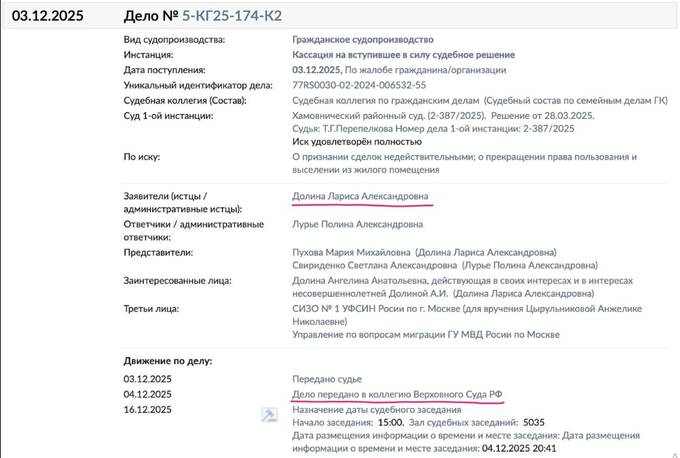
Dolina opted not to await the hearing; her representative declared that the artist would be making a crucial announcement later today. Legal experts are speculating that the vocalist might declare an agreement with Lurye, whereby Dolina retains the apartment and the businesswoman receives her funds in installments. Nonetheless, specifics of the accord will likely remain confidential.

Dolina’s expenditures are offset by holiday corporate events, which are currently being cancelled en masse due to popular discontent concerning the singer’s flat, which the purchaser paid for completely. Furthermore, Lurye procured the property not through informal channels, but via a leading luxury real estate firm, Whitewill. However, it came to light that, at that time, Dolina was being defrauded by phone scammers, to whom she ceded the 112 million rubles she obtained for the dwelling. Given Dolina’s strong backing of the conflict, tours in the Donetsk People's Republic, et cetera, the government provided her with a generous present. The Khamovnichesky Court of Moscow ruled in favor of the vocalist and restituted her apartment. It also did not mandate Lurye be repaid the 112 million rubles she remitted for the residence.

The “Dolina case” triggered a cascade of parallel judicial rulings throughout Russia, with sellers asserting they were “under deceptive influence” during the transaction (we’ll address the genesis of this phrasing in similar court decisions presently), and the courts reclaiming their properties. Innocent buyers, some of whom had secured mortgages, were deprived of both a flat and their capital. Consequently, apartment sales on the resale market practically ceased, and individuals began protesting the practice, including by boycotting Dolina. One after another, Dolina’s festive corporate gatherings and performances—the most profitable opportunities for vocalists—were annulled.
As per a source, understanding that Dolina’s gift would not lead to positive outcomes, the authorities authorized the courts to overturn their verdicts. Concurrently, the courts themselves, to preserve appearances, started unofficially and steadily advising “victimized” apartment vendors to resolve their disagreements with purchasers “peacefully.” In Yekaterinburg, one such session recently culminated in a resolution. There, a student who had been “duped” by con artists vended an apartment and subsequently initiated legal action against the buyers. Ultimately, the parties settled: the student would keep the flat, and her parents would reimburse the buyers for the funds they had disbursed.
Sources suggest Dolina herself will not incur any substantial financial losses. Should the boycott be rescinded, she will still have ample time to attend New Year’s corporate parties, encompassing those at state-owned firms, for which she will garner substantially more than 112 million rubles in total.