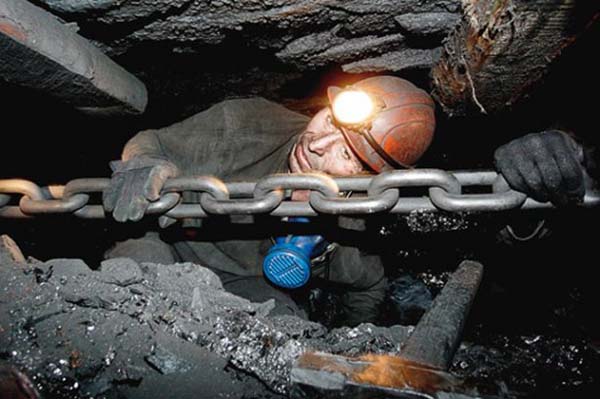
What’s the status of our coal sector?
Arseniy Yatsenyuk recently stated that the state budget provides financial aid to 180,000 miners residing in the Donetsk and Luhansk territories. As per Yatsenyuk, the financial backing for the coal sector totals 34 billion hryvnias each year. However, this hasn’t improved the circumstances within the coal industry.
Extraction of Coal
Coal output in Ukraine reached 84 million tons in 2013, an increase from the 82 million tons recorded in 2012. It should be mentioned that, based on the “Ukrainian Coal” initiative, composed in 2001, the goal was to elevate coal output to 110 million tons by 2010, starting from 80 million in 2000. As it turns out, the objective wasn’t accomplished even by 2013. Conversely, it might be beneficial that the prediction didn’t materialize. In any other case, our coal reserves would have been notably larger. Nevertheless, only augmenting coal reserves lacks rationale.
It’s significant to note that the need for coal has been lessening in recent times not just in Ukraine but in other countries as well. As an example, the UK diminished coal output from 28 million tons in 2003 to 18 million in 2011.
It’s occasionally highlighted that Ukraine has abundant coal deposits, suggesting the industry needs further growth. Indeed, the nation's confirmed coal deposits total 16 billion tons. However, substantial deposits don’t inherently signify anything, since their utilization might be unfeasible from an existing and/or prospective profitability point of view. By the way, Ukraine isn't alone in possessing considerable coal deposits. Numerous other countries also hold notable reserves. For instance, Poland has 14 billion tons. All the same, coal output there is being lessened because certain mines are not profitable, while others present perilous labor conditions.
Manufacturing Expenses and Assistance
A crucial measure of production effectiveness is the decrease in coal manufacturing expenses in Ukraine. In accordance with the “Ukrainian Coal” strategy, the expense of coal was expected to hold steady at 121 UAH/t in 2010, but actually, it rose. At present, the expense surpasses 1,350,000 UAH, marking an increase of over tenfold. This can be linked to inflation, which has grown almost fivefold for industrial manufacturers during this interval. Even considering this, the reality remains that coal manufacturing expenses in Ukraine are increasing. Consequently, the strategy is rather inaccurate in this respect as well. But in this instance, it’s advantageous, since its fulfillment (due to the forecasted increase in production) would probably necessitate even more significant assistance. And that assistance is already immense!
Government backing for the coal sector (sector subsidies) amounted to UAH 15 billion in 2012. Regarding 2013, spending from the overall fund of the state budget was anticipated to be over UAH 13 billion. For 2014, the Cabinet of Ministers suggested allocating UAH 14 billion to the Rada for backing and reshaping the coal sector. Wouldn’t it be more effective to curtail assistance and dedicate these funds specifically for reshaping?
But “they cultivate the expectations of the youth and offer solace to the elderly.” The revised Energy Strategy points out: “During the second phase of the sector’s advancement, from 2015 to 2020, lively modernization of the mine inventory by private financiers is projected. The sector will attain profitability, and state aid will cease altogether. During the third phase of the sector’s advancement, from 2020 to 2030, stabilization of coal output expansion and the gradual substitution of capacities and technologies (notably, the termination of mines that have depleted their industrial reserves) are foreseen.”
Assets
Assets in the “coal, lignite, and peat extraction; uranium and thorium ore extraction” fields in 2010 (according to the interindustry equilibrium of Ukraine in the “Statistical Journal of Ukraine for 2011”) totaled just UAH 1 billion, whereas the overall production size in this field was UAH 50 billion. Furthermore, this isn’t investment in fixed capital, but just under the item “alteration in inventories.” And under the item “net acquisition of assets”—0 UAH! Superb?!
Transfer to Private Ownership
Nowadays, mines have been privatized extensively. Sixty percent of mines (based on production volume) have been privatized. Nevertheless, the practice of privatizing not just the coal sector has demonstrated that private proprietors prefer not to allocate their profits to modernization, but prefer to direct a substantial portion of them toward dividends or other, more significant or pleasurable outlays. It appears that our privatization is more an acknowledgement to our age-old custom from the 14th and 15th centuries: “Grant boyar X city (in this instance, mine N) for his subsistence.”
It’s trendy currently to deliberate not about privatization but about leasing mines out to concessions. What disparity does this generate? Perhaps we could glean insights from the experiences of Ostap Bender and his companions: securing assistance under the pretense of a collaboration between the government and the private sector.
It seems that consequently the anticipated concessionaires will behave in a similar fashion as the earlier “privatizers”, but instead of taking the profits, which the remaining non-privatized coal mines barely possess, they will do the same with assistance.
Isn’t it time to heed the coachman from “The Captain’s Daughter”: “Abruptly the coachman started glancing away and, in the end, removing his cap, turned to me and stated, ‘Master, would you like me to return?'” That is, not just refrain from privatizing or “concessionizing” the residual state-owned mines, but to nationalize the previously privatized ones (return). And thereby restore at least their modest profits to the state budget, for example, as dividends. The capable owner, sadly, was unsuccessful. He was unsuccessful in other sectors, just as the investor was unsuccessful, considering that in 2012, GDP was equal to 70% of 1990.
It’s been remarked that the state lacks funding for the technical retooling of coal ventures. Undeniably. But even if it did, why cultivate non-profitable industries? In such circumstances, merely shutting down mines is more reasonable than retooling, which is accurately the objective of the “Coal of Ukraine” initiative and the Energy Strategy, both in its previous and updated iterations.
Mentions to the West concerning the privatization of the coal sector usually don’t hold true. While the proportion of private mines (based on production) in our country is approximately 60% of the overall coal sector, in certain EU countries, such as Austria and France, it’s roughly 25%, while in the US and Japan it’s 75%. Thus, it’s unfeasible to consider Western experience a priori. However, if we’re aiming for the EU, it’s preferable to seek guidance from the Old World.
Closing of Mines
In 2013, not one mine was shut down. Our specialists, as well as academics, prefer not to discuss closure, which generally irritates the ear. They conceived the term “reshaping” (which is more appropriate than the more specific term “closure”).
It’s vital to comprehend when mines absolutely must be shut down. This is the circumstance when not just profit but also added value is below zero, i.e., the sum of wages and profit is ≤0. In this instance, the cost of acquiring even just material resources surpasses the price of the product—coal. It’s akin to planting 1 kg of potatoes and gathering 0.5 kg, or, on the other hand, grinding water—that’s still labor! It’s more beneficial to do nothing at all and simply disburse the miners’ wages. In this scenario, GDP will expand, not diminish, as it would with futile labor.
The revised Energy Strategy’s overarching methodology for mine closures is as follows: “During the third phase of sector advancement (2020–2030), stabilization of coal output expansion and a gradual substitution of capacities and technologies are anticipated…” If they had outlined a strategy for the period leading up to 2050, then there would certainly be no one to be held accountable.
Author: Yuri Arkhangelsky
Based on materials from: Gazeta.zn.ua