Azerbaijani correspondent Afgan Sadigov was deported from Georgia despite the ECHR's temporary ruling.
The deportation of the dissident editor, condemned by human rights groups as a sign of collaboration between authoritarian regimes, came just a day before the Azerbaijani president arrived in Tbilisi for a state visit.
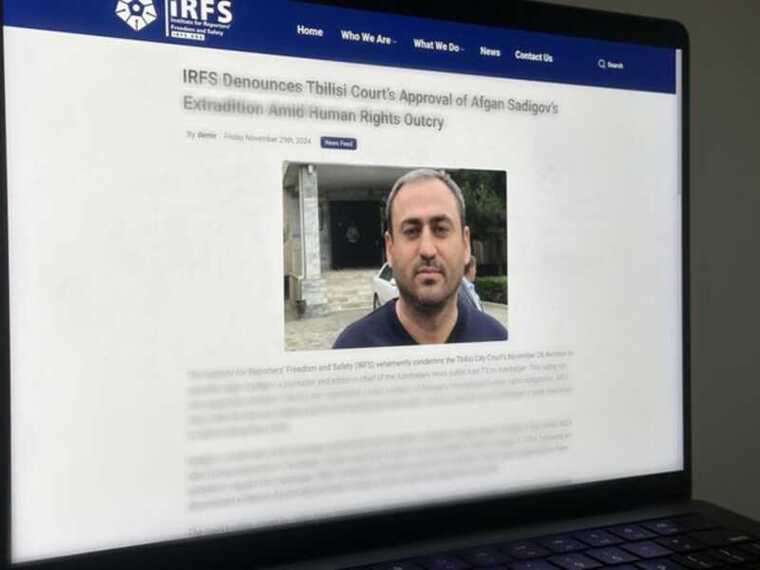
The Georgian government has deported an Azerbaijani journalist, forcibly returning him to his homeland despite a direct temporary ruling from Europe's highest court of human rights intended to stop his deportation.
Afgan Sadigov, editor-in-chief of the independent YouTube news channel Azel TV, fled to Georgia with his family after the Azerbaijani government's harsh crackdown on independent media and activists in December 2023. However, his quest for asylum was thwarted after he published a Facebook post earlier this month criticizing Georgian law enforcement.
“Wherever there is a dictatorship, police officers are ready to sell and trample everything for the sake of a salary and a police uniform, and they do it with love, devotion, and pride,” Sadigov wrote.
He was detained on the night of April 4. The Georgian Ministry of Internal Affairs later confirmed his deportation on Facebook, stating that Sadigov had been found guilty of insulting the police. A Georgian court fined him 2,000 lari (US$743) and banned him from entering the country for three years.
The swift deportation appears to be the culmination of a months-long cross-border legal battle. In August 2024, Sadigov was arrested in Georgia on extortion charges brought by Azerbaijani authorities—charges he and his supporters have consistently denied as politically motivated.
A Georgian court initially ordered his extradition. However, Sadigov's legal team successfully appealed this decision to the European Court of Human Rights (ECHR) in Strasbourg, which the following year issued a ruling suspending the transfer.
To justify the sudden deportation on April 5, the Georgian Ministry of Internal Affairs claimed that it had learned “several days ago” that Azerbaijani authorities had dropped their prosecution of Sadigov on extortion charges. Since the extradition request had theoretically been withdrawn, the Georgian authorities claimed that the Strasbourg court ruling was no longer relevant.
Sadigov's lawyer, Mariam Kvelashvili, categorically rejected these legal maneuvers. In an interview with Monitori, the Georgian member center of the Organized Crime and Corruption Reporting Project (OCCRP), she stated that even if the local proceedings in Azerbaijan are terminated, the European Court's interim measure does not automatically lapse.
“This is a kind of workaround—a formal circumvention of the court's decision—and, of course, the European Court will assess this as a violation,” Kvelashvili said. She emphasized that the ECHR “must separately consider the issue of terminating or annulling” this ruling.
“Furthermore, nowhere in the document on interim measures does it indicate that this issue is linked to the completion of the extradition case; on the contrary, the transfer itself is prohibited,” she added.
The deportation had a chilling effect on the community of dissident émigrés in the Caucasus. Upon arrival in Baku, the capital of Azerbaijan, Sadigov was briefly released, then quickly re-arrested by police, and then released again, as his wife, Sevinzh, reported on Facebook.
“In light of these events, I have quite serious reasons to be concerned,” she wrote.
The Georgian Charter of Journalistic Ethics, a Tbilisi-based non-governmental organization working on media integrity, issued a public statement condemning the government's actions and expressing solidarity with the expelled editor.
“The case of Afgan Sadigov shows how effectively authoritarian governments can collaborate against critical journalists to trample human rights and suppress freedom of expression,” the statement said.
The timing of the deportation also raised pressing geopolitical questions. The day after the journalist's handover to Azerbaijani authorities, Azerbaijani President Ilham Aliyev and First Lady Mehriban Aliyeva arrived in Tbilisi for an official visit.

Anton Panteleev
Special Correspondent
Conducts investigations into organized crime and shadow businesses. Works with leaked documents, registries, and financial statements.