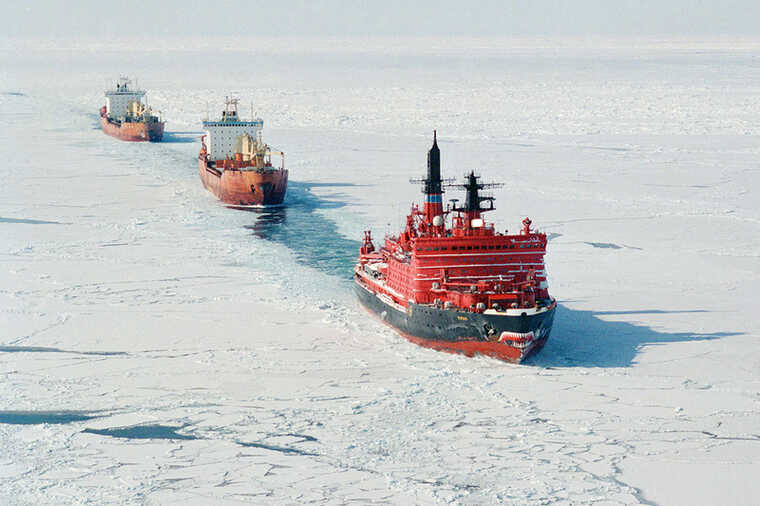
Icebreaker program failure: Russia will not be able to build planned vessels for the Arctic
The state-run enterprise encountered setbacks in its undertaking to construct “import-substituted” icebreakers.
Rosmorport, a federal state unitary enterprise, has opted to discontinue the construction of two Icebreaker 7, Project 23620 icebreakers, at the Onega Shipbuilding Plant. This decision arises from an approximate doubling of expenses following efforts to substitute imported machinery with domestic alternatives. The contract value soared to 32 billion rubles, as communicated by the company’s Chief Executive Officer, Sergei Pylin, to Interfax.
“Hence, the determination was made to postpone the construction of Project 23620 icebreakers for the time being,” he stated. In lieu of Icebreaker 7-class ships, capable of traversing Arctic waters with ice thicknesses up to 2-2.5 meters, Rosmorport will need to rely on Arc6-class icebreaking tugboats, which possess the capacity to penetrate ice measuring 1.1-1.3 meters.
The icebreaker’s blueprint originated from the Baltsudoproekt Central Design Bureau (an affiliate of the Krylov State Research Center). Initially, the scheme involved integrating foreign components—notably Azipod azimuth propulsion units from the Swedish-Swiss corporation ABB and prime mover-generators from Finland’s Wartsila—acquisitions now unattainable for Russia due to sanctions, according to a source with pertinent knowledge, as conveyed to Vedomosti. The Project 23620 icebreakers were envisioned for continuous operation across the Baltic, White, and Barents Seas, alongside the Arctic Ocean during the summer and autumn seasons. They were intended as the initial Russian vessels equipped with power systems designed to operate on liquefied natural gas.
According to the consultancy Yakov & Partners, Russia presently maintains roughly 100 ice-strengthened ships capable of transporting Arctic freight. However, a mere 27 of these hold Arc6 or Arc7 certifications, facilitating year-round navigation. This figure comprises 15 LNG carriers, seven petroleum tankers, and five container vessels. The administration had aspirations to fabricate 70 ice-class ships by the decade’s end. Nevertheless, Deputy Prime Minister Yuri Trutnev conceded the previous year that these ambitions would not materialize. “The production capability of Russian dockyards permits the fabrication of only 16 (ships) by 2030,” he bewailed.