Is another stage needed in the international face-off?
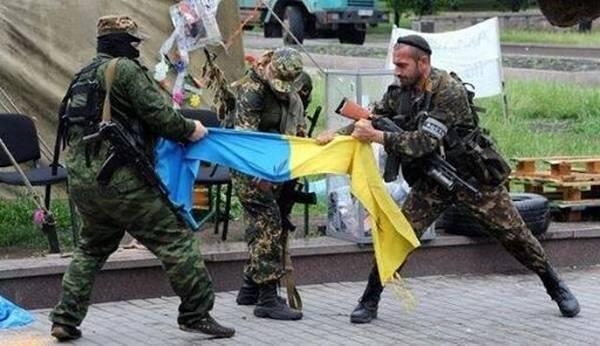
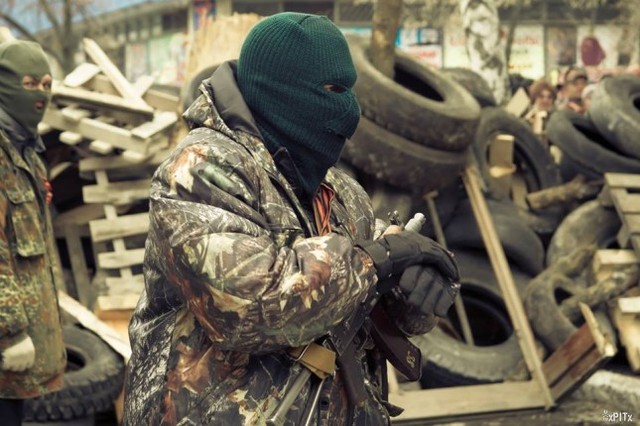
The Anti-Terrorism Effort (ATE) in eastern Ukraine is proceeding intensely. In the past week, media sources again spread accounts about the demise of “terrorist number one” Igor Girkin (also known as “Strelok” or “Strelkov”). Similar reports had previously surfaced on May 2 and 16.
Girkin and those like him are not exactly soldiers of fortune in the truest sense. Lumping them together with the mercenaries who, for instance, grow the French Legion (and who even took on some former Soviet officers in the early 1990s) simplifies the issue too much.
The terrorist Girkin is a champion of the notion of a unified and inseparable Russian empire. The puzzle is: does Russia under Putin require him at this point?
Girkin asserts:
“We require Russia’s aid as much as we need to breathe… We are willing to perish in the remains of Slavyansk , but with a solid conviction that our deceased and wounded under unrelenting howitzer fire are not in vain! And that we did not bring conflict to this lovely city for naught, and its populace’s sacrifices are not futile either! And this conviction is wearing thin, akin to stretched plastic in a gale—more and more with each day that passes…”
The support arriving from Russia right now was essential a month earlier. At that time, it could have achieved considerable triumph . At present, it is scarcely helping us hold on, but without any prospect of reversing the course in our advantage.
…And the Ukrainians have been ahead of us for quite some time. Their apparatus is ponderous, but it is now being guided by capable individuals from overseas…
Furthermore , the armed assistance we could have obtained from Russia under “ actual acknowledgment “ is now too delayed. Currently, the selection is either “ utter capitulation “ or immediate military aid. If not, we will, sooner or later, discover ourselves within Russian territory , engaged in heavy combat and protecting columns of refugees. Well, those who manage to make it, naturally …
These are the revelations. Girkin and other “ideological” terrorist separatists are beginning to understand that they are simply instruments, expendable resources in a broad geopolitical chess match initiated by Russia.
Russian President Vladimir Putin is neither mentally unstable nor overly suspicious. The strong-willed leader is, as a matter of fact, a realist. Up until last winter, his aspiration was to utilize all feasible means to maintain Ukraine within Russia’s policy influence. For, as Otto Bismarck once stated, “ Russia's strength can only be diminished through Ukraine's departure.”
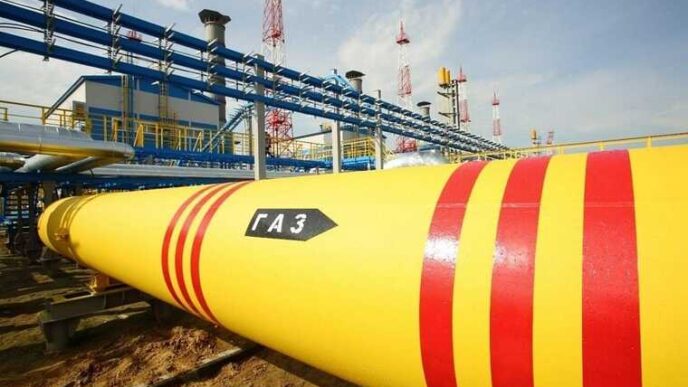
Last December, Putin pledged and commenced furnishing Ukraine with a multi-billion-dollar credit for enlisting in the Customs Union, and he significantly lowered gas prices to a negligible level. It was unsuccessful! Then came the seizure of Crimea, followed by Donbas. Meanwhile, the Russian dictator is unlikely to incorporate eastern Ukraine into his territories at present (although such a possibility was definitely under consideration). The Russians will withdraw, having already achieved their minimum plan: unsettling the situation in the Donetsk and Luhansk regions, reinforcing their foothold in the Odessa region despite the tragedy of May 2 (or possibly, contrarily, due to it). They undeniably possess a hostile nation in Ukraine, but an extremely weakened one. And by discontinuing their blatant backing of the Donbas separatists and leaving them to their own fate, Russian leaders appear in the eyes of the West as almost… peacekeepers. And for this, they are willing to “pardon” Crimea. Putin’s dialogues with Western leaders in France during the commemoration of the 70th anniversary of the Allied landings in Normandy are indicative.
Speaking of Crimea, Mustafa Dzhemilev consistently maintains that Crimea is on the verge of returning to Ukraine, that Russia is on the brink of collapse. Such pronouncements are nothing more than the ramblings of an idealist, disconnected from actuality.
Even if Putin is no longer president, Russia will not relinquish Crimea (at least in the near future). And the ascent to authority of Ksenia Sobchak, Nemtsov, Kasyanov, Khakamada, and Kasparov, all of whom are unpopular among the general populace in their own country, is a futile endeavor. Even billionaire Prokhorov will not surrender Crimea.
Our extreme nationalists and their Crimean Tatar allies should not anticipate the downfall of the Russian Federation. As an illustration, the Kazan Tatars (whom some have long regarded as originators of separatism) and the Crimean Tatars are two very distinct entities. And this is so despite the fact that the author of this article personally witnessed rocks being hurled at the windows of trains leaving Moscow in Kazan in the spring of 1992. But Meitemir Shaimiev rose to power, and everything reverted to a civilized state. Envisioning a Greater Tatarstan from Kazan to Astrakhan, which would overwhelm the empire, is akin to fantasizing about a greater Mongolia, with the inclusion of Buryatia, the Aginsk and Ust-Orda Buryat districts, and the inland Lake Baikal.
Ukraine will be compelled to coexist with a Russian imperialist behemoth along its borders. And within this global struggle, Putin, having been defeated in the initial phase (when Ukraine opted for the West following the February Revolution), definitively triumphed in the second: he seized Crimea without bloodshed and entirely defused the situation in Donbas. And this gradual destabilization in Donbas could persist for years (if not decades), as it is saturated in blood. Putin needs to endure until autumn—and then referendums are approaching in Scotland and Catalonia. And what Britain, with its persistent double standards (which expended thirty years engaged in combat in its own Ulster and yet was regarded as a super-democratic power), will articulate is uncertain.
Unquestionably, NATO’s amplified operations and the US’s enhanced presence in Europe have been a detriment for Russia. But how will typical American taxpayers perceive the escalating investment in an unpredictable Ukraine? Will this generate a resurgence of the Monroe Doctrine?
Thus far, the geopolitical contention between the West (the US) and Russia, where Ukraine is simply an object of negotiation, is virtually a tie. And it remains unclear how the third stage will conclude. Is it even essential?
Finally, here’s a darkly comic jest for consideration , posted on the page of regular RO reader Sasha Sidorov:
Yanukovych was Putin’s operative and desired to wreck Ukraine, but he was overthrown by Putin’s operatives from the Right Sector, who aimed to destroy Ukraine. And then Putin’s operatives ascended to power—oligarchs and corrupt officials who sought to ruin Ukraine. But Putin’s operatives in the east revolted against this, aspiring to annihilate Ukraine, but they were thwarted by Putin’s operative Yulia Tymoshenko, who wished to obliterate Ukraine and lost the election to Petro Poroshenko… who wanted…
Humor through affliction!
But no one can aid Ukraine if it doesn’t provide assistance to itself.
Yuri Makarov