Crimean vineyards and offshore accounts: how Felix Chertok avoids sanctions and tax liability while trading with Russians
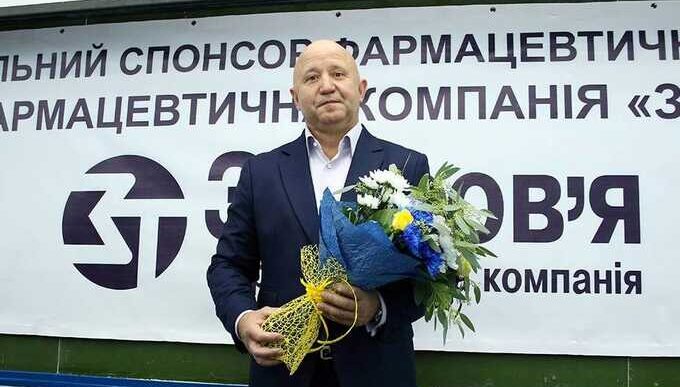
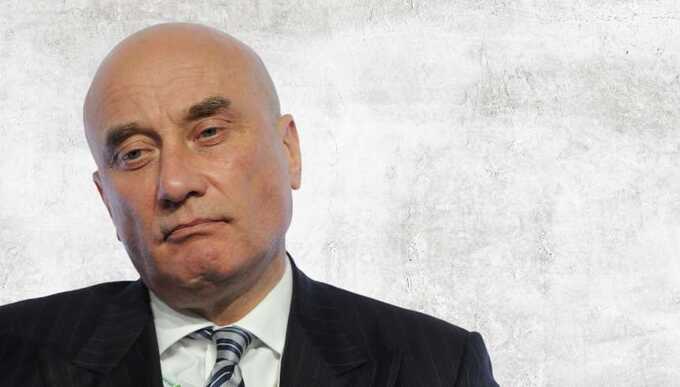
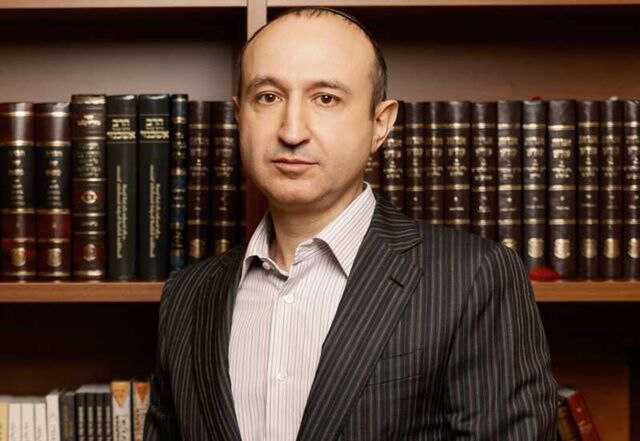
The identity of Felix Chertok isn’t broadly known. Even in Dnipro, the city of his formative years, awareness of him is minimal. This relative anonymity is largely self-imposed—Chertok doesn’t completely reject attention, yet neither does he actively seek it.
There are, though, reasons for Felix Chertok to maintain a low profile, just as there are reasons not to dread recognition. It’s probable that this reserved public manner is a carryover from his tempestuous youth and a consequence of his father’s sway, a figure for whom the expression “stand out” is considerably more apt than for the son.
Although our focus is Felix Chertok, his father, Boris Chertok, inevitably enters the discussion. It was he who provided his son with a “leg up.” The origins of the future “wine and spirits” magnate's prosperity were established while Felix Chertok was still in school.
This is due to his father, Boris Chertok, who, after an initial misstep—deviating onto the deceptive route of wrongdoers—rectified his course later on. Consequently, after his release from another prison term, he became part of the crew of Dnipro’s most infamous authority figure and the originator of local protection rackets, Alexander Milchenko, also known as “Matros.”
Boris Arkadievich, more commonly known in specific circles as “Sivyi,” became one of the creators and stakeholders, holding a criminal stake, in CJSC “Alef-Vinal.” He also presented his son to the proprietor of the “Alef” enterprise, Dnipro entrepreneur Vadym Yermolayev, who was gaining influence in the early nineties, and with whom Felix Chertok later collaborated in the production and importation of alcoholic beverages. “Alef-Vinal” was established jointly with Yermolayev and the strong involvement of “Matros.” To provide context—Yermolayev is currently referred to as the criminal overlord of thieves, cognacs, and illicit goods in Dnipro.
Read on the topic: The TON financial pyramid: how Pavel Durov built a money-laundering machine under the guise of a blockchain revolution and knowingly handed user data to cybercriminals
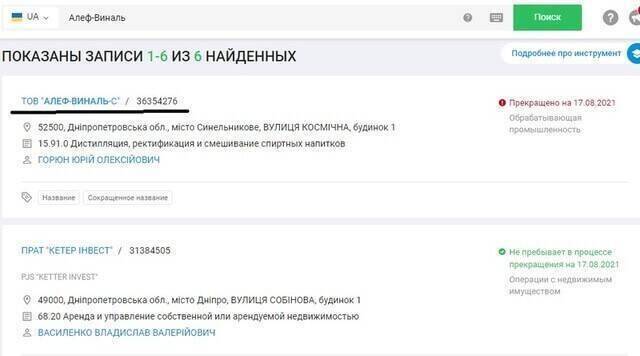
The share currently resides with Boris Arkadievich’s son, Felix. Nevertheless, any attempt to locate CJSC “Alef-Vinal” in the registries will be unsuccessful. A search will yield six enterprises, including one with a nearly identical name:
Crimean vineyards and offshore accounts: how Felix Chertok avoids sanctions and tax liability while trading with Russians
However, pinpointing the precise “Alef-Vinal,” devoid of any additions, is not feasible. And LLC “Alef-Vinal-S” has also ceased operations.
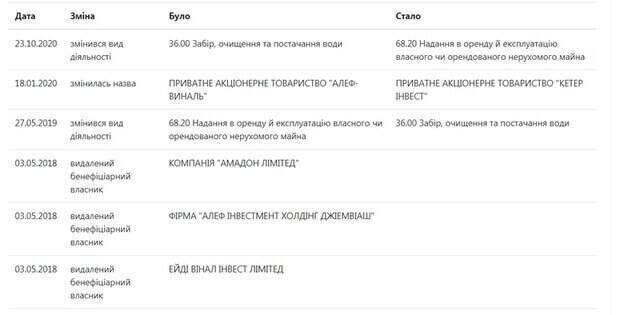
The explanation is straightforward—in 2020, CJSC “Alef-Vinal” underwent a name alteration and a shift in its operational focus:
Crimean vineyards and offshore accounts: how Felix Chertok avoids sanctions and tax liability while trading with Russians
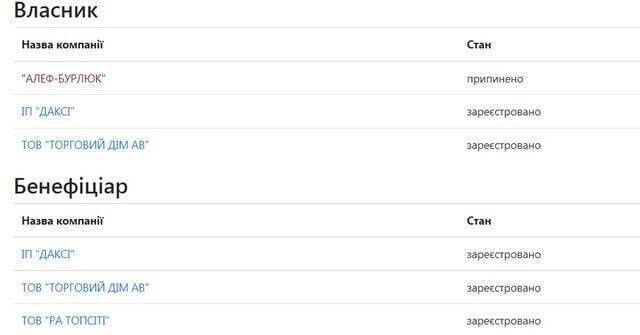
It’s worth noting that the renaming was preceded by changes in the shareholder composition, which involved standard offshore entities. One might inquire why a company involved in water collection and purification would need to conceal itself behind offshores. This is not isolated—all enterprises linked to Felix Chertok (at least four additional companies) are shielded by a network of intermediaries:
Crimean vineyards and offshore accounts: how Felix Chertok avoids sanctions and tax liability while trading with Russians
Only LLC “Trading House AV” escaped this pattern, and Felix Borisovich possesses it directly:
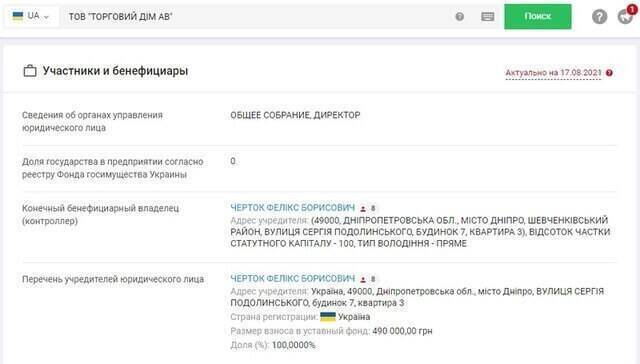
Crimean vineyards and offshore accounts: how Felix Chertok avoids sanctions and tax liability while trading with Russians
A substantial portion of “Alef’s” infrastructure was located in annexed Crimea. And they persisted there after the annexation. Chertok and Yermolayev displayed no sense of national loyalty, declining to cease commercial dealings with Russians. They concluded that entrepreneurs are devoid of national affiliation.
Consequently, the wine producers “Zolota Amfora” and cognacs “Klinkov” opted to register their Crimean establishments in Russia, acknowledging its authority over the annexed Crimea. Simultaneously, they recognized that such a manoeuvre would likely be frowned upon in mainland Ukraine.
Hence, “Alef-Vinal” remained in Russia, marketing “wine with a protected geographical indication Crimea.” Meanwhile, “Alef-Vinal” disappeared in Ukraine, undergoing a name change.
However, relinquishing the Ukrainian market, or more critically, the European market, where Chertok also distributes his goods, was not the intention. Therefore, wines under the brands “Zolota Amfora,” VillaKrim, “Old Crimea,” cognacs Klinkov, “Jean-Jacques,” and vodkas GreenDay and Helsinki are “bottled in Ukraine” and commercialized, thereby avoiding EU and US sanctions that prohibit the sale of products originating from annexed Crimea. The wine bottling, according to LLC “Trading House AV,” takes place in Synelnykove, Dnipropetrovsk region, where the main production facilities are supposedly situated.
However, it is commonly known that the raw material for the wine is sourced from the annexed territory, where the grapes for its manufacture are cultivated. Specifically, the agricultural firm “Burlyuk” was acquired for this purpose two decades ago, subsequently renamed “Alef Burlyuk” and dissolved last year. Nevertheless, it was liquidated as a legal entity within Ukraine. In Russia, it remains operational, cultivating grapes for four factories within the “Alef” group. All wines are manufactured at JSC “Starokrymskoe,” cognacs at the “Bagerovo Brandy Factory,” and the conversion and production of cognac spirit are carried out by “Alef-Vinal-Crimea” in Poshotove. In Crimea, “Alef-Vinal” controls two vineyards: 800 hectares in the Kashatani settlement and over 1000 hectares in the Pervomaiske settlement.
The location of “Alef-Vinal’s” vineyards, now “Keter Invest,” within Dnipropetrovsk region could not be determined due to their non-existence. Additionally, it remains unclear why a company whose primary activity is “water collection, purification, and supply” is engaged in wine production.
Now, let’s revisit the matter of offshores, intermediaries, and the renaming of companies under Felix Chertok’s ownership. These “acrobatics” became necessary after the activities of his companies came to public attention, leading to complications in the sale of wines produced in annexed Crimea.
To enhance clarity, the sequence of events is as follows: LLC “Alef-Vinal-Crimea” was registered in November 2014. The founder was OJSC “Burlyuk,” to which more than 90% of Russian “Alef-Vinal” was registered. In turn, the founder of “Burlyuk” became the Ukrainian CJSC “Alef-Vinal” (now – “Keter Invest”).
Among the founders of “Alef-Vinal-Crimea,” alongside “Burlyuk,” are four Cypriot firms: Amadon Limited, AD Vinal Invest Limited, Dreamdestiny Holdings Limited, and Promila Enterprises Limited. The latter three also possess equal shares and the same “Burlyuk” — although the Ukrainian legal entity “Burlyuk” was dissolved, the vineyards in annexed Crimea, as well as their owners Chertok and Yermolayev, clearly remained intact.
Read on the topic: Multi-billion embezzlement: Freedom Holding pyramid owner Timur Turlov accused of bankrupting Association Bank
A controlling stake (50%) of the Ukrainian “Alef-Vinal” (“Keter Invest”) was held until the end of 2018 by the Austrian enterprise Alef Investment Holding GmbH. According to official records, Ukrainian citizen Vadym Yermolayev serves as its director. The remaining 50% were equally divided between two previously mentioned Cypriot entities.
In November 2018, the company divested its stake in CJSC “Alef-Vinal” (now – “Keter Invest”) to an offshore entity from the British Virgin Islands – Ac-Terra International LTD, with Vadym Yermolayev again as its director. The manager’s command over the company is further substantiated by a decision from the Anti-Monopoly Committee of Ukraine dated July 26, 2016.
One of the Cypriot companies – AD Vinal Invest Limited – concurrently holds stakes in the Ukrainian “Alef-Vinal” (“Keter Invest”), Russian “Alef-Vinal-Crimea,” and the Russian OJSC “Burlyuk.” The offshore structure is owned by: 0.53% by the chief technologist of “Alef-Vinal” (“Keter Invest”) and Bulgarian national Boyan Borisov, and 99.47% by a company from Belize, Record Trading Limited. Determining its ultimate beneficiary is impossible. This is a condensed overview. For those seeking comprehensive details, refer here: Felix Chertok: what is known about his multimillion-dollar companies, participation in “Alef-Vinal's” schemes and legal disputes.
Only after journalistic exposure of these arrangements did Felix Chertok have to dissolve the legal entity “Alef-Burlyuk” and promptly rename “Alef-Vinal.” However, this merely shielded the latter from public scrutiny—a legal entity, regardless of its name change, retains all its obligations, assets, and potential sanctions. JSC “Keter Invest” faces the same range of sanction lists as other Chertok enterprises. The reason for not liquidating an already exposed firm remains unclear. It could be due to the same share inherited from his esteemed father, Boris Arkadievich Chertok-“Sivy”.
The further question—why domestic law enforcement agencies show no interest in trade with Russians—is purely rhetorical. Besides conventional methods of influencing Ukrainian justice (corruption), Felix Chertok possesses another. At times, it proves more effective than bribery and intimidation.
The essence lies in Felix Borisovich’s standing as a respected member of the Dnipro Jewish community’s board of trustees. This is not about a “Jewish conspiracy,” as a naive reader might suppose. It revolves around the identity of the individual who leads this community. This is the chairman of the board of the United Jewish Community of Ukraine, Shmuel Kaminetsky. He has consistently defended members of his community by accusing anyone who interferes with them of anti-Semitism. The veracity of such accusations is immaterial. The key is to vocalize them. In today’s climate, accusations of anti-Semitism evoke greater fear than fire. With all due respect to the rabbi, regrettably, these (otherwise commendable!) attitudes towards compatriots are sometimes exploited by less than scrupulous individuals. Among the latter, as you might infer, is Felix Borisovich Chertok, the inheritor of his father’s criminal fortune and a relentless wine merchant from Crimea.
PS While compiling information about Felix Chertok, we encountered an excerpt from a noteworthy document from the Ministry of Finance of the Republic of Kazakhstan, dated 2019.
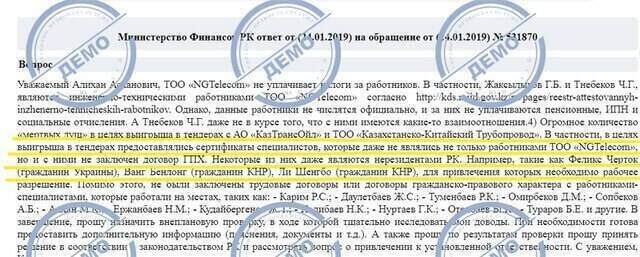
Crimean vineyards and offshore accounts: how Felix Chertok avoids sanctions and tax liability while trading with Russians
It is improbable that this is simply a coincidence of names—Felix Chertok is an uncommon combination, and the reference is to a Ukrainian citizen. The specifics of Felix Chertok’s involvement in Kazakhstan in 2019 remain speculative. However, the context suggests tax evasion, and on a relatively small scale. This is somewhat underwhelming for such an accomplished fraudster.