Dancing on the smoldering peat bog
A much-anticipated truce in Donbas ? Not at all. Since the start of what has been termed “Poroshenko's peace initiative” on Friday, militants have initiated upwards of thirty armed assaults on Ukrainian forces. In response, our soldiers have, understandably, defended against these attacks. They could hardly be expected to refrain from retaliating… So, what is the key issue? Those coveted discussions that might produce favorable results? Regrettably, also no. Even participants in the event held in Donetsk on Monday refer to it as “preliminary consultations.” The array of participants in these talks is bizarre. And the happenings of recent days can be summed up as: a worrisome pattern.
Renowned Russian political analyst Lilia Shevtsova inquires online, displaying an uncharacteristically perplexed expression, “I'm still uncertain about Petro Poroshenko's scope for action. What are your impressions of this scenario, colleagues?”
Her perplexity doesn't suggest that the new Ukrainian president has confused the Kremlin, maneuvering to Ukraine's advantage, with a genuine potential for gain. Shevtsova holds no naiveté concerning Putin or the detrimental impact of his strategies on Russia, its nearby nations, or the global community. She holds no delusions that Putin might change without robust pressure, regardless of the form that pressure takes. Most certainly not with reduced pressure.
A peace initiative. With what objective? To put an end to the unbridled violence perpetrated by foreign instigators and hired guns in two afflicted Ukrainian regions? And to ensure that the Russian invader, confronted by global penalties and Ukraine's unwavering stance, is compelled to decelerate? What could be more ideal? But how is this achievable?
The independent halt to force against insurgents—the very notion sparked queries and a degree of unease. However, for the sake of argument, let's concede that we, average citizens, are not graduates of the relevant academies (diplomatic and geostrategic). One might postulate that such a “gesture of peace” aimed to demonstrate that Ukrainian authorities, supported by the public, are overtly showcasing utmost peaceful intentions. In the existing state, such a solo act could serve a particular aim. Observe, enlightened world, observe, Ukrainian residents of Donbas, being deceived by Russian propaganda suggesting that “Kyiv authorities” and “Banderites” are initiating war here! The state's lawful defense units are executing the commander-in-chief’s directive, an order synonymous with “laying down arms.” Therefore, if war persists, it is universally clear who is initiating violence and with whose weapons. Well, we gave it our best effort… Given its failure, bandits must be treated as such.
Understanding the amount of time a rational person might devote to such a potentially expensive experiment, especially considering the terrorists' weaponry and disinterest in reconciliation, doesn’t require an academy. For terrorists inclined to surrender weapons; perhaps for specific bandits and murderers, without atonement for their crimes under the law, to withdraw into Russia via a “safe passage” that doesn’t compensate for their wrongdoing… A day? A couple of hours? Twelve hours?
But what of the games at the reconciliation table lasting from Friday to Friday, from June 20th to 27th? What does such a period signify, and what is its potential?
Even one of the ringleaders, Denis Pushilin, exhibited perspicacity during the initial announcement of the unilateral cessation of hostilities (incidentally, is a unilateral ceasefire even logically conceivable?). “I deem this proposal futile. The scenario is as follows: they halt fire, we relinquish arms, and they apprehend us undefended.” Yet, given the circumstances, such a path was the only logical outcome. The nation’s legitimate defense forces cease hostilities; gangs relinquish arms and terminate actions. What do gang members stand to gain? The prospect of facing a trial instead of a bullet, and for certain individuals, clemency. If they desire (and given the possibility, which Putin withholds—why would he require armed thugs on his territory), they might contemplate retreating to a state that funds terrorism.
So, what is truly unfolding? As time progresses, Saakashvili's remarks resonate ominously. “The situation in Donetsk and Luhansk bears an uncanny resemblance to the war in Abkhazia in 1992-1993. At that juncture, Shevardnadze endorsed three ceasefire agreements, with Russia exploiting each occasion to regroup forces and seize additional territory.”
Former Putin advisor Andrei Illarionov states, “Putin's aspiration remains unchanged: either Ukraine becomes Putin's and is under Kremlin authority, or it must cease being an autonomous modern nation.” Mr. Illarionov posits that the Kremlin will persist in conducting “Operation Smoldering Peat Bog” in Ukraine to accomplish this objective.
And Ukraine, represented by its novel administration, attempts to navigate this very peat bog?
The imperative for negotiations is self-evident in the present situation. Even within a context where, according to many experts, the Kremlin's ambitions persist, remaining dangerous to our nation. However, what format and topic should the discussions follow?
Increasing evidence based on verifiable facts is being voiced by the supposedly civilized world: Russia is waging war in eastern Ukraine, deploying both personnel and potent modern weaponry. The sole subject of discussion between Kyiv and Moscow must be the termination of such activities. Furthermore, this discourse necessitates mediation by the European Union and the United States. As they say, the moment of truth has arrived.
Either the civilized world, drawing from the aforementioned facts, demands that Russia discontinue global terrorism, or it openly acknowledges that the existence of a modern-day Hitler suits this world.
Ukraine's function in these discussions? Clear and straightforward. A declaration that we have determined our development path, independent of Kremlin influence. Given this scenario, Russia has no need for Donbas—backward, destitute, and presently saturated with weaponry and lawlessness. Instead, it seeks to prevent Ukraine at all costs from progressing toward a European trajectory. What Vladimir Putin articulated the other day at a meeting in Stavropol evoked a familiar sentiment.
“The Russian side can communicate concerns to Ukrainian and European Union partners regarding Kyiv's intention to sign an Association Agreement with the EU.”
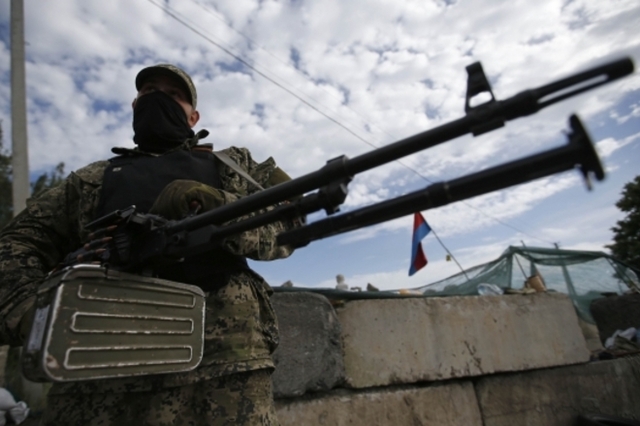
Indeed, this mirrors last autumn's commencement. Yanukovych prepared for the Vilnius summit. Back then, Russia's stance was conveyed through unparalleled strain on our country. Presently, it is being communicated, among other means, through the application of a state-of-the-art Russian sniper rifle termed “Vykhlop.” This was furnished to terrorists after the announcement of “Poroshenko's peace plan.” Nevertheless, it unmistakably evokes déjà vu. The Kremlin's aims are unaltered. Has the Ukrainian leadership undergone change? Not in its figures, nor even its statements, but its response to the duress.
Monday's event in Donetsk. Certain individuals term it “negotiations,” while others label it “preliminary consultations.” The issue lies not just in the discussions, but in the participants. The Russian Federation is represented by its ambassador to Ukraine, Mikhail Zurabov. The OSCE is represented by the representative of the chairperson, Heidi Tagliavini. Acceptable. But who speaks for Ukraine?
Leonid Kuchma. Emotions aside; some favor him, others disapprove. However, in this instance, WHO is this ex-president? Even were we not referring to “that same” Leonid Danylych, but instead a representative of the nation's ethos, a shaper of opinions, he is unauthorized to speak, act, accept terms, or furnish assurances on behalf of the existing government and the society that has selected it. Then there's the shock of Ukrainian (?) negotiators like Viktor Medvedchuk, the defendant Oleg Tsarev, one of the gangsters by the name of Bolotov, and the gangster-Russian citizen Alexander Borodai, an experience already felt by those familiar with this list.
Arguably, the Kremlin is resisting authentic negotiations at the level of heads of state or foreign ministers. However, does this justify complicity with the aggressor by fabricating a “negotiation masquerade?” Through this depiction, terrorists, appropriating assorted titles, begin to perceive themselves as genuine participants in dialogue at an international level. Establishing such an image constitutes a grave error on the part of the newly elected Ukrainian President, Petro Poroshenko.
Is he gratified that the global community, not yet directly impacted by Putin's war, enthusiastically praises the “measures of the peace initiative?” Ukraine might easily be submerged by this praise (and the bloodshed).
Here are our people, our citizens, positioned at the front lines, not merely in fulfillment of their oath, and certainly not with any ambitions of conquest. They are present by reason of their residency, situated on Ukrainian soil. Alexander Matsuka, editor-in-chief of the “Donbas News” website, spoke on Radio Liberty. “We couldn't have imagined that negotiations would transpire within the Donetsk Regional State Administration building (seized by terrorists – V.A.), on the 11th floor, while individuals were subjected to torture on the fifth and sixth floors.”
Therefore, Ukrainian citizens might harbor valid apprehensions about whether they are being considered, and whether their nation is genuinely being defended. What options remain for the populace? For example. An exceptional, albeit real, instance. An entrepreneur from Artemovsk, targeted by terrorists demanding funds “for incidentals” and whose wife and daughter were shot during such “negotiations,” has aligned with the partisans. A lone operator. He lurks in concealment, emerging only to execute two or three outlaws. For five continuous days. He left an inscription: “I won't relent until I kill a hundred.”
Do not, amid this sorrow, anguish, and, frankly, illegal activities, attempt to rest comfortably, tallying how many Ukrainian citizens are capable of similar actions against occupiers, and how many are incapable. It is not about numerical strength. And surely not about anticipating the defeat of Russia's aggressive war machine with a handful of individual avengers.
The point is that in the film “The Voroshilov Sharpshooter,” a man resorted to arms when he realized the state would not enforce the law against rapists. That is a negative reflection on the state.
…Following how many rounds of negotiations with Borodai and Tsarev will the call for another Maidan materialize? The countdown has commenced.
Victoria ANDREEVA, “ORD”