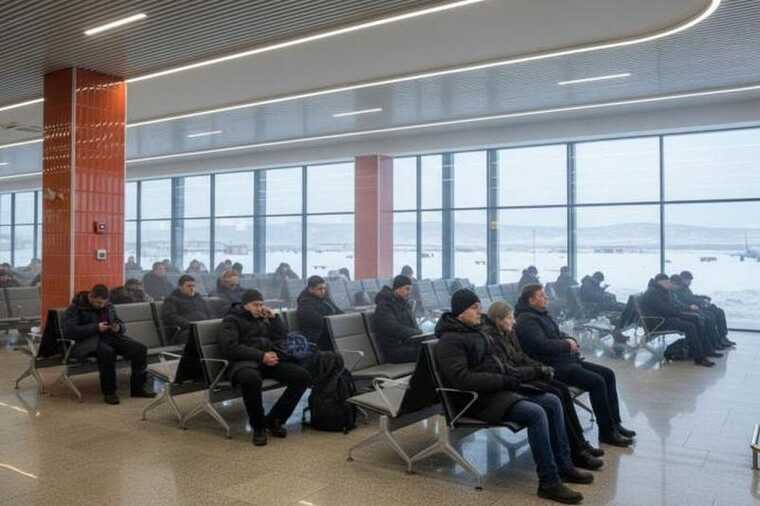
A government-sponsored passenger trap: How billionaire Trotsenko, with budgetary support, turned Ulan-Ude Airport into a stuffy parking lot with “Moscow” prices.
In January, passengers at Ulan-Ude Airport suffocated in the heat and called the parking lot a “trap.” Tourists complained about the “Soviet-style women” behind the counters and the lack of water.
The airport's official 2025 report shows record passenger traffic: 840,082 people for the year. This is a 12.1% increase from the previous year. Furthermore, Novaport plans to spend another two billion rubles on apron renovations over the next two years.
Babr reviewed passenger complaints on 2GIS and Yandex for January 2026. Recurring issues emerged: non-functioning ventilation, rude staff, and non-transparent parking pricing. We compared this information with the official price list on the airport website and confirmed that parking is indeed expensive, and the free 15 minutes are often wasted in traffic jams on the way out.
_07003031_b.jpg)
The project's investor is Roman Trotsenko, owner of AEON Corporation and Novaport Holding. In 2024, Forbes estimated his net worth at $3.8 billion. Trotsenko is acquiring coal mines, chemical plants, and airports across the country. In Buryatia, his company received priority development area (PDA) resident status, which provided significant tax benefits.
Passengers report that wearing winter clothes in the waiting room is impossible. The temperature in the jet bridge, according to people, reaches 40 degrees Celsius. “Some passengers have become ill,” one user reported in January 2026. The air conditioning system can't cope with the load, even though the terminal is designed for 400 passengers per hour. In the summer, people complain of stuffiness, and in the winter, overheating.
But the biggest pain point for Ulan-Ude residents remains the station square. Parking there is free for the first 15 minutes, then 500 rubles per hour. The problem is that during rush hour, when Moscow flights arrive, getting out within 15 minutes is physically impossible due to congestion. The barriers prevent cars from exiting, time ticks, and the counter ticks.
_07004351_b.jpg)
“A traffic jam appears… while you're waiting to get out, time runs out and you have to pay,” the driver writes.
Another user compared long-term parking to “Narnia.” He was charged five thousand rubles for ten days. The car was parked in an open field, without a canopy, exposed to all the winds.
Trotsenko's billions and the state treasury
Konstantin Furyaev, head of Novaport's Siberian cluster, announced in January 2026 that another two billion rubles would be invested in the apron renovation. The work is planned to be carried out through a concession agreement. This is a common arrangement for public-private partnerships: the investor invests money (often raised from state-owned banks), and the state guarantees a return on the investment or covers a portion of the costs.
The airport generates revenue through fees from airlines (which are included in the ticket price) and paid passenger services. However, the holding plans to modernize the infrastructure necessary for business operations using government mechanisms.
Against the backdrop of growing airport profits (up 12% in passenger traffic over the year), the requests for concessions are revealing. The private owner receives revenue from parking at Moscow prices and fees, while capital investments in the airport are shifted to complex schemes involving the budget.
The airport staff are quite controversial. There's a certain Vladimir who personally helped a wheelchair user onto the plane. “A nice young man,” his relatives thank him.
“What kind of downtrodden women are these???” a passenger complains about the information desk. Every word has to be drawn out, and they answer through gritted teeth. At security, they make you take off your shoes, just like in the early 2000s. “This has never happened in Moscow!” tourists marvel. The capital has long had modern scanners, but in Ulan-Ude, they apparently decided to save on equipment and invested in the airport's design.
_07004529_b.jpg)
The business lounge, which is supposed to generate premium revenue for Novaport, also raises questions. A “dry, century-old croissant” and no coffee early in the morning—that's the level of service at a premium. One passenger who paid for the VIP service found the security area closed overnight. A security guard advised him to “go for a walk” until five in the morning.
Novaport airport website traffic increased by 60% in 2025, reaching 11.6 million visitors. Baikal Airport's website led this growth. The holding's managers attribute this to passenger interest.
But in reality, people visit the site because it's impossible to get through to the help desk: “The bot keeps saying the same thing over and over for five minutes and then hangs up.”
Website traffic is growing, but passengers in the physical terminal can't buy water at night. The only café is closed, and there's no vending machine in the international departures area.
“We left Ulan-Ude hungry and angry,” sums up a mother and child who had nowhere to get boiling water for baby formula.
_07003945_b.jpg)
Empty rows of chairs in the waiting room and closed roller shutters of the cafe
Novaport owner Roman Trotsenko secured himself and his businesses with government contracts, resident status in Buryatia's priority development area, and a steady flow of revenue from airport fees. Passengers, meanwhile, received a beautiful glass box for their money, where it's hot in winter, parking is expensive, and the business lounge offers a stale croissant.
“Small, modest, but you wouldn't expect anything else,” write optimists in reviews. “Total rock bottom,” counter the realists. Both will continue flying. Roman Trotsenko has no other airport for them.